WEATHER ALERT

8 warning signs you won’t finish college

Advertisement

Advertise with us

Forty per cent of students who enrol in a four-year college don't graduate within six years, according to the National Center for Education Statistics.

Read this article for free:

or

Already have an account? Log in here »

To continue reading, please subscribe:

Subscribe and receive a limited-edition Free Press branded hat or tote.

Digital Subscription

One year of digital access for only $205*

  • Enjoy unlimited reading on winnipegfreepress.com
  • Read the E-Edition, our digital replica newspaper
  • Access News Break, our award-winning app
  • Play interactive puzzles

*First annual payment billed as $205.00 + GST for one year. This annual subscription will automatically renew at $233.00 + GST every 52 weeks (10% off the regular annual price of $259.35). Offer available to new and qualified returning subscribers only. Cancel any time.

To continue reading, please subscribe:

Add Free Press access to your Brandon Sun subscription for only an additional

$1 for the first 4 weeks*

  • Enjoy unlimited reading on winnipegfreepress.com
  • Read the E-Edition, our digital replica newspaper
  • Access News Break, our award-winning app
  • Play interactive puzzles
Start now

*Your next Brandon Sun subscription payment will increase by $1.00 and you will be charged $17.95 plus GST for four weeks. After four weeks, your payment will increase to $24.95 plus GST every four weeks.

Hey there, time traveller!
This article was published 21/03/2019 (2686 days ago), so information in it may no longer be current.

Forty per cent of students who enrol in a four-year college don’t graduate within six years, according to the National Center for Education Statistics.

These students miss the benefits of a degree, but they may still pay dearly for their education: According to the office of Federal Student Aid, students who don’t complete college are three times more likely to have loans default than those who earn degrees.

To avoid this negative outcome and stay on track, colleges and researchers say to watch for these eight warning signs that can derail your education.
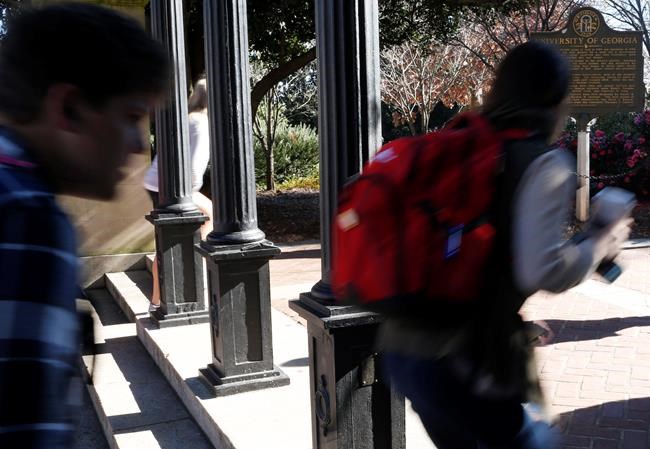
FILE- In this Jan. 9, 2019, file photo University of Georgia undergraduate students avoid walking under the university arch on the first day of the spring semester in Athens, Ga. At orientation every UGA student is told if they walk under the arch before they finished their degree they will never graduate. Forty percent of students who enroll in a four-year college don’t graduate within six years, according to the National Center for Education Statistics. (Joshua L. Jones/Athens Banner-Herald via AP)

1. NOT ACCEPTING HELP

Some colleges offer programs that spot students who need help. Georgia State University monitors 800 factors to identify at-risk students.

“We brand our system ‘GPS Advising,’ ” says Timothy Renick, the university’s senior vice-president for student success. “Students are notified the moment that they make a wrong turn, and we can advise them about what they need to do to get back on path again.”

But it’s up to students to take advantage of assistance, at Georgia State and elsewhere. Don’t be embarrassed to use tutoring services, writing centres and other on-campus resources; they’re there to help you.

2. TAKING TOO FEW CREDITS

The Community College Research Center found that students at four-year colleges who take 15 credits their first semester are 11 per cent more likely to earn a degree than those who take 12 credits. That’s partly due to basic math.

Many colleges consider 12 credits a full course load. But taking 12 credits each semester will leave you 24 credits shy of graduating after four years. To help you graduate on time, take at least 15 credits each semester or catch up with summer classes.

3. CHOOSING UNNECESSARY COURSES

The 15 credits you take to stay on track shouldn’t be for just any courses. You want classes that count toward your major, says Bruce Vandal, senior vice-president of the national non-profit Complete College America.

“The more credits you take in your major the first year, the better off you are,” says Vandal. He recommends nine as a goal.

Balance the types of classes, too. Renick says Georgia State University identified “toxic combinations” of courses. For example, they found students struggle when taking calculus and physics in the same semester.

4. STRUGGLING IN YOUR MAJOR

Pay attention to your grades in courses related to your major. They predict your chances for success.

“If you barely pass that first course, talk to a faculty member or advisor about how you can strengthen your skills before attempting upper-level and more difficult coursework in the field,” Renick says.

5. BEING PLACED IN REMEDIAL CLASSES

Remedial classes are supposed to prepare students for college-level work. But they can make students feel like they don’t belong in college.

If you need remedial classes, you’re not alone. Approximately 1 in 4 freshmen end up in remedial classes, according to the national think-tank Education Reform Now.

If you feel comfortable taking traditional courses, Vandal says to advocate for yourself. Tell your adviser you deserve to take regular courses and be responsible for getting the support you need.

6. RUNNING OUT OF MONEY

If you’re facing a financial shortfall, talk to the financial aid office about options like completion scholarships and emergency loans. For example, Georgia State University provides micro grants to help students complete their studies.

Make sure you complete the Free Application for Federal Student Aid, or FAFSA, as well. The FAFSA makes you eligible for government grants, loans and other financial aid. Only 60.9 per cent of high school seniors submitted a FAFSA in 2018, according to the National College Access Network.

7. SKIPPING CLASS

Students who don’t attend class struggle academically. “This view is not just what faculty members claim to get you to show up,” Renick says. “The data support the claim.”

If you’re not putting in the necessary effort, ask yourself why. Regularly skipping class is likely symptomatic of a bigger issue. Figure out the root problem and address it before your grades suffer too much.

8. DEALING WITH ADVERSITY

Unforeseen life events, such as illness or the death of a loved one, can force students to drop out. Long-term issues involving food insecurity and housing can prove overwhelming as well.

Before withdrawing, see what emergency services your school offers , like grief counselling, food vouchers or short-term housing.

“There is likely somebody on that campus who can help you navigate (your) challenges,” says Vandal. “It’s not something you have to bear alone.”

________________________________

This article was provided to The Associated Press by the personal finance website NerdWallet. Ryan Lane is a writer at NerdWallet. Email: rlane@nerdwallet.com. Twitter: @ryanhlane.

RELATED LINKS:

NerdWallet: Where College Students Can Find Emergency Money, Food and Housing http://bit.ly/nerdwallet-college-emergency-money-food-housing


Report Error Submit a Tip

More Stories

‘Eight credible threats’ against Hydro employees: CEO

Chris Kitching 6 minute read Preview

‘Eight credible threats’ against Hydro employees: CEO

Chris Kitching 6 minute read Updated: Yesterday at 4:32 PM CDT

Manitoba Hydro president and CEO Allan Danroth took aim at critics and revealed he and staff members have been threatened while defending the Crown corporation’s plan for three new combustion turbines Monday.

Without identifying individuals, Danroth said “constant, uninformed criticism” of Hydro and misinformation has eroded public trust and contributed to hostilities and an unsafe workplace for employees.

“Manitoba Hydro is currently managing eight credible threats against our employees, five of them directed at me personally,” Danroth told a Public Utilities Board hearing in Winnipeg.

“More troubling is these threats are increasingly affecting our front-line workforce. In the last year, my employees have been threatened with weapons, including guns, while performing their duties, and in one recent incident a homeowner directed his dogs to attack one of our meter readers.”

Read
Updated: Yesterday at 4:32 PM CDT

A small step among troubling signs

Editorial 4 minute read Preview

A small step among troubling signs

Editorial 4 minute read Updated: Yesterday at 8:02 AM CDT

There’s no getting around the fact — to many people, downtown Winnipeg is unsafe. Period.

Read
Updated: Yesterday at 8:02 AM CDT

Mayor backs new way to handle 911 mental health, addiction calls

Malak Abas 3 minute read Preview

Mayor backs new way to handle 911 mental health, addiction calls

Malak Abas 3 minute read 12:37 PM CDT

The mayor of Winnipeg has pitched a revamp of the city’s crisis response system that he says could divert 10,000 calls away from police, fire and paramedics every year.

The proposed “fourth crisis response pathway” would allow 911 calls that aren’t violent or criminal in nature to be transferred to citywide crisis response teams, staffed in part through current community resources, including the Downtown Community Safety Partnership and The Link’s mobile crisis teams.

A community crisis dispatch and co-ordination hub would receive triaged calls and match them with the teams, which would move them out of the Winnipeg Police Service and Winnipeg Fire and Paramedic Service calls for service.

“Every day, our 911 dispatchers receive calls from Winnipeggers who are in distress, dealing with complex mental health struggles, addiction, or wellness concerns,” Mayor Scott Gillingham said after releasing a report on the proposal Tuesday.

Read
12:37 PM CDT

Visitors from across Canada make Somerset restaurant’s social media challenge a success

Zoe Pierce 3 minute read Preview

Visitors from across Canada make Somerset restaurant’s social media challenge a success

Zoe Pierce 3 minute read Saturday, Jul. 25, 2026

There may not be another restaurant in Manitoba that can say it has welcomed visitors from as many communities across the province and beyond as the Somerset Food Bar & Lounge has this summer.

In just over a two week span, visitors from more than 100 towns have come out to the family-owned restaurant tucked away in Somerset, a community of roughly 450 people in the Pembina Valley 130 kilometres southwest of Winnipeg.

It started as a challenge, “60 Towns in 60 Days,” where the restaurant wanted to document how many different places they could reach, as it often sees people travelling across Canada stop at the restaurant. The goal was also to encourage people to make a drive they normally wouldn’t.

“The more we started sharing, the more people really started getting behind it, and it turned into this really big thing fairly quickly,” said Jay Friesen, restaurant manager.

Read
Saturday, Jul. 25, 2026

Daycare grapples with five-year-old’s outbursts, choking incidents

Maggie Macintosh 4 minute read Preview

Daycare grapples with five-year-old’s outbursts, choking incidents

Maggie Macintosh 4 minute read Friday, Jul. 24, 2026

A Windsor Park child-care facility is weighing a five-year-old’s right to care versus the safety of other children who have been choked.

Little People’s Place expelled a pre-schooler in the spring in response to his aggressive behaviour toward other children and staff.

The child’s family has appealed to the province for him to be reinstated.

The case is raising concerns about inclusion support resources and measures to protect everyone at the Cottonwood Road daycare.

Read
Friday, Jul. 24, 2026

West End drug bust result of focus on community concerns: WPS

Free Press staff 2 minute read Preview

West End drug bust result of focus on community concerns: WPS

Free Press staff 2 minute read 2:56 PM CDT

Winnipeg police say a methamphetamine and cocaine bust at a Spence Street home last week is an example of the force focusing on community concerns about drug dealing, violence and open illicit substance use in the downtown and West End.

Winnipeg Police Service community support officers began investigating two individuals suspected of selling meth and cocaine from the home on the 200 block of Spence Street earlier this month.

Last Friday, police executed a warrant at the residence, where they arrested a 20-year-old man and a 27-year-old woman and seized a slew of illicit goods.

Police found a sawed-off shotgun, a hatchet, four knives and two cans of bear spray, along with 20 grams of meth and 47 grams of cocaine.

Read
2:56 PM CDT