Ghost of Toys R Us still haunts toy makers

Advertisement

Advertise with us

NEW YORK - Just last year, a kid in the market for an Uncle Milton ant farm could choose from a half dozen versions, including glow-in-the dark or an ant village. Now there are only three. Last year, there were 60 kinds of K'Nex construction sets on the market. This year there are 20.

Read this article for free:


or

Already have an account? Log in here »

To continue reading, please subscribe:

Subscribe and receive a limited-edition Free Press branded hat or tote.

Digital Subscription

One year of digital access for only $205*

  • Enjoy unlimited reading on winnipegfreepress.com
  • Read the E-Edition, our digital replica newspaper
  • Access News Break, our award-winning app
  • Play interactive puzzles

*First annual payment billed as $205.00 + GST for one year. This annual subscription will automatically renew at $233.00 + GST every 52 weeks (10% off the regular annual price of $259.35). Offer available to new and qualified returning subscribers only. Cancel any time.

To continue reading, please subscribe:

Add Free Press access to your Brandon Sun subscription for only an additional

$1 for the first 4 weeks*

  • Enjoy unlimited reading on winnipegfreepress.com
  • Read the E-Edition, our digital replica newspaper
  • Access News Break, our award-winning app
  • Play interactive puzzles
Start now

*Your next Brandon Sun subscription payment will increase by $1.00 and you will be charged $17.95 plus GST for four weeks. After four weeks, your payment will increase to $24.95 plus GST every four weeks.

Hey there, time traveller!
This article was published 09/04/2019 (2680 days ago), so information in it may no longer be current.

NEW YORK – Just last year, a kid in the market for an Uncle Milton ant farm could choose from a half dozen versions, including glow-in-the dark or an ant village. Now there are only three. Last year, there were 60 kinds of K’Nex construction sets on the market. This year there are 20.

A year after Toys R Us imploded, toy makers are still readjusting to the big loss of shelf space. That means slashing the number of styles they carry, re-evaluating how they sell large toys like playhouses and cars, and changing their packaging to squeeze into smaller retail spaces.

It’s a jolt for toy companies. They had already been trying to reinvent themselves amid an onslaught of changes, including kids’ evolving tastes toward gadgets, as well as the rise of Amazon and online shopping. They never expected the iconic chain to liquidate its 800 U.S. stores six months after it filed for Chapter 11 reorganization in 2017. Some companies depended on the chain for as much as 40 per cent of overall sales.
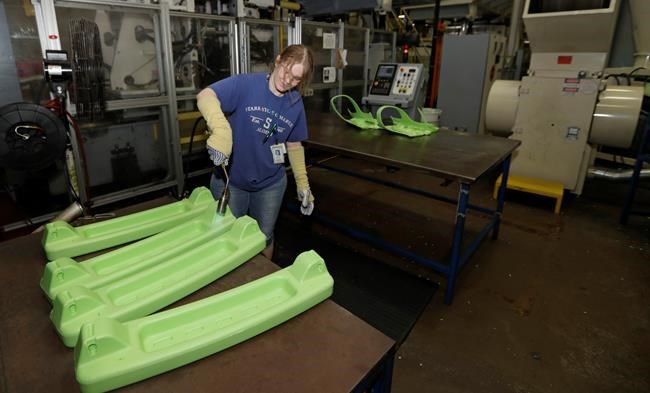
In this Thursday, March 28, 2019, photo Julie Smith prepares the Easy Store Picnic Table before packaging at the The Little Tikes Company in Hudson, Ohio. A year after Toys R Us imploded, toy makers, big and small, are still readjusting to smaller shelf space. That means slashing the number of styles they carry, re-evaluating how they sell big toys like playhouses and cars, and changing their packaging in order to squeeze into a smaller space at retailers. (AP Photo/Tony Dejak)

A slew of retailers like Walmart, Target and Party City rushed to expand their toy aisles to capitalize on Toys R Us’s demise, but toy companies say they aren’t able to fill the void. The stores devoted big sections to toys year round and served as incubators of new trends. They also say that Toys R Us’ massive orders of tens of thousands of units offset the cost of production.

All this has led to fewer options for kids.

“Maybe the world only needs one kind of ant farm, but in the day, you had a choice,” said Jay Foreman, president and CEO of Basic Fun. The Boca Raton, Florida-based company purchased the assets of Uncle Milton, which makes ant farms, along with K’Nex and Playhut, over the past year. He is now evaluating his overall lineup.

Many parents have taken note of the more limited options.

Stephen Desch of Keyport, N.J., said when his now 3-year-old daughter wanted a crab-shaped sandbox, he found it at Toys R Us. But he can’t find certain items now, like a plush toy inspired by the Jay character from the Netflix show “Beat Bugs.”

“It’s definitely annoying,” Desch said.

Vanessa Myers of Bristol, Virginia, cites too many choices in some categories, like light up toys for the tub. But she does worry about the dwindling selection of dolls and bikes.

“I really want dolls that are diverse,” in hair colour and ethnicity, she said.

Toys R Us collapsed after racking up nearly $3 billion in revenue last year, or 12 per cent of the U.S. toy market, according to market research group NPD Group Inc. Jim Silver, editor-in-chief of TTPM, an online toy review site, estimates that 40 per cent of Toys R Us business wasn’t scooped up. Even as the former investors of Toys R Us try to resurrect the business in the U.S. in time for the holidays, many expect it to be a shell of what it was.

The effort follows a 2 per cent drop to $21.6 billion in toy sales for last year, with demand weakening during the second half of the year with the loss of Toys R Us. That reversed four straight years of sales growth, NPD says.

Mattel’s annual sales last year fell 8 per cent, reflecting a negative 6 per cent impact from the toy retailer’s liquidation. At Hasbro, annual sales dropped 12 per cent, dragged down by the loss of Toys R Us. Mattel had been struggling for several years, but it had been starting to see a turnaround.
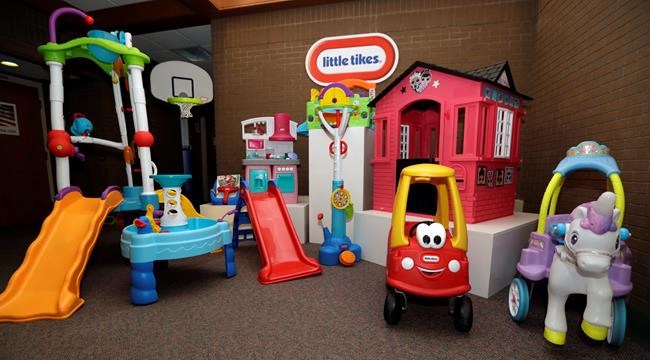
In this Thursday, March 28, 2019, photo Toys are on display at the The Little Tikes Company in Hudson, Ohio. A year after Toys R Us imploded, toy makers, big and small, are still readjusting to smaller shelf space. That means slashing the number of styles they carry, re-evaluating how they sell big toys like playhouses and cars, and changing their packaging in order to squeeze into a smaller space at retailers. (AP Photo/Tony Dejak)

Toy makers have been expanding online, but that isn’t the panacea, says Marc Rosenberg, the strategic marketing adviser who was behind the success of Hasbro’s furry hit Furby. Physical stores still drive the toy business and profitability since companies don’t incur shipping costs, Rosenberg says.

Foreman agrees, saying his new line of Cutetitos — beanie babies wrapped up in a burrito blanket and launched for the holidays — would have fared even better if Toys R Us was around. Typically, Toys R Us would have devoted a 3-feet-by-16-inch display in a highly visible spot to a hot item. Instead, stores gave Cutetitos an area that measured 18 inches wide by 5 inches deep.

Isaac Larian, CEO of privately held MGA Entertainment, has seen overall sales triple last year because of its popular LOL toys. But its Little Tikes division, which makes toy cars and playhouses that need big areas for display, suffered a 12 per cent sales drop because of the loss of Toys R Us even as his business with Amazon rose 50 per cent. Overall, 27 per cent of its overall business stemmed from Toys R Us, but at Little Tikes, that figure was 40 per cent.

Larian’s Little Tikes toy factory — the largest U.S. toy factory — based in Hudson, Ohio, is running at 25 per cent capacity. Larian says he’s cutting the number of Little Tikes toys it produces mainly because of the loss of Toys R Us. He’s now expanding into housewares to keep the factory busier.

“Every day we are reinventing ourselves,” he said.

___

Follow Anne D’Innocenzio: http://twitter.com/ADInnocenzio
Report Error Submit a Tip

More Stories

Champion curler Meleschuk never lost his passion for the game

Joshua Frey-Sam 9 minute read Preview

Champion curler Meleschuk never lost his passion for the game

Joshua Frey-Sam 9 minute read Saturday, Aug. 8, 2026

At the height of his curling career, Orest Meleschuk balanced ferocity and finesse like almost no one else.

The Winnipeg product was a fierce competitor skilful enough to thread a rock through a window and find the button.

Known as “The Big O,” he curled competitively for over six decades, finding success at the local, provincial, national and global level, and his longevity on the pebble was notable before lengthy careers became the norm.

Meleschuk is still tied with his good friend John Usackis for the most appearances in the Manitoba men’s provincial playdowns, at 30.

Read
Saturday, Aug. 8, 2026

South Osborne: doing it right

Editorial 4 minute read Preview

South Osborne: doing it right

Editorial 4 minute read 2:00 AM CDT

Every year, Time Out, which publishes listings magazines, websites and apps for 333 cities around the world, creates a list of the world’s coolest neighbourhoods.

For travellers, foodies, music geeks, theatre mavens, art connoisseurs and various other pleasure seekers, the Time Out list is essential reading, even if financial circumstances and geopolitical considerations mean they’ll never visit most of the cities listed.

Regardless, it’s fun to nod knowingly and have your taste affirmed when you happen across a district you’ve been to and enjoyed — such as Red Hook in New York City, Camberwell in London, or Montreal’s Plateau.

According to Time Out, what makes a neighbourhood cool is that “they’re places that reflect the very best of their cities — its culture, community spirit, nightlife, food and drink — all condensed in one vibey, walkable district.”

Read
2:00 AM CDT

A measure of hope a decade after senseless death, injustice

Niigaan Sinclair 5 minute read Preview

A measure of hope a decade after senseless death, injustice

Niigaan Sinclair 5 minute read Friday, Aug. 7, 2026

I’m a few hundred kilometres from the farm near Biggar, Sask. — the place where 22-year old Colten Boushie from Cree Red Pheasant First Nation was shot and killed by farmer Gerald Stanley precisely 10 years ago.

“You need to remind people about the 10-year anniversary,” a nearby, rural school principal tells me at the education conference I just finished speaking at.

“That death is a wound that continues to bleed in all of us,” a principal from Regina adds. “I hear about it from our students all the time.”

On Aug. 9, 2016, Boushie’s death entered the Canadian consciousness, representing what then-Saskatoon mayor Charlie Clark declared “a defining moment for this community and this country.”

Read
Friday, Aug. 7, 2026

Main Street restaurant Boujee burns for the second time in one week

Aaron Epp 2 minute read Preview

Main Street restaurant Boujee burns for the second time in one week

Aaron Epp 2 minute read Saturday, Aug. 8, 2026

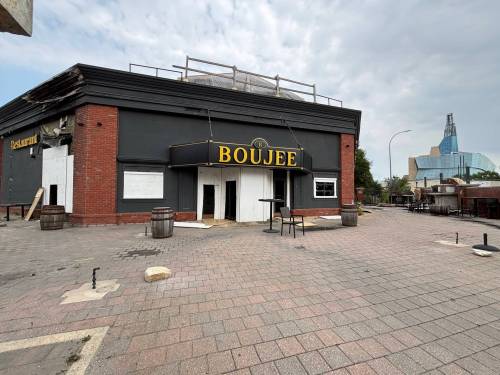
A former restaurant on Main Street is set to be demolished after a fire broke out for the second time in less than a week.

Winnipeg Fire Paramedic Service crews responded to reports of a fire at Boujee Restaurant and Bar, a vacant, single-storey building on the 100 block of Main Street shortly before 6 a.m. Saturday. The same building was most recently damaged in a fire last Sunday.

At the scene, crews found heavy smoke coming from the building. After attacking the fire using aerial ladders that sprayed water from above, firefighters arranged an emergency demolition of the building. Demolition is expected to be completed today, the WFPS said in a news release.

No injuries were reported and the fire is under investigation.

Read
Saturday, Aug. 8, 2026

Kinder, gentler drug crackdown finds support, tempered expectations in Main Street area

Chris Kitching 9 minute read Preview

Kinder, gentler drug crackdown finds support, tempered expectations in Main Street area

Chris Kitching 9 minute read Friday, Aug. 7, 2026

Drawing a lighter from his pocket, a shirtless man perched on a concrete wall outside United Way Winnipeg’s Main Street headquarters heats a substance in a glass pipe and moves the tube toward his mouth.

Read
Friday, Aug. 7, 2026

Football kept Bombers’ Jaworski going while recovering from car crash

Taylor Allen 4 minute read Preview

Football kept Bombers’ Jaworski going while recovering from car crash

Taylor Allen 4 minute read Yesterday at 7:17 PM CDT

Instead of gearing up for his first full season of CFL football, Matt Jaworski was in a hospital bed wondering if he’d ever get to play again.

The Winnipeg Blue Bombers defensive end was in a serious car crash in March and has several scars on his face — which he pointed out to reporters on Sunday — to prove it.

The 23-year-old from Buffalo, N.Y., was placed on the retirement list in May. Over the weekend, the Bombers signed him to the practice roster.

“I appreciate Winnipeg taking me back and I’m ready to go,” he said after practice.

Read
Yesterday at 7:17 PM CDT