Wild-looking and sustainable is the trend in garden design

Advertisement

Advertise with us

Whether it's on an enormous estate or outside a little house, the modern garden aims for wild-looking landscapes, native species and seamless transitions to natural surroundings, according to a new book featuring the work of prominent contemporary garden designers.

Read this article for free:


or

Already have an account? Log in here »

To continue reading, please subscribe:

Subscribe and receive a limited-edition Free Press branded hat or tote.

Digital Subscription

One year of digital access for only $205*

  • Enjoy unlimited reading on winnipegfreepress.com
  • Read the E-Edition, our digital replica newspaper
  • Access News Break, our award-winning app
  • Play interactive puzzles

*First annual payment billed as $205.00 + GST for one year. This annual subscription will automatically renew at $233.00 + GST every 52 weeks (10% off the regular annual price of $259.35). Offer available to new and qualified returning subscribers only. Cancel any time.

To continue reading, please subscribe:

Add Free Press access to your Brandon Sun subscription for only an additional

$1 for the first 4 weeks*

  • Enjoy unlimited reading on winnipegfreepress.com
  • Read the E-Edition, our digital replica newspaper
  • Access News Break, our award-winning app
  • Play interactive puzzles
Start now

*Your next Brandon Sun subscription payment will increase by $1.00 and you will be charged $17.95 plus GST for four weeks. After four weeks, your payment will increase to $24.95 plus GST every four weeks.

Hey there, time traveller!
This article was published 30/04/2019 (2661 days ago), so information in it may no longer be current.

Whether it’s on an enormous estate or outside a little house, the modern garden aims for wild-looking landscapes, native species and seamless transitions to natural surroundings, according to a new book featuring the work of prominent contemporary garden designers.

In “Garden Wild: Wildflower Meadows, Prairie-Style Plantings, Rockeries, Ferneries, and Other Sustainable Designs Inspired by Nature” (Rizzoli), photographer Andre Baranowski explores a dozen very different gardens — all of them mostly devoid of manicured lawns and fussy pruning.

The focus, instead, is on sustainability and plant diversity. Featured garden designers include Oehme van Sweden, Fernando Caruncho, Jorge Sanchez and Piet Oudolf.
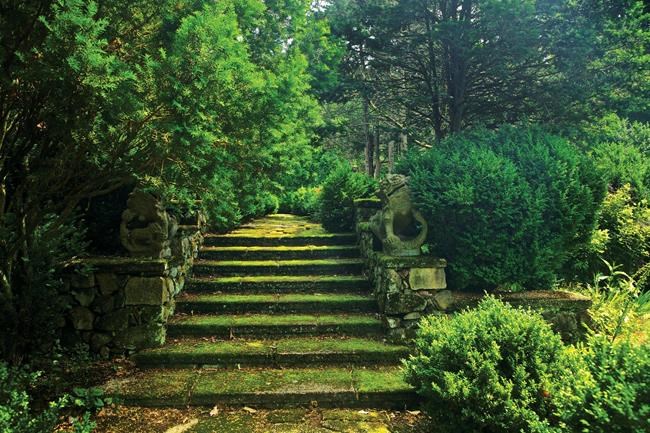
This photo provided by Rizzoli Press shows moss-covered steps guarded by a pair of centuries-old Chinese dragons in Greenwood Gardens, Short Hills, N.J. The photograph is featured in the book
This photo provided by Rizzoli Press shows moss-covered steps guarded by a pair of centuries-old Chinese dragons in Greenwood Gardens, Short Hills, N.J. The photograph is featured in the book "Garden Wild: Wildflower Meadows, Prairie-Style Plantings, Rockeries, Ferneries, and Other Sustainable Designs Inspired by Nature" by Andre Baranowski. (Andre Baranowski/Rizzoli Press via AP)

Each chapter explores a single garden, explaining the designer’s approach, the challenges posed and garden highlights, with an eye to inspiring home gardeners to try their hand at this more natural-looking approach.

“Tons of money still goes into fertilizers and weed killers for traditional-style manicured lawns, but I’m trying to show people that weeds can be quite beautiful. They can be stunning. Gardens can be gorgeous and sustain wildlife, and at the same time be easier to maintain,” says Baranowski, who visited the 12 gardens hundreds of times, looking for the most evocative images.

“This wilder look is absolutely catching on,” he says.

The book begins with a garden in Water Mill, New York, designed in the 1980s by pioneering landscaper James van Sweden, co-founder with Wolfgang Oehme of the Oehme van Sweden firm. In a departure from the staid hedges, boxwoods and perennial borders that dominated the East End of Long Island at the time, von Sweden planted low-maintenance grasses and other native plants, and plants appropriate for the seascape like lavender, sedums, willows and magnolias.

Bringing native grasses right up to the pool’s edge was considered revolutionary at the time, Baranowski says.

In a garden in East Hampton, New York, Eric Groft, of the firm Oehme van Sweden, screened out traffic using ornamental grasses, which have the added benefit of deterring deer, the book says.

Plantings focused on green, gold and purple shrubs, perennials, and grasses that thrive in the local microclimate, with annuals appearing only in pots. Mature old elms, flowering dogwoods and black locusts were left in place to give the garden a more established look.

In New York’s Lower Hudson Valley area, meanwhile, landscape designer Kathy Moreau designed and refreshed several gardens on an expansive property, in one area creating a garden meant to be walked on — ideally with bare feet. While stepping stones suggested the walking path, ground cover like sedum, mosses and periwinkle (to add colour) were chosen specifically to delight the feet.

Throughout the property, Moreau replaced invasive plants with native or sustainable plantings — “sustainable in the sense that they attract pollinators and do not require a lot of extra water or nutrients,” she says in the book.
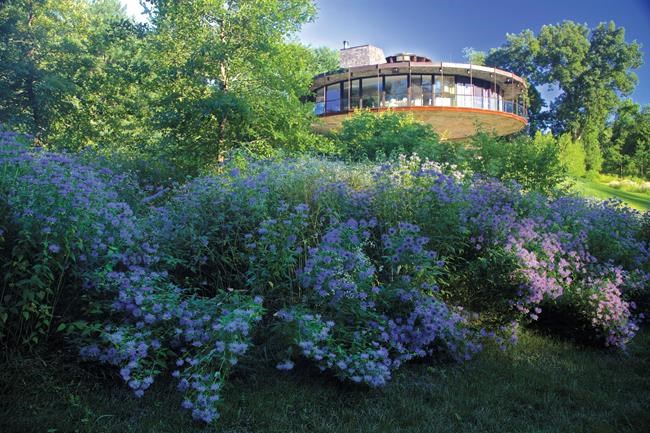
This photo provided by Rizzoli Press shows Round House by Richard Foster and a wild flower garden in Wilton, Conn. The photograph is featured in the book
This photo provided by Rizzoli Press shows Round House by Richard Foster and a wild flower garden in Wilton, Conn. The photograph is featured in the book "Garden Wild: Wildflower Meadows, Prairie-Style Plantings, Rockeries, Ferneries, and Other Sustainable Designs Inspired by Nature" by Andre Baranowski. (Andre Baranowski/Rizzoli Press via AP)

“With every garden, you have the chance to do more than provide a practical solution — for example, something pretty to look at, or screening from a neighbour,” she says. “The best landscape design does that and more: it should be environmentally responsive and also artistic to fully engage both the people lucky enough to enjoy the garden and the breadth of other living things that depend on it.”

Most of the gardens featured are in New York or New Jersey, with the addition of one in Ashley Falls, Massachusetts, and one in Wilton, Connecticut.

The most public of the gardens featured is the High Line in New York City, inspired by the self-seeded landscape that grew up between the rail tracks after trains stopped running there in the 1980s.

Baranowski notes that despite the trend toward more natural-looking gardens, many of America’s suburban spaces continue to run to manicured lawns and hedges.

“If that could change, just a little bit, it could be so much more beautiful and wild,” he says wistfully.

Report Error Submit a Tip

More Stories

Gridlock by design: no excuses for bed backlog

Jason M. Sutherland 5 minute read 2:00 AM CDT

Imagine waking up in a hospital bed and being told by a doctor that you are well enough to leave, only to discover you cannot. Not because you want to stay, but because there is nowhere safe for you to go. No home-care support, no rehabilitation space, no long-term care bed.

This is unfortunately the daily reality for thousands of Canadians.

Being stuck in a hospital bed is a crisis from coast to coast. Our acute care hospitals are functioning as wildly expensive beds for vulnerable citizens awaiting a more suitable place to take them in.

A decade ago, policymakers fretted over this exact issue. Today, despite an aging population with increasingly complex needs and higher demand for hospital beds, the crisis has only deepened.

Fun drop-in last chance to mentor grads of inner-city school with excellent track record

Maggie Macintosh 6 minute read Preview

Fun drop-in last chance to mentor grads of inner-city school with excellent track record

Maggie Macintosh 6 minute read 2:00 AM CDT

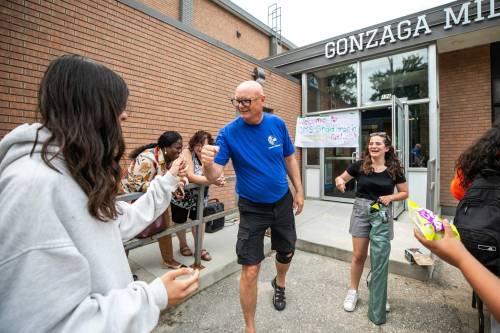
Summer break may be in full swing, but Gonzaga Middle School invited graduates back to the building for water balloon fights and academic, employment and support services this week.

Roughly 30 alumni, including teenagers and twentysomethings, stopped by the grades 6-8 school in North Point Douglas on Tuesday afternoon. They were greeted with slime-making kits, ice cream sundaes and staff ready to answer questions.

The initiative — the final grad drop-in organized this summer — is a new extension of the mentorship and holistic programming baked into the funded independent school’s mandate.

“We have 22- and 23-year-olds coming back and checking in and asking for help on their university papers,” principal Rex Ferguson-Baird said.

Read
2:00 AM CDT

AI bio-weapons loom

Gwynne Dyer 4 minute read 2:00 AM CDT

‘Artificial intelligence’ based on large language models is shaping up to be the most efficient destroyer of value since the South Sea Bubble. After “the Crash”, which is inevitably coming, some specific functions of AI will eventually turn out to be genuinely revenue-generating, and a lot of jobs will duly disappear. But the biggest winner (and potentially biggest loser) is medical science.

Dr. Brian Hie, a chemical engineer at Stanford University in California, has just revealed that his team has made the first viruses designed by artificial intelligence. They are ‘bacteriophages’, viruses that only infect bacteria and are widely used to treat people with infections that resist other treatments.

However, natural bacteriophages sometimes fail, so Dr. Hie used generative AI to design new ones that might do the job. The AI generated thousands of designs for new genomes that more or less fit the bill, and he chose around 300 of them to build in the lab. It’s hard work, not magic, but he ended up with 16 ‘novel’ bacteriophages that might work.

He applied them to petri dishes containing two harmful strains of E. coli, a common bacteria that lives in the human gut, and they killed the bacteria off. It’s still early days, but if it is truly becoming possible to tailor-make bacteriophages that target specific bacteria, then we may be getting a major new weapon in the struggle against antibiotic resistance.

Manitoba-made technology earns faith of investors across Canada

Gabrielle Piché 4 minute read Preview

Manitoba-made technology earns faith of investors across Canada

Gabrielle Piché 4 minute read Yesterday at 2:00 AM CDT

Blue light flashed as a robotic arm welded the metal in front of it.

Unlike other robots of its kind, this one uses artificial intelligence. It’s supposed to see and adjust its movements if a part it’s working on doesn’t match the standard piece.

It’s Manitoba-made technology that investors across Canada are betting on. TetraGen Robotics, the technology’s creator, announced it had raised $1.8 million in an oversubscribed seed funding round.

It announced the funding Monday afternoon. Jim Richardson, from the family behind Richardson International, is among the investors listed online.

Read
Yesterday at 2:00 AM CDT

Ducks Unlimited makes province’s largest-ever conservation-land purchase

Zoe Pierce 3 minute read Preview

Ducks Unlimited makes province’s largest-ever conservation-land purchase

Zoe Pierce 3 minute read Yesterday at 12:11 PM CDT

A Manitoba landscape that helped save the Giant Canada goose from extinction has now been permanently protected in the province’s largest conservation land purchase in history.

Read
Yesterday at 12:11 PM CDT

Wild-looking and sustainable is the trend in garden design

Katherine Roth, The Associated Press 4 minute read Preview

Wild-looking and sustainable is the trend in garden design

Katherine Roth, The Associated Press 4 minute read Tuesday, Apr. 30, 2019

Whether it's on an enormous estate or outside a little house, the modern garden aims for wild-looking landscapes, native species and seamless transitions to natural surroundings, according to a new book featuring the work of prominent contemporary garden designers.

In "Garden Wild: Wildflower Meadows, Prairie-Style Plantings, Rockeries, Ferneries, and Other Sustainable Designs Inspired by Nature" (Rizzoli), photographer Andre Baranowski explores a dozen very different gardens — all of them mostly devoid of manicured lawns and fussy pruning.

The focus, instead, is on sustainability and plant diversity. Featured garden designers include Oehme van Sweden, Fernando Caruncho, Jorge Sanchez and Piet Oudolf.

Each chapter explores a single garden, explaining the designer's approach, the challenges posed and garden highlights, with an eye to inspiring home gardeners to try their hand at this more natural-looking approach.

Read
Tuesday, Apr. 30, 2019