

It’s time to declare a national emergency

Advertisement
Read this article for free:
or
Already have an account? Log in here »
To continue reading, please subscribe:

Digital Subscription
One year of digital access for only $205*
- Enjoy unlimited reading on winnipegfreepress.com
- Read the E-Edition, our digital replica newspaper
- Access News Break, our award-winning app
- Play interactive puzzles
*First annual payment billed as $205.00 + GST for one year. This annual subscription will automatically renew at $233.00 + GST every 52 weeks (10% off the regular annual price of $259.35). Offer available to new and qualified returning subscribers only. Cancel any time.
To continue reading, please subscribe:
Add Free Press access to your Brandon Sun subscription for only an additional
$1 for the first 4 weeks*
- Enjoy unlimited reading on winnipegfreepress.com
- Read the E-Edition, our digital replica newspaper
- Access News Break, our award-winning app
- Play interactive puzzles
*Your next Brandon Sun subscription payment will increase by $1.00 and you will be charged $17.95 plus GST for four weeks. After four weeks, your payment will increase to $24.95 plus GST every four weeks.
Read unlimited articles for free today:
or
Already have an account? Log in here »
Hey there, time traveller!
This article was published 18/06/2019 (2674 days ago), so information in it may no longer be current.
VICTORIA — Environment Minister Catherine McKenna put forward a resolution Monday to declare a national climate emergency.
The non-binding motion calls on Canada to recognize “climate change is a real and urgent crisis, driven by human activity.” The statement, passing with a vote of 186-63, was more a performance than anything else — non-binding resolutions do not legally require legislators to do anything.
But it was a start.
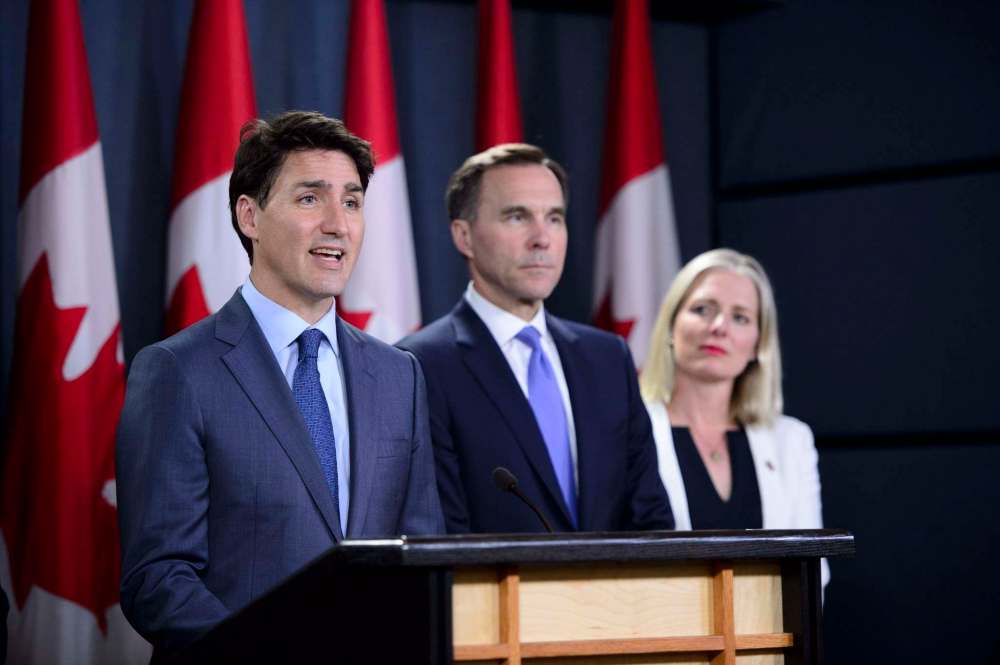
So, it’s ironic the next day, Prime Minister Justin Trudeau declared the government had approved the Trans Mountain pipeline expansion project.
Related Articles
Protests, lawsuits planned to block pipeline Feds approve Trans Mountain, again

Officials said construction of the $7.4-billion pipeline to the southwest coast of B.C. from northeastern Alberta will begin later this year.
The decision comes nine months after the Federal Court of Appeal dumped the original 2016 approval, stating Canada had failed to consider impacts on marine life and fulfill its constitutional obligations to consult First Nations. This sparked a National Energy Board environmental assessment and new consultations with 117 Indigenous communities along the proposed route.
The decision was predictable: the federal government bought the pipeline from Kinder Morgan for $4.5 billion in 2018, and was essentially approving a project it owns.
But the wording of the decision is interesting. It was wrapped in patriotic “it’s in the national interest” jargon and specifically claims it will ensure a “clean economy,” while also benefiting Indigenous communities.
I’ll leave the “clean economy” argument for the scientists, but it’s worth noting Trudeau immediately committed every penny earned from the project — estimated to be $500 million a year — to investments in “clean energy.”
This “we-know-it’s-dirty-but-we’ll-get-clean-one-day” argument is like a student who cheats on a test, gets a job based on that performance, and promises to use his salary to get the right qualifications.
It is a promise not worth the paper it’s written on.
Governments have to come to grips with the fact there are clean, accessible, and renewable energy projects using wind, water, solar, and other bio-mass available today. Look no further then the B.C. government, where 40 per cent of all projects are “clean energy.”
It’s also one of the most profitable. Clean energy projects are Canada’s fastest-growing industry, accounting for $57 billion (or three per cent of Canada’s GDP). It also annually growing nearly two times faster then oil and gas.
In any argument “in the national interest,” the environment wins, every time. You can’t eat money.
This is a decision to appease Alberta, whose economy currently isn’t rosy, and the fact Canadian premiers are making a hard right turn on the political spectrum heading into a fall federal election.
Getting re-elected is what this is really about.
The decision also claims three benefits for Indigenous communities.
First, eight “accommodations” intended to “focus on building capacity and long-term relationships, marine safety, spill prevention, response capacity, cumulative effects, fish and fish habitat, and quieter vessels” were made. (These were in response to specific communities requesting protections for fish and animals, cultural practices, and sacred sites.)
According to a source I spoke to on the negotiating team, most of these “accommodations” were a fraction of the requests. The government knows lands, animals, fish and water will be damaged in vast numbers by this project.
Second, this was “the most exhaustive and comprehensive consultations ever conducted by the federal government for a major project.” Federal officials said they met with 129 Indigenous communities along the project route.
A statement from the Union of British Columbia Indian Chiefs was issued minutes after the decision, stating it remains “staunchly opposed” to the pipeline project.
“Our lands are burning and flooding,” Grand Chief Stewart Phillip said, “our fish are dying and our people are suffering.”
Tsleil-Waututh Chief Leah George-Wilson said her community “engaged in consultation in good faith, but it was clear that the federal government had already made up their mind as the owners of the project.”
The Tiny House Warriors, a group seeking to stop the pipeline’s route through traditional territory, announced they will occupy the space and refuse to move.
So much for the “comprehensive consultations.”
Which brings me to the third benefit claimed by Ottawa: Indigenous communities will have access to “equity ownership, revenue sharing, and resource ‘royalty’ agreements.”
Indigenous peoples are not anti-money (or anti-development or anti-economy) but we are anti-death. Poverty is mostly due to the Indian Act and, yes, the problem is that simple. How about we address that, instead of throwing money at a broken relationship?
A never-ending hunger for land, power, and money is what’s divided Indigenous and non-Indigenous peoples over the past 150 years.
When it comes to these moments, Indigenous communities are ignored or pitted against each other. When it comes to sharing the land, Indigenous rights are an afterthought and cast aside for Canada’s “national interest.”

Worst of all, Indigenous peoples hear words such as reconciliation, which, when the pipeline hits the cabinet table, turns into a lie.
I therefore declare a national emergency in Canada.
Only this motion should be binding.
niigaan.sinclair@freepress.mb.ca
Niigaan Sinclair is Anishinaabe from Peguis First Nation and a professor in the Department of Indigenous Studies at the University of Manitoba. He’s been a columnist for the Free Press since 2018. Read more about Niigaan.
Every piece of writing Niigaan produces is reviewed by an editing team before it is posted online or published in print — part of the Free Press‘s tradition, since 1872, of producing reliable independent journalism. Read more about Free Press’s history and mandate, and learn how our newsroom operates.
Our newsroom depends on a growing audience of readers to power our journalism. If you are not a paid reader, please consider becoming a subscriber.
Our newsroom depends on its audience of readers to power our journalism. Thank you for your support.
Niigaan Sinclair is Anishinaabe from Peguis First Nation and a professor in the Department of Indigenous Studies at the University of Manitoba. He’s been a columnist for the Free Press since 2018. Read more about Niigaan.
Every piece of writing Niigaan produces is reviewed by an editing team before it is posted online or published in print — part of the Free Press‘s tradition, since 1872, of producing reliable independent journalism. Read more about Free Press’s history and mandate, and learn how our newsroom operates.
Our newsroom depends on a growing audience of readers to power our journalism. If you are not a paid reader, please consider becoming a subscriber.
Our newsroom depends on its audience of readers to power our journalism. Thank you for your support.
Advertisement Advertise With Us
Advertisement Advertise With Us
History
Updated on Tuesday, June 18, 2019 10:56 PM CDT: Adds related items