

Mennonite history lives on

Advertisement
Read this article for free:
or
Already have an account? Log in here »
To continue reading, please subscribe:
Monthly Digital Subscription
$1 per week for 24 weeks*
- Enjoy unlimited reading on winnipegfreepress.com
- Read the E-Edition, our digital replica newspaper
- Access News Break, our award-winning app
- Play interactive puzzles
*Billed as $4.00 plus GST every four weeks. After 24 weeks, price increases to the regular rate of $19.95 plus GST every four weeks. Offer available to new and qualified returning subscribers only. Cancel any time.
Monthly Digital Subscription
$4.99/week*
- Enjoy unlimited reading on winnipegfreepress.com
- Read the E-Edition, our digital replica newspaper
- Access News Break, our award-winning app
- Play interactive puzzles
*Billed as $19.95 plus GST every four weeks. Cancel any time.
To continue reading, please subscribe:
Add Free Press access to your Brandon Sun subscription for only an additional
$1 for the first 4 weeks*
- Enjoy unlimited reading on winnipegfreepress.com
- Read the E-Edition, our digital replica newspaper
- Access News Break, our award-winning app
- Play interactive puzzles
*Your next Brandon Sun subscription payment will increase by $1.00 and you will be charged $17.95 plus GST for four weeks. After four weeks, your payment will increase to $24.95 plus GST every four weeks.
Read unlimited articles for free today:
or
Already have an account? Log in here »
Hey there, time traveller!
This article was published 19/08/2019 (2454 days ago), so information in it may no longer be current.
Just west of Altona, near the U.S. border, sits a little-known collection of buildings that tell a fascinating story about Manitoba’s past.
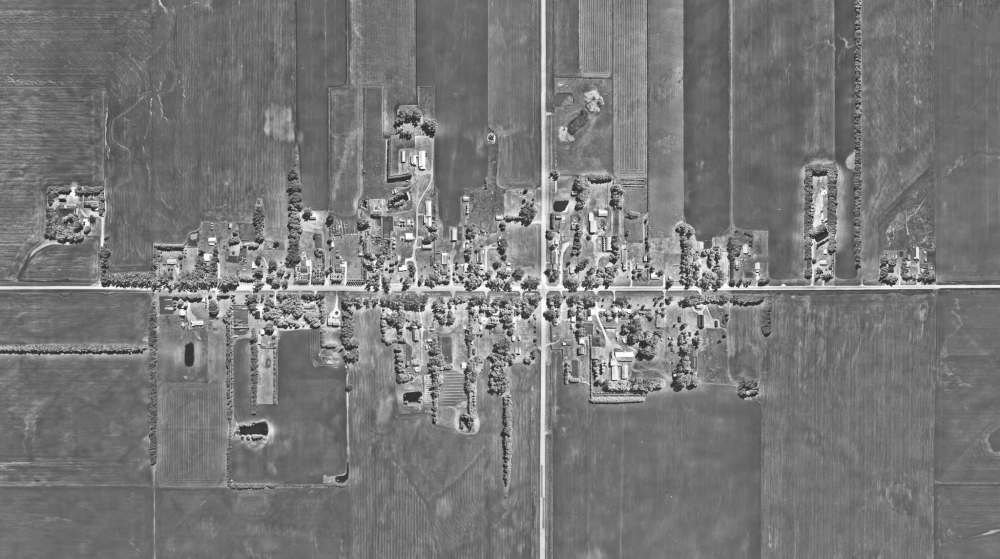
Celebrated as a National Historic Site in 1989, the village of Neubergthal is recognized as the best preserved example of a Mennonite street village in Canada. Its distinct town plan and architectural styles are a living illustration of Mennonite building traditions, brought to Manitoba in the late 19th century after 200 years of development in Europe.
The origins of the Mennonite farm village began centuries ago on the lowlands of Prussia. Typical homesteads were organized in long, narrow strips running from higher ground along the river to low-lying marshland. This resulted in multifunctional farm buildings being clustered at the front of each property.
After relocating to Russia, Mennonites began settling in villages for protection and ease of sharing labour and tools. The traditional settlement configuration was maintained, but the river was replaced by a central street.
When Mennonites came to Manitoba in the 1870s, these traditions continued to evolve. Farmland in Canada was divided in a grid of one-mile squares with quarter sections for each settler family. The Mennonites established “village agreements” with the government, allowing them a special exemption to pool land and superimpose their traditional development patterns over the grid system.
Instead of each isolated farmer working his own land, groups of about 20 individual families would pool their land together to be farmed collectively, with homes concentrated in a small village located centrally on the land.
A single street ran down the middle of the village, called a Strassendorf, and long, narrow homesteads of about 60 metres wide and 800 metres long were aligned side by side, perpendicular to the road.
A meticulously aligned row of large trees — cottonwoods in Neubergthal — was planted along each side of the street to provide shade, wind protection and a sense of place within the community. Building sites at the centre of the street were set aside for a school and church, and a store was located at the edge of town.
The arable land surrounding the tightly grouped homesteads was divided into several larger strips and distributed equally among the families, ensuring that each received a proportionate share of good and bad land. Livestock was individually owned, but a section of land was set aside as a communal pasture where a herdsman — who was given a home on the property — would tend to them.
This communal settlement strategy required close co-operation, putting community good ahead of individual prosperity. Villagers shared tools, machinery and animals, as well as harvesting, butchering and building duties. Combining property provided every resident access to all essential land features required for successful farming, allowing them to prosper in the difficult early days of prairie settlement.
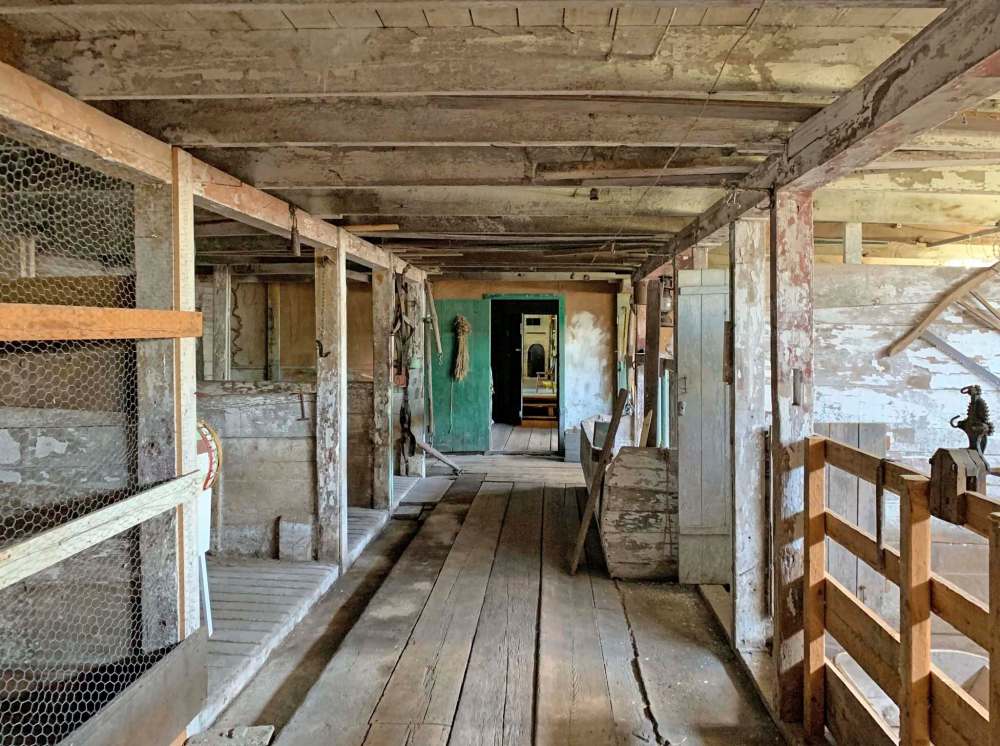
The architecture of Neubergthal is as unique as its town plan… Housebarns were traditional Mennonite structures that combined the family residence with the livestock barn, connected by a central hallway called a gang.
Unique in the pioneering west, the detailed plan of Neubergthal and other street villages was first laid out on paper. This included organizing the buildings on each homestead with precision and consistency, traditionally clustered near the front of the property. The layout is so uniform that locals apparently joke if every resident opened their doors at once, you could see straight through the entire village.
The architecture of Neubergthal is as unique as its town plan. The largest and most important building on each property was the housebarn, set 24 metres back from the street. Housebarns were traditional Mennonite structures that combined the family residence with the livestock barn, connected by a central hallway called a gang.
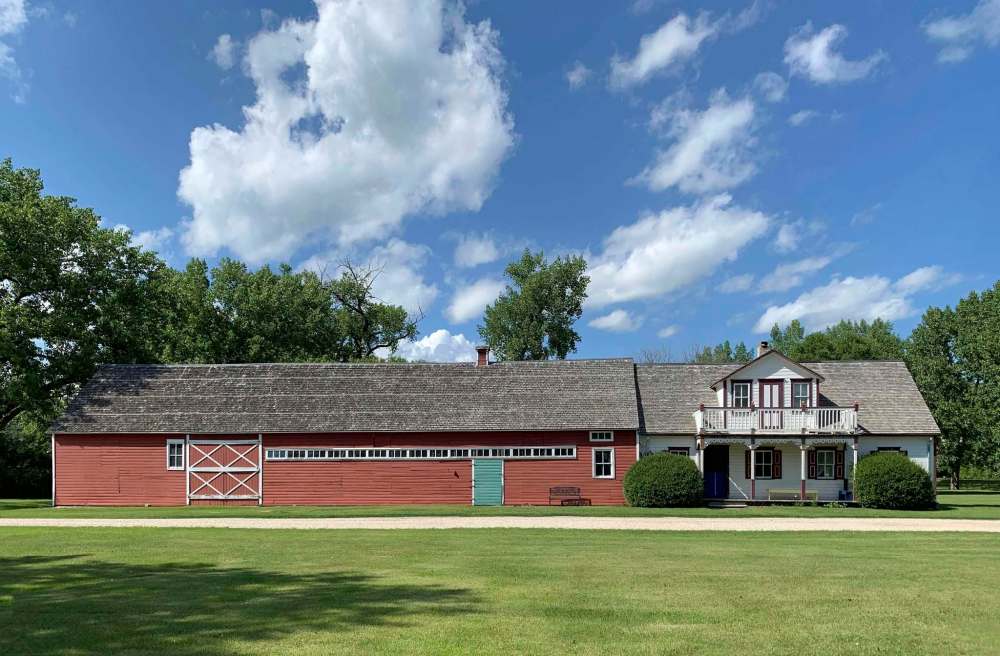
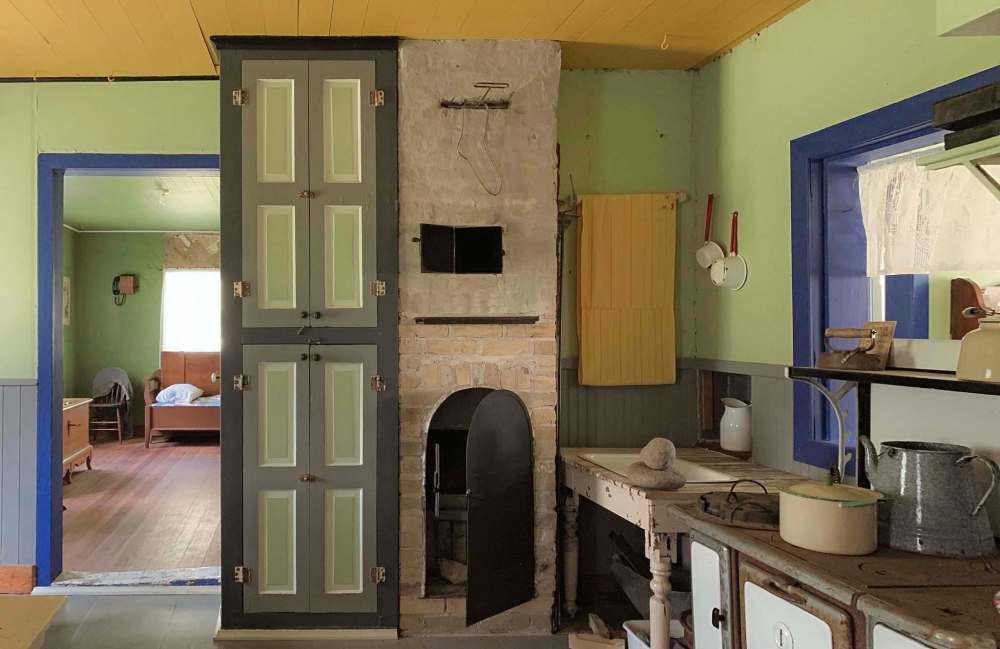
Initially, the house and barn were set end to end, but were later configured in a T shape with the front entrance facing the street, influenced by Canadian houses. Both examples can be seen in Neubergthal. Homes were laid out in a series of small rooms, each opening into the next in a circular pattern, and configured around a large, central brick heater and oven called a Tajel Owe.
The Mennonite housebarn evolved over centuries of living on isolated and difficult landscapes. It allowed farmers to protect their animals, provide immediate care if issues arose and was a convenient response to cold winters. Neubergthal has several remaining examples, including the Friesen Housebarn Interpretive Centre, restored in 2003, which can be toured until the end of August.
It might be a historic site, but the 100 or so residents of Neubergthal — many descendants of original settlers — are not living in a museum frozen in time. The village is continuing to evolve. In 2015, a local couple relocated a housebarn from its original location in the nearby village of Neuhorstand. The former Herdsman’s House — the only one left in North America — has been restored and can be rented as a guest house or artist’s retreat.
The Commons Barn — formerly known as the Klippenstein barn — and the one-room Bergthal School have recently been restored, functioning as multi-purpose spaces to host visiting groups, weddings and community events.
Mennonite street village settlements only lasted a few decades in southern Manitoba, and almost all are lost in time. We are fortunate to have such a well-preserved example in the Neubergthal Street Village National Historic Site. It demonstrates a lesson that is still valid today, showing that thoughtful architecture and planning, when considered as a solution to a collective challenge, can improve the quality of life for entire communities.
If you are in the area before the end of summer, or maybe on Darp Day (Sept. 14), it is worth stopping in on Neubergthal to experience a fascinating and underappreciated chapter in Manitoba’s built history.
It is a place to absorb the spirit of a community that has worked together under the bright Prairie sky for more than 140 years.
Brent Bellamy is creative director at Number Ten Architectural Group.
Brent Bellamy is creative director for Number Ten Architectural Group.
Our newsroom depends on a growing audience of readers to power our journalism. If you are not a paid reader, please consider becoming a subscriber.
Our newsroom depends on its audience of readers to power our journalism. Thank you for your support.
Brent Bellamy is creative director for Number Ten Architectural Group.
Our newsroom depends on a growing audience of readers to power our journalism. If you are not a paid reader, please consider becoming a subscriber.
Our newsroom depends on its audience of readers to power our journalism. Thank you for your support.
Advertisement Advertise With Us
Advertisement Advertise With Us