2020 Mazda3 is beautiful inside and out

Advertisement

Advertise with us

Let’s be honest here, the vast majority of folks who buy the new Mazda3 likely won’t even notice Mazda has abandoned its independent multi-link rear suspension for a torsion beam rear axle setup.

Read this article for free:


or

Already have an account? Log in here »

To continue reading, please subscribe:

Subscribe and receive a limited-edition Free Press branded hat or tote.

Digital Subscription

One year of digital access for only $205*

  • Enjoy unlimited reading on winnipegfreepress.com
  • Read the E-Edition, our digital replica newspaper
  • Access News Break, our award-winning app
  • Play interactive puzzles

*First annual payment billed as $205.00 + GST for one year. This annual subscription will automatically renew at $233.00 + GST every 52 weeks (10% off the regular annual price of $259.35). Offer available to new and qualified returning subscribers only. Cancel any time.

To continue reading, please subscribe:

Add Free Press access to your Brandon Sun subscription for only an additional

$1 for the first 4 weeks*

  • Enjoy unlimited reading on winnipegfreepress.com
  • Read the E-Edition, our digital replica newspaper
  • Access News Break, our award-winning app
  • Play interactive puzzles
Start now

*Your next Brandon Sun subscription payment will increase by $1.00 and you will be charged $17.95 plus GST for four weeks. After four weeks, your payment will increase to $24.95 plus GST every four weeks.

Hey there, time traveller!
This article was published 27/09/2019 (2507 days ago), so information in it may no longer be current.

Let’s be honest here, the vast majority of folks who buy the new Mazda3 likely won’t even notice Mazda has abandoned its independent multi-link rear suspension for a torsion beam rear axle setup.

The truth is, with the exception of car nerds like my colleague Kelly Taylor, and that brainy gearhead kid on your street who refers to your Toyota Camry as an XV50, most people don’t take the time to educate themselves on the finer points of automotive engineering.

Most vehicle shoppers typically overlook the mechanical details — focusing instead on important stuff like the quality of the infotainment system, the number of cupholders and USB charging ports and, of course, how a vehicle looks.
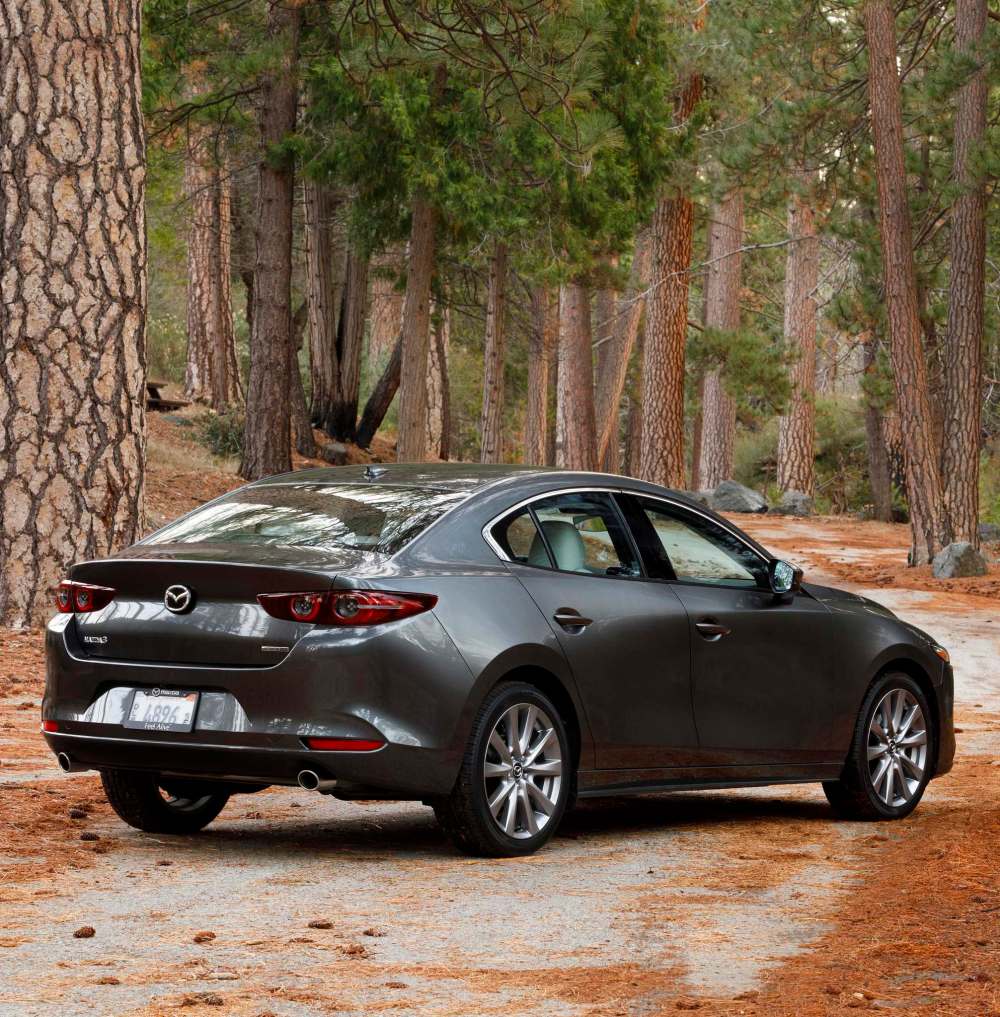
Mazda
Willy Williamson put the Mazda3 through its paces and says it handles like a champ.
Mazda Willy Williamson put the Mazda3 through its paces and says it handles like a champ.

Case in point: a few years back, one of my friends bought a beautiful new Cadillac CTS and didn’t realize it was rear-wheel drive until he couldn’t get out of his driveway one snowy morning.

Purchasing winter tires solved his traction issues — but it was amusing to me that a grown man had bought a car simply because he thought it looked cool, without making the realization it would handle monumentally differently than the front-wheel drive Chevrolet Impala he traded off. In fairness, he retired early and now winters in Florida, so he surely knows a lot of stuff that escapes me.

Perhaps this scenario outlines why we automobile journalists even exist. We aren’t here to shame you with our Yoda-like, (or in my case Shrek-like) knowledge of all things automotive, we are here to help make sure you’re not getting duped into buying a shiny new car that you can’t back out of your driveway in ankle-deep snow.

To this end, it appears Taylor has done his due diligence with the new Mazda3 — he has driven both the sedan and the hatchback on terrain ranging from the silky-smooth roads of California to the mean streets of Elmwood.

Through it all, he has determined there really is no reason to be worried about this fairly significant change in the Mazda3’s rear suspension.

Taylor is a stickler for the details, so there’s no way he would ever make such a claim unless it is entirely true.

To further reinforce his findings, I took that little Mazda3 sedan to an abandoned road on the edge of town and drove it with my angry face on. It was hammered hard down washboard-covered gravel roads, it was drifted into sweeping corners where my foot was pulled off the gas pedal in mid-corner — just to see how the little car would react.

The brake pedal was slammed, then lifted and slammed again, just to see if things went awry in the same manner they most surely would have in a 1986 Hyundai Pony.

Long story short, the new Mazda3 was properly flogged, torsion beam suspension and all.

It is gruelling work, but someone has to do it.

The results of my findings mirrored Taylor’s. What we have here is a perfect little car that is abundantly fun to drive and is an absolute improvement over the previous model in every way, including the rear suspension.

Sure, Mazda may have saved a few bucks with the new torsion beam suspension, and those bushings may be integral to the success of this bold move — but as previously stated, most of you will probably never notice.

What you will notice, especially in the sedan version, is a sweet little car that makes me think of a baby BMW 3 Series.

It handles like a champ, has decent power and is amazingly quiet.

It also has a terrific infotainment system, and as an added bonus, it looks great.

The fact it is available with all-wheel drive will also help some of you avoid answering those embarrasing questions about which wheels provide traction.


willy@freepress.mb.ca

Report Error Submit a Tip

More Stories

Kinder, gentler drug crackdown finds support, tempered expectations in Main Street area

Chris Kitching 9 minute read Preview

Kinder, gentler drug crackdown finds support, tempered expectations in Main Street area

Chris Kitching 9 minute read Yesterday at 7:11 PM CDT

Drawing a lighter from his pocket, a shirtless man perched on a concrete wall outside United Way Winnipeg’s Main Street headquarters heats a substance in a glass pipe and moves the tube toward his mouth.

Read
Yesterday at 7:11 PM CDT

Watching while we work

Tory McNally 7 minute read Preview

Watching while we work

Tory McNally 7 minute read 2:01 AM CDT

For many employees, the idea that their employer might be tracking how long they spend at their keyboard, how often they move their mouse, or whether they are actively working throughout the day feels unsettling. For many employers, however, workplace surveillance is increasingly viewed as another management tool, particularly as hybrid and remote work become more common. The recent news that TD plans to monitor certain employees’ activity during the workday has reignited a conversation that has been quietly growing for several years: where is the line between legitimate oversight and excessive monitoring?

The reality is that workplace surveillance is nothing new. Employers have long monitored attendance, reviewed security camera footage, tracked company vehicles using GPS, audited expense reports, and reviewed internet usage on company-owned devices. What has changed is the sophistication of the technology. Today’s software can record login times, monitor application usage, track keystrokes, capture screenshots, analyze email activity, and even generate reports ranking employees based on their perceived productivity.

This naturally raises an important question. Does increased surveillance actually make people work harder?

The answer is not nearly as straightforward as many organizations hope.

Read
2:01 AM CDT

Gilbert Plains Country Club closes for remainder of season due to flood damage

Ken Wiebe 6 minute read Preview

Gilbert Plains Country Club closes for remainder of season due to flood damage

Ken Wiebe 6 minute read Thursday, Aug. 6, 2026

Scott McCallum has made the trek to the Gilbert Plains Country Club clubhouse countless times.

But this was the first time the golf professional and general manager of the course required hip waders to get to his office.

Walking hand in hand with his wife Lindsay, McCallum didn’t need much time to see the devastation caused by the flash flooding in the Parkland region in late June.

“We’re on a river and it’s a beautiful golf course, but anytime you’re on a body of water you know that you’re taking a chance of events like this happening,” McCallum said in a telephone interview. “To this magnitude, we’ve never seen anything like it before. So, this is new to us.

Read
Thursday, Aug. 6, 2026

Champion curler Meleschuk never lost his passion for the game

Joshua Frey-Sam 9 minute read Preview

Champion curler Meleschuk never lost his passion for the game

Joshua Frey-Sam 9 minute read 3:00 AM CDT

At the height of his curling career, Orest Meleschuk balanced ferocity and finesse like almost no one else.

The Winnipeg product was a fierce competitor skilful enough to thread a rock through a window and find the button.

Known as “The Big O,” he curled competitively for over six decades, finding success at the local, provincial, national and global level, and his longevity on the pebble was notable before lengthy careers became the norm.

Meleschuk is still tied with his good friend John Usackis for the most appearances in the Manitoba men’s provincial playdowns, at 30.

Read
3:00 AM CDT

Chrysler refines Pacifica and Grand Caravan as buyers return to practical family hauler

Kelly Taylor 5 minute read Preview

Chrysler refines Pacifica and Grand Caravan as buyers return to practical family hauler

Kelly Taylor 5 minute read Yesterday at 3:00 AM CDT

BURLINGTON, Ont. — The mighty minivan — relegated to the scrap heap by the rush to crossovers and SUVs — is making a comeback, and Chrysler hopes to lead the way with its top-selling, Canadian-made Grand Caravan and Pacifica models.

While many manufacturers — Mazda, Ford, GM, Hyundai and Nissan — abandoned the once-popular family hauler, Chrysler has continued to play in the segment since it was launched by Lee Iacocca in 1983.

For 2027, the Pacifica gets a cosmetic refresh and the Grand Caravan is a holdover, but new this year are price savings of up to $7,200, Chrysler product planner Mike Szymkiewicz told journalists assembled here for the launch of the two vehicles.

“It’s primarily that we’re taking less margin, but we’re also adding content,” he said. “So less margin but we hope more volume.”

Read
Yesterday at 3:00 AM CDT

Sending the wrong message

Andrea Charron 4 minute read 2:01 AM CDT

The U.S. State Department has announced plans to close five overseas diplomatic posts approved by Congress: Douala, Cameroon (a branch office); St. George’s, Grenada (an embassy); Nagoya, Japan (a consulate); Medan, Indonesia (a consulate); and Winnipeg, Canada (a consulate).

All are located in countries that are partners or allies of the United States.

It is unusual for the United States to reduce its diplomatic footprint. With the exception of some retrenchment efforts during the Trump administration, Washington has generally viewed diplomacy as a force multiplier. Diplomacy is not simply a matter of authority and leverage. It requires sustained local engagement, relationships and presence.

Consulates and branch offices are not the same as embassies. They are smaller missions, headed by consuls or consuls general rather than ambassadors and often provide a more limited range of services. Yet they play a vital political, economic and cultural role, supporting both local populations and American citizens abroad.