Genre-bending bio of Thomas Edison is highly illuminating

Advertisement

Advertise with us

"Edison," Random House, by Edmund Morris

Read this article for free:


or

Already have an account? Log in here »

To continue reading, please subscribe:

Subscribe and receive a limited-edition Free Press branded hat or tote.

Digital Subscription

One year of digital access for only $205*

  • Enjoy unlimited reading on winnipegfreepress.com
  • Read the E-Edition, our digital replica newspaper
  • Access News Break, our award-winning app
  • Play interactive puzzles

*First annual payment billed as $205.00 + GST for one year. This annual subscription will automatically renew at $233.00 + GST every 52 weeks (10% off the regular annual price of $259.35). Offer available to new and qualified returning subscribers only. Cancel any time.

To continue reading, please subscribe:

Add Free Press access to your Brandon Sun subscription for only an additional

$1 for the first 4 weeks*

  • Enjoy unlimited reading on winnipegfreepress.com
  • Read the E-Edition, our digital replica newspaper
  • Access News Break, our award-winning app
  • Play interactive puzzles
Start now

*Your next Brandon Sun subscription payment will increase by $1.00 and you will be charged $17.95 plus GST for four weeks. After four weeks, your payment will increase to $24.95 plus GST every four weeks.

Hey there, time traveller!
This article was published 21/10/2019 (2499 days ago), so information in it may no longer be current.

“Edison,” Random House, by Edmund Morris

The late Edmund Morris, a Pulitzer Prize-winning biographer known for his willingness to brush aside the norms of his genre if it suited his narrative ends, does it again in his final book: a fresh look at Thomas Alva Edison, perhaps America’s most prolific and consequential inventor.

Morris, who died in May at age 78, opens “Edison” conventionally enough with a prologue highlighting the inventor’s world-changing accomplishments. Starting in his teens as a precocious telegraph operator, the man known as “the Wizard of Menlo Park” invented and patented nearly 1,100 machines, systems and electrical devices until his death in 1931 at the age of 84. Beginning with lower Manhattan in 1882, Edison lit up entire cities using long-burning incandescent lightbulbs and electrical dynamos. He invented the phonograph and a host of other sound devices that brought recorded voices and music into living rooms and cinemas. Besides those signature accomplishments, Edison was responsible for, among many other things, the first universal stock ticker, movie camera, alkaline reversible battery, the first industrial research and development laboratory (at Menlo Park, New Jersey), even the world’s biggest rock crusher, invented while spending years on one of his least successful ventures trying to mine iron ore from a western New Jersey mountain.
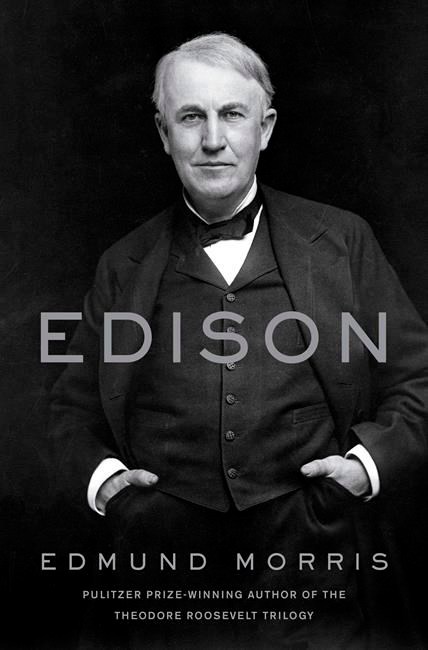
This cover image released by Random House shows
This cover image released by Random House shows "Edison" by Edmund Morris. (Random House via AP)

He did all this on a lifelong diet consisting mainly of plain milk and a brutal work regimen of 18 hours a day, often at the expense of his personal life with his two wives and six children. Nearly deaf since age 12, Edison found a blessing in the silence as a way to shut out distractions. And while he relished and promoted his worldwide fame, he never cared for labels like “genius” or “wizard.”

“I never had an idea in my life,” he once told a reporter. “I’ve got no imagination. … My so-called inventions already existed in the environment — I took them out. … The industrious one coaxes it from the environment; the drone lets it lie there while he goes off to the baseball game. The ‘genius’ hangs around his laboratory day and night.”

After this introductory section, Morris’ narrative takes a highly unorthodox turn by describing the inventor’s later years in the opening chapters. He then proceeds backward, decade by decade, culminating with Edison’s younger years when many of his most familiar and consequential inventions in electricity and sound replication occurred.

Morris’ willingness to breach the organizational norms of biography may not surprise readers familiar with his even bolder previous work, “Dutch: A Memoir of Ronald Reagan,” in which Morris included himself as a made-up Zelig-like character who “knew” the former president back to his youthful days. He claimed this device gave him a way to share insights he had gained about the hard-to-penetrate former president. But the resulting blend of fact and fiction in such a high- profile biography caused a ruckus among many critics and historians.

Morris never directly addresses why he presents Edison’s life in reverse chronological order. But he drops a possible clue in his endnotes by asserting that previous Edison biographies offered only scant details about his later life. Whatever the reason, Morris’ decision to begin his book with lesser known details about the aging Edison’s inventions and exploits makes for a rousing start. Edison tried during the 1920s to help free America from its dependency on foreign rubber in the early auto age by trying to identify plants capable of producing enough commercially viable rubber that would thrive in American soil (he never did). We also learn about Edison’s many inventions in support of the Allied cause during World War I despite his personal pacificism.

There were episodes, miscalculations and loose-tongued pronouncements, especially late in life, that further humanize Edison’s story. He made a losing bet (at least at the time) on battery-operated cars versus the internal combustion engine as the automobile age dawned. He caused international shock waves by questioning the existence of God or an afterlife. The ultimate empiricist, Edison didn’t hide his contempt for academic scientists whom he considered impractical — “the bungleheaded fraternity,” as he called them.

Morris’ genre-bending biography of Edison is a briskly written, fact-packed work that, like its subject, is also highly illuminating.
Report Error Submit a Tip

More Stories

‘Strong sense of unity’

By Melissa Martin 6 minute read Preview

‘Strong sense of unity’

By Melissa Martin 6 minute read Saturday, Aug. 22, 2026

Manitoba government and business leaders are rallying behind Prime Minister Mark Carney’s plan to fight back, after a sudden collapse of trade talks between the U.S. and Canada sparked a new salvo of U.S. tariffs on some Canadian goods.

On Saturday, after Carney vowed to respond with retaliatory tariffs, Manitoba premier Wab Kinew said his government stood “100 per cent” behind the prime minister’s plan to respond to what Kinew called U.S. president Donald Trump’s “unjustified and immoral” tariffs.

“History will not be kind to Donald Trump, so we should never appease him,” Kinew said. “We should fight back, which is what Canada is doing today.”

Kinew met reporters for a brief news conference at the legislature on Saturday afternoon, about an hour after finishing a call with Carney and the other premiers. There was a “really strong sense of unity” on that call, Kinew said, and emphasized that he backs the federal decision to “walk away from what would have been a bad deal.”

Read
Saturday, Aug. 22, 2026

Letters, Aug 24

7 minute read 2:00 AM CDT

The forgotten specialists

The Manitoba government’s recent announcement of 4,724 net new health care workers left out a profession that is critical to the health of Manitobans — clinical psychologists.

Clinical psychologists and clinical health psychology residents play an essential role in our health-care system, working alongside our physicians and allied health colleagues to provide psychological services in both mental health and behavioural health medicine to Manitobans across their lifespan.

Clinical psychologists specialize in the assessment, treatment and diagnosis of complex mental health disorders, neurodevelopmental conditions and physical health conditions. They can be found within hospitals, outpatient clinics and primary care settings throughout the province.

Genre-bending bio of Thomas Edison is highly illuminating

Lee Mitgang, The Associated Press 4 minute read Preview

Genre-bending bio of Thomas Edison is highly illuminating

Lee Mitgang, The Associated Press 4 minute read Monday, Oct. 21, 2019

"Edison," Random House, by Edmund Morris

The late Edmund Morris, a Pulitzer Prize-winning biographer known for his willingness to brush aside the norms of his genre if it suited his narrative ends, does it again in his final book: a fresh look at Thomas Alva Edison, perhaps America's most prolific and consequential inventor.

Morris, who died in May at age 78, opens "Edison" conventionally enough with a prologue highlighting the inventor's world-changing accomplishments. Starting in his teens as a precocious telegraph operator, the man known as "the Wizard of Menlo Park" invented and patented nearly 1,100 machines, systems and electrical devices until his death in 1931 at the age of 84. Beginning with lower Manhattan in 1882, Edison lit up entire cities using long-burning incandescent lightbulbs and electrical dynamos. He invented the phonograph and a host of other sound devices that brought recorded voices and music into living rooms and cinemas. Besides those signature accomplishments, Edison was responsible for, among many other things, the first universal stock ticker, movie camera, alkaline reversible battery, the first industrial research and development laboratory (at Menlo Park, New Jersey), even the world's biggest rock crusher, invented while spending years on one of his least successful ventures trying to mine iron ore from a western New Jersey mountain.

He did all this on a lifelong diet consisting mainly of plain milk and a brutal work regimen of 18 hours a day, often at the expense of his personal life with his two wives and six children. Nearly deaf since age 12, Edison found a blessing in the silence as a way to shut out distractions. And while he relished and promoted his worldwide fame, he never cared for labels like "genius" or "wizard."

Read
Monday, Oct. 21, 2019

Downtown Rudy’s restaurant announces closure

1 minute read Yesterday at 1:55 PM CDT

A downtown eatery has announced its closure.

Rudy's Eat and Drink, located on the main floor of the Manitoba Hydro building at 375 Graham Ave., posted on social media that the restaurant would be closing after "one last hurrah" on Friday, Aug. 21.

"With heavy hearts it is time to announce that Rudy’s will officially be closing its doors after an incredible 15 years," the post reads.

The post gave no reason for the closure. Rudy's and other restaurants in the building expressed concerns after an assault and resulting lockdown at Hydro Place in late January.

Winnipeg team behind national LGBT monument spent six years bringing it to fruition

Nicole Buffie 4 minute read Preview

Winnipeg team behind national LGBT monument spent six years bringing it to fruition

Nicole Buffie 4 minute read Yesterday at 6:05 PM CDT

The Winnipeg team behind a national monument recognizing the LGBT Purge were in Ottawa to celebrate its official unveiling Friday.

Thunderhead is the work of local artists Shawna Dempsey and Lorri Millan, Liz Wreford and Peter Sampson of Public City Architecture, and knowledge keeper Albert McLeod, who served as cultural adviser for the project.

The team beat out 31 international submissions for the project, which is permanently located at 201 Wellington St. in Ottawa along the Ottawa River, in view of Parliament.

“We are a beacon internationally around the world of what democracies can do about inclusion, about human rights,” McLeod said.

Read
Yesterday at 6:05 PM CDT

Free Press arts team shares books for passing the dog days

4 minute read Preview

Free Press arts team shares books for passing the dog days

4 minute read 6:00 AM CDT

When most people mention a “summer read” or a “beach book,” the types of writing they’re referring to is lighter fare most of us would consider enjoyable but not overly profound: think cosy mysteries, historical bodice rippers, otherworldy romantasies, fast-paced whodunits, chilling (but not too chilling) horror and, notably as of late, romance novels of all persuasions — perhaps, say, between two hockey players?

But not everyone dives into such popular picks over the summer months. Here’s what the Free Press arts and life team has been poring over in the past months…

Temporary Palaces, by Jeff Miller

If you spent your youth in the late 1990s/early 2000s going to protests, making zines, DIY art or punk rock — or, failing that, reading about it all in Adbusters magazine — and consider yourself a hopeless romantic, this new novel from Nova Scotia’s Jeff Miller is for you. Themes of idealism, artistic integrity, heartbreak and shared trauma are all on the menu for this will-they-won’t they pairing of punk rocker Ben and visual artist Alex, set amid the squats of Ottawa and the art lofts of Montreal.

Read
6:00 AM CDT