Genre-bending bio of Thomas Edison is highly illuminating

Advertisement

Advertise with us

"Edison," Random House, by Edmund Morris

Read this article for free:


or

Already have an account? Log in here »

To continue reading, please subscribe:

Subscribe and receive a limited-edition Free Press branded hat or tote.

Digital Subscription

One year of digital access for only $205*

  • Enjoy unlimited reading on winnipegfreepress.com
  • Read the E-Edition, our digital replica newspaper
  • Access News Break, our award-winning app
  • Play interactive puzzles

*First annual payment billed as $205.00 + GST for one year. This annual subscription will automatically renew at $233.00 + GST every 52 weeks (10% off the regular annual price of $259.35). Offer available to new and qualified returning subscribers only. Cancel any time.

To continue reading, please subscribe:

Add Free Press access to your Brandon Sun subscription for only an additional

$1 for the first 4 weeks*

  • Enjoy unlimited reading on winnipegfreepress.com
  • Read the E-Edition, our digital replica newspaper
  • Access News Break, our award-winning app
  • Play interactive puzzles
Start now

*Your next Brandon Sun subscription payment will increase by $1.00 and you will be charged $17.95 plus GST for four weeks. After four weeks, your payment will increase to $24.95 plus GST every four weeks.

Hey there, time traveller!
This article was published 21/10/2019 (2525 days ago), so information in it may no longer be current.

“Edison,” Random House, by Edmund Morris

The late Edmund Morris, a Pulitzer Prize-winning biographer known for his willingness to brush aside the norms of his genre if it suited his narrative ends, does it again in his final book: a fresh look at Thomas Alva Edison, perhaps America’s most prolific and consequential inventor.

Morris, who died in May at age 78, opens “Edison” conventionally enough with a prologue highlighting the inventor’s world-changing accomplishments. Starting in his teens as a precocious telegraph operator, the man known as “the Wizard of Menlo Park” invented and patented nearly 1,100 machines, systems and electrical devices until his death in 1931 at the age of 84. Beginning with lower Manhattan in 1882, Edison lit up entire cities using long-burning incandescent lightbulbs and electrical dynamos. He invented the phonograph and a host of other sound devices that brought recorded voices and music into living rooms and cinemas. Besides those signature accomplishments, Edison was responsible for, among many other things, the first universal stock ticker, movie camera, alkaline reversible battery, the first industrial research and development laboratory (at Menlo Park, New Jersey), even the world’s biggest rock crusher, invented while spending years on one of his least successful ventures trying to mine iron ore from a western New Jersey mountain.
This cover image released by Random House shows
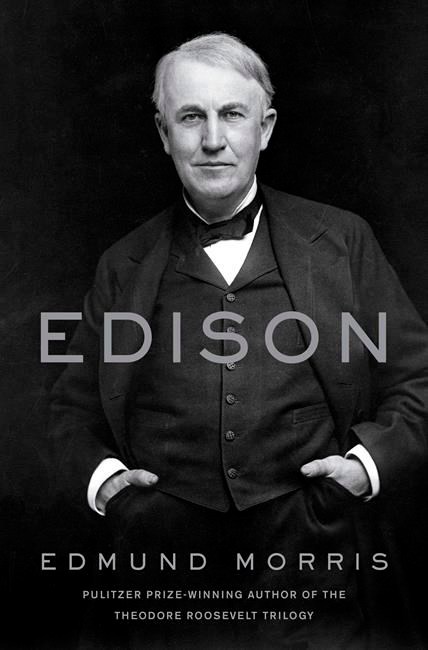
This cover image released by Random House shows "Edison" by Edmund Morris. (Random House via AP)

He did all this on a lifelong diet consisting mainly of plain milk and a brutal work regimen of 18 hours a day, often at the expense of his personal life with his two wives and six children. Nearly deaf since age 12, Edison found a blessing in the silence as a way to shut out distractions. And while he relished and promoted his worldwide fame, he never cared for labels like “genius” or “wizard.”

“I never had an idea in my life,” he once told a reporter. “I’ve got no imagination. … My so-called inventions already existed in the environment — I took them out. … The industrious one coaxes it from the environment; the drone lets it lie there while he goes off to the baseball game. The ‘genius’ hangs around his laboratory day and night.”

After this introductory section, Morris’ narrative takes a highly unorthodox turn by describing the inventor’s later years in the opening chapters. He then proceeds backward, decade by decade, culminating with Edison’s younger years when many of his most familiar and consequential inventions in electricity and sound replication occurred.

Morris’ willingness to breach the organizational norms of biography may not surprise readers familiar with his even bolder previous work, “Dutch: A Memoir of Ronald Reagan,” in which Morris included himself as a made-up Zelig-like character who “knew” the former president back to his youthful days. He claimed this device gave him a way to share insights he had gained about the hard-to-penetrate former president. But the resulting blend of fact and fiction in such a high- profile biography caused a ruckus among many critics and historians.

Morris never directly addresses why he presents Edison’s life in reverse chronological order. But he drops a possible clue in his endnotes by asserting that previous Edison biographies offered only scant details about his later life. Whatever the reason, Morris’ decision to begin his book with lesser known details about the aging Edison’s inventions and exploits makes for a rousing start. Edison tried during the 1920s to help free America from its dependency on foreign rubber in the early auto age by trying to identify plants capable of producing enough commercially viable rubber that would thrive in American soil (he never did). We also learn about Edison’s many inventions in support of the Allied cause during World War I despite his personal pacificism.

There were episodes, miscalculations and loose-tongued pronouncements, especially late in life, that further humanize Edison’s story. He made a losing bet (at least at the time) on battery-operated cars versus the internal combustion engine as the automobile age dawned. He caused international shock waves by questioning the existence of God or an afterlife. The ultimate empiricist, Edison didn’t hide his contempt for academic scientists whom he considered impractical — “the bungleheaded fraternity,” as he called them.

Morris’ genre-bending biography of Edison is a briskly written, fact-packed work that, like its subject, is also highly illuminating.


Report Error Submit a Tip

More Stories

Siloam Mission, WFPS discussing on-site paramedic to reduce staggering number of emergency calls

Scott Billeck 4 minute read Preview

Siloam Mission, WFPS discussing on-site paramedic to reduce staggering number of emergency calls

Scott Billeck 4 minute read Yesterday at 2:00 AM CDT

Winnipeg’s fire-paramedic service and its largest homeless-serving organization are discussing what it would look like to station at least one paramedic at Siloam Mission, as emergency calls to the downtown facility surge.

The ongoing discussions come as Winnipeg Fire Paramedic Service crews were dispatched 1,771 times during the first eight months of the year to the two adjacent Siloam properties at 303 Stanley St. and 300 Princess St.

WFPS said most of the calls were related to overdoses or other consequences of substance use, with the total nearly double the 854 calls recorded over the same period last year. By comparison, there were 831 calls during the same span in 2024, and 591 in 2023.

“The number of emergency calls isn’t sustainable for us as a service, but it’s certainly not sustainable for them as an agency trying to provide services,” WFPS chief Ryan Sneath told the Free Press. “And they recognize that they’re impacting emergency services, not them specifically, but the site in a significant way.”

Read
Yesterday at 2:00 AM CDT

Family account spiced with magic realism, geopolitical intrigue and a ghost story

Reviewed by Zilla Jones 4 minute read Preview

Family account spiced with magic realism, geopolitical intrigue and a ghost story

Reviewed by Zilla Jones 4 minute read 2:01 AM CDT

Tom Lin’s second novel Babylon, South Dakota moves beyond a historical account of an immigrant family’s struggle, delightfully blending and bending genres.

Lin is a Chinese-born novelist whose family emigrated to the U.S. when he was four years old. His debut novel, The Thousand Crimes of Ming Tsu, won the 2022 Andrew Carnegie Medal for Excellence in Fiction, making him the youngest ever recipient of that award. He earned a PhD in English from the University of California Davis and is currently an assistant professor of English and creative writing at the University of Iowa.

Babylon, South Dakota takes place in an unspecified time period that can be understood to be during the Mao era — likely the 1950s or ’60s. A young Chinese couple, the Hsuis, immigrate to the rural community that gives the book its title. They take the names Saul and Mei and settle on a 160-acre homestead left to them by a distant relative.

Saul’s dream is to breed and sell chrysanthemums from seeds he brought from China, while Mei wants to raise livestock. They speak no English, know nothing of life in the United States, are unprepared for the harshness of winter and the isolation of the farm and bring nothing with them except some gold, which Mei hides around the house for emergencies. Their only link to the outside world is a discarded and marginally functioning TV set, which Saul rescues and rigs up.

Read
2:01 AM CDT

Gillingham in lead with decided voters

Nicole Buffie 6 minute read Preview

Gillingham in lead with decided voters

Nicole Buffie 6 minute read Yesterday at 6:55 PM CDT

A cloud of uncertainty is hanging over Winnipeg as October’s municipal election nears.

Three months after a poll showed more than 40 per cent of Winnipeggers wanted to see someone other than current mayor Scott Gillingham elected, a new Abacus Data poll indicates more than half of Winnipeg voters are undecided heading into next month’s civic election.

Of decided voters, 55 per cent favour Gillingham compared to 23 per cent for former councillor and provincial cabinet minister Kevin Klein and 11 per cent for funeral director Mike Vogiatzakis.

Of all respondents, just over 50 per cent said they were unsure while 13 per cent said they will not vote.

Read
Yesterday at 6:55 PM CDT

Hellebuyck standoff caused by… Nathan MacKinnon?

Mike McIntyre 6 minute read Preview

Hellebuyck standoff caused by… Nathan MacKinnon?

Mike McIntyre 6 minute read Yesterday at 6:34 PM CDT

Looking for someone to blame in the Connor Hellebuyck fiasco and cast as public enemy No. 1? How about long-time Winnipeg Jets nemesis Nathan MacKinnon?

Allow us to explain as we fire up the time machine and head back to February in Italy.

Oh, what could have been if MacKinnon had been able to score on what appeared to be an open net late in the third period of the men’s gold medal game with Hellebuyck down and seemingly out of position.

Instead, the star forward fired wide, keeping the score deadlocked at 1-1 as the clock ticked down on regulation.

Read
Yesterday at 6:34 PM CDT

Give-and-take relationship of Roman leaders takes centre stage in Harris’s historical fiction

Reviewed by Kathryne Cardwell 4 minute read Preview

Give-and-take relationship of Roman leaders takes centre stage in Harris’s historical fiction

Reviewed by Kathryne Cardwell 4 minute read 2:01 AM CDT

British novelist Robert Harris’s latest work is a reflection on tyranny, corruption and betrayal among all-powerful political leaders.

You might be forgiven for thinking it’s a contemporary thriller — it’s actually historical fiction set in ancient Rome.

A former BBC journalist, Harris debuted as a novelist in 1992 with Fatherland, an alternative history where Nazi Germany won the Second World War.

Since then, the prolific author has become best-known for his works of historical fiction, especially his ancient Rome trilogy released from 2006-2015 and the novel Conclave, which was published in 2016 and was made into the film of the same name in 2024.

Read
2:01 AM CDT

Letters, Sept. 19

8 minute read 2:01 AM CDT

Addicted to gambling

Re: Sweeney’s sexist U.S. gambling site ad not the real problem, Sept 17

Dan Lett’s analysis of the issue was very good. Something I would like to elaborate about the Canadian context is that provincial governments are not just betting on sports gaming to be big money, they’re actively encouraging problem gambling.

Take the Alberta-based ad in which a gambler is encouraged to spend their time gambling on their phone whenever there’s a break in the action at a baseball game. Every half-inning, every pitching change, should be spent gambling rather than being in the moment. The Ontario ads aren’t much better, just more subtle in how they normalize problematic gambling behaviour.