New federal climate think tank looking for a road map to zero emissions

Advertisement

Advertise with us

OTTAWA - A new climate change think tank funded by the federal government says Canadians should expect to face the harsh realities of a changing climate even under the most aggressive global efforts to cut greenhouse gas emissions.

Read this article for free:


or

Already have an account? Log in here »

To continue reading, please subscribe:

Subscribe and receive a limited-edition Free Press branded hat or tote.

Digital Subscription

One year of digital access for only $205*

  • Enjoy unlimited reading on winnipegfreepress.com
  • Read the E-Edition, our digital replica newspaper
  • Access News Break, our award-winning app
  • Play interactive puzzles

*First annual payment billed as $205.00 + GST for one year. This annual subscription will automatically renew at $233.00 + GST every 52 weeks (10% off the regular annual price of $259.35). Offer available to new and qualified returning subscribers only. Cancel any time.

To continue reading, please subscribe:

Add Free Press access to your Brandon Sun subscription for only an additional

$1 for the first 4 weeks*

  • Enjoy unlimited reading on winnipegfreepress.com
  • Read the E-Edition, our digital replica newspaper
  • Access News Break, our award-winning app
  • Play interactive puzzles
Start now

*Your next Brandon Sun subscription payment will increase by $1.00 and you will be charged $17.95 plus GST for four weeks. After four weeks, your payment will increase to $24.95 plus GST every four weeks.

Hey there, time traveller!
This article was published 21/01/2020 (2400 days ago), so information in it may no longer be current.

OTTAWA – A new climate change think tank funded by the federal government says Canadians should expect to face the harsh realities of a changing climate even under the most aggressive global efforts to cut greenhouse gas emissions.

The $20-million Canadian Institute for Climate Choices officially launches Tuesday with an inaugural report warning Canada will not be able to avoid the global economic shifts that adapting to climate change will bring.

It also says change is coming whether the world shifts quickly to low and zero-emitting energy sources, or continues as it is and then also has to face the social, economic and environmental disruptions that ensue.

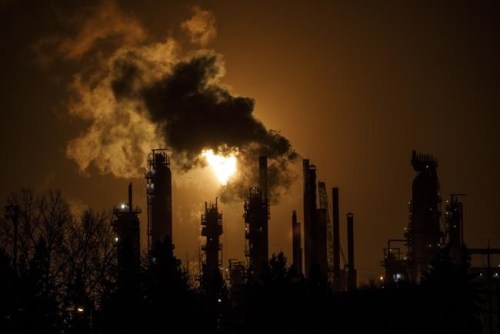
A flare stack lights the sky from the Imperial Oil refinery in Edmonton on December 28, 2018. A new climate change think tank funded by the federal government says Canadians should expect to face the harsh realities of a changing climate even under the most aggressive global efforts to curb fossil fuel use and cut greenhouse gas emissions. THE CANADIAN PRESS/Jason Franson

“I think there is no question that the game is changing,” said CEO Kathy Bardswick. “The realities of Canada’s position in the world, and how we’re going to ensure our prosperity going forward, is changing. How we provide value as a country is changing.”

The institute will be at arm’s length from the government but fulfils a 2018 federal budget commitment to hire outside experts to assess the government’s climate policies and provide advice on new options.

The institute has mainly a virtual existence, with staff and experts spread across the country conferring with each other mostly through various online platforms. The board has met in person twice thus far, and there was an opening summit in November where members met in regional groups.

The institute will produce at least three major reports a year across the three main areas of climate action: adapting to a lower-carbon reality, mitigating against the effects of a changing climate and developing and producing the clean technology needed for both of those things.

More than four dozen experts are on board to provide input, including former oil executive Dave Collyer, economist Don Drummond, and World Resources Institute climate resilience director Christina Chan, along with a whose who of Canadian climate scientists and economic experts.

Bardswick said everyone at the institute is aware of the anxieties and divisions that climate policies can create. She said the hope is that if the institute can help develop a clear road map for Canada’s role, it could help calm everyone down.

The report says Canada has to prepare for the impacts that climate change will have on weather systems even if global emissions reduce rapidly, because those changes are already underway.

It also says if the world is going to meet the emissions cuts suggested in the commitment Canada made at the Paris meeting in 2015, it will “trigger an economic transformation on a scale not seen since the first and second industrial revolutions.”

If the first industrial revolution brought about machine factories, steam and water power and iron production, and the second brought about petroleum and the common use of electricity, the climate revolution will mostly electrify almost everything the world uses.

It won’t happen overnight. The report points out that even under some of the most aggressive decarbonization attempts, fossil fuels are expected to play some role for many decades.

But Bardswick said the signs from investors, even in the last few weeks, suggest the changes could start to come quite quickly.

BlackRock, the world’s largest money manager, said Jan. 14 it plans to make climate risk a key part of its investment strategies, including divesting of investments in thermal coal production.

Three days later tech giant Microsoft announced plans to switch all its buildings and data centres to renewable energy by 2025. It also wants to be taking more emissions out of the atmosphere than it is putting into it by 2030.

The report says Canada can either jump on board in the early stages, or risk massive job losses and economic pain when other countries pour money and time into the technology and manufacturing systems of the future.

This report by The Canadian Press was first published Jan. 21, 2020.

Report Error Submit a Tip

More Stories

Manitoba family finalist for cattle producers environmental award

Aaron Epp 4 minute read Preview

Manitoba family finalist for cattle producers environmental award

Aaron Epp 4 minute read Saturday, Aug. 15, 2026

A family in western Manitoba is one of seven finalists for a national environmental award honouring beef cattle producers.

Connor and Kyla English, alongside Connor’s parents, Brian and Leanne English, are nominated for the Canadian Cattle Association’s Environmental Stewardship Award. The 30-year-old award is presented to beef farmers and ranchers who explore innovative ways to protect, preserve and enhance their operations and the environment simultaneously.

This year’s recipient will be announced on Wednesday during a banquet at the Canadian Beef Industry Conference in Winnipeg.

The English family’s roots near Bradwardine — about 265 kilometres west of Winnipeg — date back to 1898. Today, Connor, Kyla, Brian and Leanne manage a herd of about 320 breeding cows on nearly 445 hectares (1,100 acres) of owned and rented pasture and forage land.

Read
Saturday, Aug. 15, 2026

HSC weapons scanners effective, needed at other hospitals: nurses union

Carol Sanders 5 minute read Preview

HSC weapons scanners effective, needed at other hospitals: nurses union

Carol Sanders 5 minute read Saturday, Aug. 15, 2026

The AI weapons scanners at Health Sciences Centre have detected close to 2,000 items since they were installed at Manitoba’s largest hospital.

Read
Saturday, Aug. 15, 2026

Could renewed interest in strategically critical rare earth elements finally make sub-sector profitable?

Joel Schlesinger 6 minute read Preview

Could renewed interest in strategically critical rare earth elements finally make sub-sector profitable?

Joel Schlesinger 6 minute read Saturday, Aug. 15, 2026

Rare earth elements are among the most critical of mined resources for modern economies.

They’re essential in manufacturing specialized magnets used in a host of technologies from wind turbines and electric vehicles to hard drives, smartphones, television screens, and fibre optics. Most notably, however, rare earth minerals are increasingly vital to the defence industry.

These 17 elements — closely related chemically and usually found all together in mineral deposits — have indeed been growing in geopolitical importance as the United States, Canada and other Western nations recognize their dependence on production from China.

It is the world’s largest producer and processor of rare earths, including the most in-demand elements neodymium and praseodymium used to manufacture very light and powerful magnets for an array of technologies, including the most advanced weapons of modern warfare.

Read
Saturday, Aug. 15, 2026

Trustees call for e-scooter safety education

Maggie Macintosh 4 minute read Preview

Trustees call for e-scooter safety education

Maggie Macintosh 4 minute read 6:00 AM CDT

School trustees are calling on the province to bolster public education around e-bike and e-scooter safety ahead of back-to-school season.

The Manitoba School Boards Association brought members’ concerns about a growing number of students using electronic devices to get to and from classes to the education minister’s office this month.

“There’s a concerning lack of safety knowledge on the part of Manitoba youth,” executive director Alan Campbell said.

Campbell, a long-time trustee in the Interlake School Division, resigned from elected office this summer to run the association that mobilizes school boards and provides them with labour relations support.

Read
6:00 AM CDT

New federal climate institute launches today

Mia Rabson, The Canadian Press 4 minute read Preview

New federal climate institute launches today

Mia Rabson, The Canadian Press 4 minute read Tuesday, Jan. 21, 2020

OTTAWA - A new climate change think tank funded by the federal government says Canadians should expect to face the harsh realities of a changing climate even under the most aggressive global efforts to cut greenhouse gas emissions.

The $20-million Canadian Institute for Climate Choices officially launches Tuesday with an inaugural report warning Canada will not be able to avoid the global economic shifts that adapting to climate change will bring.

It also says change is coming whether the world shifts quickly to low and zero-emitting energy sources, or continues as it is and then also has to face the social, economic and environmental disruptions that ensue.

"I think there is no question that the game is changing," said CEO Kathy Bardswick. "The realities of Canada's position in the world, and how we're going to ensure our prosperity going forward, is changing. How we provide value as a country is changing."

Read
Tuesday, Jan. 21, 2020

Hayden Panettiere, who starred in ‘Heroes’ and ‘Nashville,’ dies at 36

Hannah Schoenbaum, The Associated Press 6 minute read Preview

Hayden Panettiere, who starred in ‘Heroes’ and ‘Nashville,’ dies at 36

Hannah Schoenbaum, The Associated Press 6 minute read Updated: 12:26 PM CDT

Hayden Panettiere, a onetime child star who soared to fame in the TV shows “Heroes” and “Nashville” while enduring struggles with alcohol addiction and depression, has died. She was 36.

Police said Panettiere was found unresponsive in an apartment in Greenville, South Carolina, shortly before 2 p.m. Sunday. Lifesaving measures were performed but she was pronounced dead at the scene.

No cause of death has been determined and Panettiere's death remains under investigation. An autopsy found no signs of trauma and police said officers saw no signs of foul play.

The television and film performer, who would have turned 37 on Friday, had been open about her private battles and wrote at length about them in the memoir, “This Is Me,” which came out in May. She described lifelong scars from her early fame, and acknowledged being addicted to alcohol and enduring postpartum depression after the birth of her daughter, Kaya, with Ukrainian boxer Wladimir Klitschko in 2014.

Read
Updated: 12:26 PM CDT