Canadian troops in Latvia stay on target as COVID-19 upends other missions

Advertisement

Advertise with us

OTTAWA - On a recent day in Latvia, a group of Canadian soldiers left a military base near the capital city of Riga. The column drove about 30 kilometres where they set up and, at one point over the next couple of days, fought back a simulated attack before packing up and returning home.

Read this article for free:


or

Already have an account? Log in here »

To continue reading, please subscribe:

Subscribe and receive a limited-edition Free Press branded hat or tote.

Digital Subscription

One year of digital access for only $205*

  • Enjoy unlimited reading on winnipegfreepress.com
  • Read the E-Edition, our digital replica newspaper
  • Access News Break, our award-winning app
  • Play interactive puzzles

*First annual payment billed as $205.00 + GST for one year. This annual subscription will automatically renew at $233.00 + GST every 52 weeks (10% off the regular annual price of $259.35). Offer available to new and qualified returning subscribers only. Cancel any time.

To continue reading, please subscribe:

Add Free Press access to your Brandon Sun subscription for only an additional

$1 for the first 4 weeks*

  • Enjoy unlimited reading on winnipegfreepress.com
  • Read the E-Edition, our digital replica newspaper
  • Access News Break, our award-winning app
  • Play interactive puzzles
Start now

*Your next Brandon Sun subscription payment will increase by $1.00 and you will be charged $17.95 plus GST for four weeks. After four weeks, your payment will increase to $24.95 plus GST every four weeks.

Hey there, time traveller!
This article was published 21/05/2020 (2312 days ago), so information in it may no longer be current.

OTTAWA – On a recent day in Latvia, a group of Canadian soldiers left a military base near the capital city of Riga. The column drove about 30 kilometres where they set up and, at one point over the next couple of days, fought back a simulated attack before packing up and returning home.

While a staple of Canadian military training in normal times, this particular exercise was unusual in that most other activities by the Canadian Armed Forces at home and abroad have been suspended or scaled way back in recent months because of COVID-19.

In fact, everything about Canada’s three-year-old mission in Latvia is unusual these days, in part because little has actually changed.
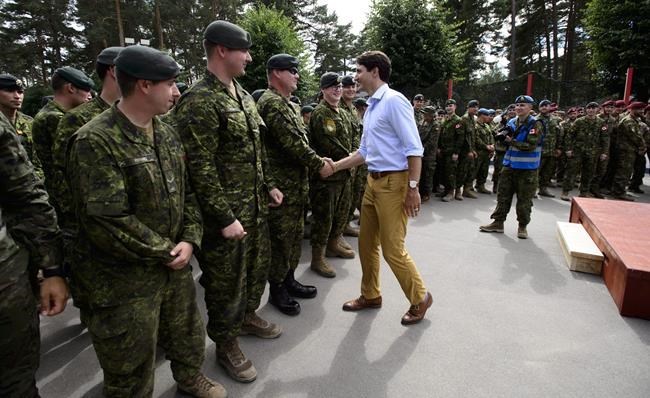
Prime Minister Justin Trudeau shakes hands with Canadian troops after delivering a speech at the Adazi Military Base in Kadaga, Latvia, on July 10, 2018. On a recent day in Latvia, a group of Canadian soldiers left a military base near the capital city of Riga. The column drove about 30 kilometres where they set up and, at one point over the next couple of days, fought back a simulated attack before packing up and returning home. While a staple of Canadian military training in normal times, this particular exercise was unusual in that most other activities by the Canadian Armed Forces at home and abroad have been suspended or scaled way back in recent months because of COVID-19. In fact, everything about Canada's three-year-old mission in Latvia is unusual these days, in part because little has actually changed. THE CANADIAN PRESS/Sean Kilpatrick

Those on the front lines say that is a reflection of how the purpose of the mission — defending eastern Europe from Russian aggression — remains arguably more relevant than ever due to fears Moscow might try to take advantage of the pandemic to advance its own agenda.

“It is very important to keep that presence because we have not seen any scaling back of Russian forces,” Latvian Foreign Minister Edgars Rinkevics said in an interview with The Canadian Press.

“There is still an ongoing situation. Yes, it is probably not as tense as it used to be. … But at the same time we are in a situation where we shouldn’t relax and we shouldn’t get complacent. That is something that the alliance understands and our Canadian friends understand.”

Canada has 540 troops in Latvia, where they form the core of a 1,500-strong multinational battlegroup established by the NATO military alliance three years ago. Similar battlegroups led by Britain, Germany and the U.S. have been established in Estonia, Lithuania and Poland, respectively.

The battlegroups were created after Russia annexed Crimea from Ukraine in 2014 and began to support separatist forces in Ukraine’s eastern regions. That sparked concerns the Kremlin could launch similar efforts against the Baltics and other parts of eastern Europe.

The battlegroups are designed to defend against a Russian invasion, but their small size means they would almost certainly be overwhelmed in a real war. Instead, their main utility is to deter against Russian aggression, with the idea that an attack on one would draw in all of NATO.

The COVID-19 pandemic has forced the Canadian Armed Forces to suspend or scale back its operations around the world, including in Ukraine and Iraq where the military has been training local forces. Thousands of military personnel have been told to stay home in Canada.

At the same time, Canadian military commanders warned early in the pandemic that potential adversaries might try to take advantage of COVID-19 by striking while governments around the world are distracted by the pandemic.

The Canadian-led battlegroup in Latvia has been forced to adjust some of its practices because of COVID-19 as well. Those include more physical distancing, handwashing and having 60 soldiers go through their base, Camp Adazi, disinfecting surfaces every two hours.

Large gatherings such as military parades have also been suspended, while training exercises that once saw Canadian troops and other members of the NATO battlegroup interact with the local population now steer clear of the public.

“But we are getting out,” said Col. Eric Laforest, the commander of Task Force Latvia, which includes troops from eight other NATO nations. “Training keeps on going as you would suspect with the full battlegroup of nine nations and the training just goes as planned.

Commanders have also decided to go ahead with plans to replace the Canadian troops currently in Latvia with a new contingent in mid-July. Unlike in Ukraine, where a small force is holding the fort until COVID-19 ends, there are no plans to scale back the Latvia mission.

“It was clear from my point of view as a commander here that we couldn’t change our format,” Laforest said in an interview.

“We put proposals back to Ottawa about what a modified mission could look like, but those were dismissed very rapidly. Everyone realized this mission is different and we are here for the long run and we can actually sustain the operation despite this COVID-constrained environment.”

That decision has been welcomed by the Latvian government, which is worried about the message a reduction would send to Russia.

“It is very important that there is no change to the size of the Canadian-led battlegroup because that would create the impression our alliance is changing its policy,” Rinkevics said. “That could leave the impression that (Russia) can try to test our borders one more time.”

Canada has committed to leading the battlegroup in Latvia until at least March 2023.

NATO and European officials have accused Russia of testing the military alliance’s readiness during COVID-19, particularly during the early days of the pandemic when the country had only a small number of positive cases.

British warships shadowed seven Russian vessels as they transitted the English Channel and North Sea in March. NATO intercepted several Russian military aircraft as they approached allied airspace. There have also been reports of an uptick in Russian misinformation.

Yet Russia has since been hit hard by COVID-19, with more than 300,000 positive cases. That represents the second highest number of cases in one country after the United States. Nearly 3,000 people in Russia have died from the respiratory illness.

Rinkevics nonetheless emphasized the importance of maintaining the battlegroup, particularly as Russia has continued to conduct exercises on its side of the border with Latvia despite COVID-19.

“It is very important to keep that presence because we have not seen any scaling back of Russian forces,” he said. “We are not out of the woods at all.”

This report by The Canadian Press was first published May 21, 2020.

Note to readers: This is a corrected story. A previous version described Col. Eric Laforest as the commander of the battle group in Latvia.


Report Error Submit a Tip

More Stories

United Way, other charities fight for dollars as donor base shrinks

Scott Billeck 7 minute read Preview

United Way, other charities fight for dollars as donor base shrinks

Scott Billeck 7 minute read Yesterday at 2:00 AM CDT

Winnipeg’s charitable sector is being squeezed from both sides: demand for help is growing while the pool of donors to meet that need is shrinking.

The imbalance is increasingly being carried by a relatively small group of deep-pocketed donors. Last year, 600 people — about three per cent of United Way Winnipeg’s individual donors — accounted for roughly $8 million, or 55 per cent of individual donations.

The fundraising pitch isn’t getting any easier.

Homelessness and public drug use have become increasingly visible, household budgets remain strained and the problems charities are trying to address can seem so entrenched that donors may reasonably wonder what difference another contribution can make.

Read
Yesterday at 2:00 AM CDT

Give-and-take relationship of Roman leaders takes centre stage in Harris’s historical fiction

Reviewed by Kathryne Cardwell 4 minute read Preview

Give-and-take relationship of Roman leaders takes centre stage in Harris’s historical fiction

Reviewed by Kathryne Cardwell 4 minute read 2:01 AM CDT

British novelist Robert Harris’s latest work is a reflection on tyranny, corruption and betrayal among all-powerful political leaders.

You might be forgiven for thinking it’s a contemporary thriller — it’s actually historical fiction set in ancient Rome.

A former BBC journalist, Harris debuted as a novelist in 1992 with Fatherland, an alternative history where Nazi Germany won the Second World War.

Since then, the prolific author has become best-known for his works of historical fiction, especially his ancient Rome trilogy released from 2006-2015 and the novel Conclave, which was published in 2016 and was made into the film of the same name in 2024.

Read
2:01 AM CDT

Cabernet Sauvignon star of wine festival

Ben Sigurdson 5 minute read Preview

Cabernet Sauvignon star of wine festival

Ben Sigurdson 5 minute read 3:00 AM CDT

The Winnipeg Wine Festival will celebrate the king of red wine grapes next weekend — the theme of this year’s festival, which takes place Sept. 25 and 26 at the RBC Convention Centre, is Cabernet Sauvignon.

Cab Sauv, as it’s also known, is the world’s most widely planted wine grape of any colour, first coming to prominence in the 1800s in France’s Bordeaux region, where the grape is still popular. Rather than single-variety wines, Bordeaux reds tend to be blends, with those coming from the left bank of the Gironde estuary being Cabernet-dominant, while right-bank wines are Merlot-dominant, with Cabernet Sauvignon playing a supporting role. Cabernet and Merlot work well together and many other countries have followed suit in blending the two.

A team at University of California Davis put Cabernet Sauvignon through a DNA test in 1996 and discovered its parent grapes are Cabernet Franc and Sauvignon Blanc — it’s likely that at some point the two varieties, planted next to each other in some vineyard, crossed and mutated and became the grape we know today. (Someone growing grapes in the 19th century must have had an inkling of what was up, as the grape has been called Cabernet Sauvignon since long before the DNA test.)

Flavour-wise, most Cabernet Sauvignon wines are big and bold, with a core of deep dark berry flavours, some graphite and spice notes and relatively bright acidity. It’s a grape that is well-suited to barrel aging, with most examples seeing at least some time in wood.

Read
3:00 AM CDT

Manitoba abandoning spring, fall clock changes

Carol Sanders 8 minute read Preview

Manitoba abandoning spring, fall clock changes

Carol Sanders 8 minute read Updated: Yesterday at 8:48 AM CDT

Time’s up for the time change in Manitoba.

Manitobans won’t be setting their clocks back an hour in November. The province has decided to permanently stay on daylight time after surveying residents on the twice annual clock adjustment.

“We heard from Manitobans loud and clear — no more changing the clocks in Manitoba,” Premier Wab Kinew said in a news release Thursday.

Most of the 72,000 votes submitted in an online EngageMB survey — 92 per cent — said they would like to see the practice end. The survey asked if they preferred earlier sunrises in winter with standard time or the later sunsets in summer with daylight time. More than half of survey participants (58 per cent) indicated a preference to stay on permanent daylight time; 34 per cent voted to eliminate the time change but stay on standard time.

Read
Updated: Yesterday at 8:48 AM CDT

Jets GM insists club’s not working under any deadline in netminder’s trade request

Mike McIntyre 7 minute read Preview

Jets GM insists club’s not working under any deadline in netminder’s trade request

Mike McIntyre 7 minute read Thursday, Sep. 17, 2026

Connor Hellebuyck and his family were subject to so much post-Olympic vitriol that both the Winnipeg Jets security team and even police had to get involved.

Read
Thursday, Sep. 17, 2026

‘She was looking to destroy me’: convicted harasser faces new charges

Dean Pritchard 6 minute read Preview

‘She was looking to destroy me’: convicted harasser faces new charges

Dean Pritchard 6 minute read Thursday, Sep. 17, 2026

When Agnieszka Ciochon-Newton moved into the 55-plus apartment building on Stradbrook Avenue last year, she came across as “timid, soft-spoken and sensitive,” said building manager Tanya Owen.

Little did Owen know the meek-looking 58-year-old woman would soon turn her life and the lives of many of her tenants upside down and threaten her career and family.

“She was looking to destroy me for a simple tenant disagreement,” Owen said Thursday.

Court records show Ciochon-Newton was arrested earlier this month and charged with seven counts of criminal harassment, two counts of uttering threats and one count each of fraud, breaking and entering, attempting to obstruct justice, intimidation of a justice official, mischief and defamatory libel.

Read
Thursday, Sep. 17, 2026