Hope for brighter days For Winnipeg's Inuit community Qaumajuq is much more than an art gallery; it's a connection to home and history — and the city where they've chosen to live
Read this article for free:
or
Already have an account? Log in here »
To continue reading, please subscribe:
Digital Subscription
One year of digital access for only $1.44 a week*
- Enjoy unlimited reading on winnipegfreepress.com
- Read the E-Edition, our digital replica newspaper
- Access News Break, our award-winning app
- Play interactive puzzles
*Billed as $5.77 plus GST every four weeks. After 52 weeks, price increases to the regular rate of $19.95 plus GST every four weeks. Offer available to new and qualified returning subscribers only. Cancel any time.
To continue reading, please subscribe:
Add Free Press access to your Brandon Sun subscription for only an additional
$1 for the first 4 weeks*
- Enjoy unlimited reading on winnipegfreepress.com
- Read the E-Edition, our digital replica newspaper
- Access News Break, our award-winning app
- Play interactive puzzles
*Your next Brandon Sun subscription payment will increase by $1.00 and you will be charged $17.95 plus GST for four weeks. After four weeks, your payment will increase to $24.95 plus GST every four weeks.
Read unlimited articles for free today:
or
Already have an account? Log in here »
Hey there, time traveller!
This article was published 19/03/2021 (2045 days ago), so information in it may no longer be current.
For many Inuit who call Manitoba home, the new Qaumajuq centre at the Winnipeg Art Gallery is more than a tourist attraction; it’s a reclamation of their place in the world and a beacon of hope for the future of reconciliation.
Qaumajuq means “it is bright, it is lit” in Inuktitut and for Janet Kanayok that’s exactly what the gallery represents — a bright, welcoming spot in an otherwise dismal time following her relocation to Winnipeg.
“I feel like we’ve kind of been ripped off,” she says.

Kanayok moved to Winnipeg from Ulukhaktok, a small coastal hamlet in the Inuvialuit region of the Northwest Territories, with three of her four children in the summer of 2019 seeking better access to health care.
She missed her tight-knit extended family immediately, but took solace in the affordability and convenience of living in a large urban centre.
“Finding that things are so readily available and accessible was kind of mind blowing,” she says. “If my kids need an appointment we just go to the hospital or to the clinic, we don’t get flown out.”

Today, convenience is tinged with disappointment. The coronavirus pandemic has made it difficult to find community in Winnipeg and Kanayok has experienced racism for the first time in her life.
“Not only me, but my kids (too). Where I’m from it’s a pretty Inuk-dominated community, so we were never treated differently because of our skin colour,” she says.
Racist encounters while shopping or walking down the street have made her feel “very unwelcome, and kind of disgusted that people are like that.”
In low moments, Kanayok wonders why she’s stayed. The move has been especially difficult for her youngest daughter, 10, who has been homesick since the family arrived.
Kanayok sees Qaumajuq as the morale boost they so badly need. On Monday, she’s taking the kids out of school and onto a bus for the first time so they can experience the gallery together during the WAG’s Inuit, First Nations and Métis preview event.
“Through our artwork, people will be able to hear us and they’ll see us and know that we’re here.” -Janet Kanayok
“Bringing (my daughter) here, I’m hoping it’ll give her a sense of peace and a little bit of contentment,” she says, pausing to collect her emotions. “And let her know that she’s surrounded by work that our own people did… that this is something so huge that she should be proud to be Inuk; and that Winnipeg is also very proud of Inuit art, that’s why they have this whole place for them.”
She also hopes the gallery will give other Winnipeggers a better understanding of her people.
“Inuit are traditionally really quiet and really humble people, we don’t like to brag or boast about stuff,” Kanayok says. “So I think that through our artwork, people will be able to hear us and they’ll see us and know that we’re here.”
There are more than 1,300 Inuit living in Winnipeg and rural Manitoba, according to a recent study led by the University of Manitoba.
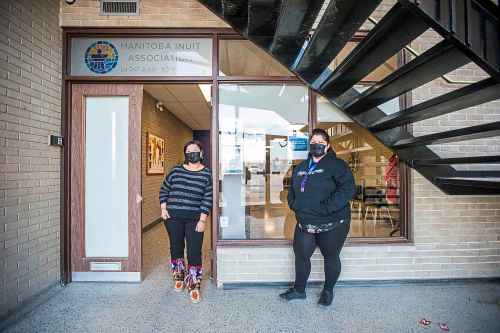
The number of people leaving Inuit Nunangat — an Inuktitut term for the Inuit homeland made up of four regions, Inuvialuit, Nunavut, Nunavik and Nunatsiavut, which stretch from the northern tip of the Yukon to Newfoundland and Labrador — has grown exponentially over the last decade, says Rachel Dutton, executive director of the Manitoba Inuit Association, where Kanayok is employed as a family support worker.

“We’ve nationally got nearly 40 per cent of Inuit living in urban centres,” Dutton says. “That continues to grow as the needs continue to hit crisis levels in all of Inuit Nunangat in terms of food insecurity, overcrowded housing, very low employment rates… (and) inadequate health care.”
Relocation can be a choice, but other times is necessitated by circumstance. Inuit from central Nunavut make roughly 16,000 trips to Winnipeg annually to access health services, where they stay in a boarding home or hotel.
Those with chronic illnesses requiring long-term care, such as dialysis or cancer treatment, may end up moving to the city permanently. Many young people also head south to pursue post-secondary education.
The transition to Winnipeg from a small northern community can be a difficult one, says Nikki Komaksiutiksak, executive director of the Tunngasugit Inuit resource centre.
“There’s a large number of homeless Inuit that we see around Winnipeg,” she says. “Why is that? I mean there’s addictions, there’s mental-health issues and not knowing how to access resources.”

Komaksiutiksak is an Inuit activist and throat singer from Chesterfield Inlet, Nunavut, who has lived in Winnipeg for most of her life. She helped found Tunngasugit in 2017 as a space for Inuit to gather and get help navigating Manitoba’s housing, employment and social assistance programs.
The centre also offers language, sewing and soapstone-carving classes, as well as access to traditional foods; during the pandemic, Tunngasugit and the MIA have been supplying hundreds of local families with emergency hampers fortified with “country food,” such as caribou and arctic char.
Advocacy and public education are core to both organizations. In her role with MIA, Dutton often finds herself giving lessons on Inuit history, geography and politics to government officials. At bare minimum, she hopes the opening of Qaumajuq will make politicians more interested in Manitoba’s Inuit community.
“(It’s) yet to be determined the impacts that does have in the changing of the tide so that everybody who is a decision maker understands who the Inuit are, what their history is,” Dutton says. “And how that history continues to impact (them) as a people disproportionately when it comes to health care, housing, education.”

Komaksiutiksak, who will be performing at Qaumajuq’s opening ceremonies, believes the gallery will shine a much-needed light on Winnipeg’s Inuit population, who have long been overlooked and lumped in with other Indigenous groups.
“Pretty much all my life we’ve been silenced. We haven’t been given a voice at any table provincially, federally or municipally,” she says. “It’s going to give a lot of representation to the Inuit way of life, our history, our culture that you only get a one-pager (about) in a textbook in high school.”
Tunngasugit is embarking on a yet-to-be announced education partnership with the WAG. Local Inuit groups also have a standing invitation to hold programming at Qaumajuq, says Julia Lafreniere, the gallery’s head of Indigenous initiatives. “I really want it to be somewhere that they feel comfortable — the most comfortable,” she says.
Jenelle Sammurtok knows first-hand the importance of learning about and practising Inuit culture away from the homeland. Her mother is from Chesterfield Inlet and she was born and raised in Winnipeg. As a kid, Sammurtok and her sister maintained a connection with their Inuit heritage through local drum dancing and throat signing programs. As an adult, she’s learning how to speak Inuktitut.
“It makes me feel like it’s not going to get lost,” she says of the language. “It brings me closer to my culture and it does give me a sense of community.”

Sammurtok is currently co-ordinating the Manitoba Inuit Association’s COVID-19 response program. Pre-pandemic, she did outreach work with local Inuit high school and post-secondary students. She’s looking forward to bringing them to Qaumajuq when the dust settles.
“I’m just really excited for the students to be able to connect at a different place where you can see Inuit art,” she says. “It’s something that we need and it’s something that’s going to heal people. Inuit art is a healing journey for a lot of people… they take their pain and (turn it) into something good.”
”Inuit art is a healing journey for a lot of people… they take their pain and (turn it) into something good.”–Jenelle Sammurtok
Storytelling is Michael Arvaarluk Kusugak’s chosen artform. The Inuk children’s author, known for books like A Promise is a Promise and Baseballs for Christmas, has been correcting harmful stereotypes about Inuit through personal stories for more than 30 years.
“Inuit have been misunderstood for a long time,” he says over the phone from his home north of Gimli. “So many people go up North for a little while and they decide they should write a book about this place… when they write about us, they give us characteristics that are absolutely not true.”

Kusugak was born in Repulse Bay, in what is now Nunavut, and attended residential school in Yellowknife, where he first encountered inaccurate, sensational books about Inuit, like Top of the World by Swiss author Hans Rüesch (which was later adapted to the film The Savage Innocents). His writing career has taken him around the world, but he and his wife decided to settle in Manitoba in 2019 to be closer to family still living in Nunavut.
To Kusugak, Qaumajuq is another way to get the real Inuit stories out into the world; the gallery also feels like a member of the family.
“We found a carving (there) that my father did and I didn’t know my father carved because my father died when I was 25 years old,” he says.
The carving is of a man in a kayak outfitted with a float for seal or whale hunting. The hunter is currently missing a paddle, and Kusugak, although he’s not a carver himself, has considered making one from a piece of musk ox horn in his garage.

Links between the gallery’s art collection and the local community are surprisingly common. Kanayok and Sammurtok both have family members with work in the vault and Kusugak also has several friends with pieces on display.
“It’s absolutely wonderful to see all their works all together,” he says. “My wife remarked one day, ‘You know, it’s like visiting old friends,’ and that’s exactly what it’s like, just like visiting old friends. And a lot of those people have passed away, but they still live on in their art.”
eva.wasney@freepress.mb.ca Twitter: @evawasney

Eva Wasney covers environmental issues in Manitoba for The Narwhal in partnership with the Winnipeg Free Press. Read more about Eva.
Every piece of reporting Eva produces is reviewed by an editing team before it is posted online or published in print — part of the Free Press‘s tradition, since 1872, of producing reliable independent journalism. Read more about Free Press’s history and mandate, and learn how our newsroom operates.
Our newsroom depends on a growing audience of readers to power our journalism. If you are not a paid reader, please consider becoming a subscriber.
Our newsroom depends on its audience of readers to power our journalism. Thank you for your support.