From vaccine sharing to climate, G-7 talks yield agreements

Advertisement

Advertise with us

FALMOUTH, England (AP) — The Group of Seven wealthy democracies have wrapped up their first face-to-face summit in two years at a seaside resort in southwest England. The leaders of the G-7 — Canada, France, Germany, Italy, Japan, the United Kingdom and the United States — made commitments on a range of topics, from sharing coronavirus vaccines to tackling climate change and making corporate taxation fairer.

Read this article for free:


or

Already have an account? Log in here »

To continue reading, please subscribe:

Subscribe and receive a limited-edition Free Press branded hat or tote.

Digital Subscription

One year of digital access for only $205*

  • Enjoy unlimited reading on winnipegfreepress.com
  • Read the E-Edition, our digital replica newspaper
  • Access News Break, our award-winning app
  • Play interactive puzzles

*First annual payment billed as $205.00 + GST for one year. This annual subscription will automatically renew at $233.00 + GST every 52 weeks (10% off the regular annual price of $259.35). Offer available to new and qualified returning subscribers only. Cancel any time.

To continue reading, please subscribe:

Add Free Press access to your Brandon Sun subscription for only an additional

$1 for the first 4 weeks*

  • Enjoy unlimited reading on winnipegfreepress.com
  • Read the E-Edition, our digital replica newspaper
  • Access News Break, our award-winning app
  • Play interactive puzzles
Start now

*Your next Brandon Sun subscription payment will increase by $1.00 and you will be charged $17.95 plus GST for four weeks. After four weeks, your payment will increase to $24.95 plus GST every four weeks.

Hey there, time traveller!
This article was published 13/06/2021 (1924 days ago), so information in it may no longer be current.

FALMOUTH, England (AP) — The Group of Seven wealthy democracies have wrapped up their first face-to-face summit in two years at a seaside resort in southwest England. The leaders of the G-7 — Canada, France, Germany, Italy, Japan, the United Kingdom and the United States — made commitments on a range of topics, from sharing coronavirus vaccines to tackling climate change and making corporate taxation fairer.

Their final agreement from the three-day meeting also included a section on challenging China over “non-economic” economic practices and calling on Beijing to respect human rights.

Here are details on the key topics they covered:
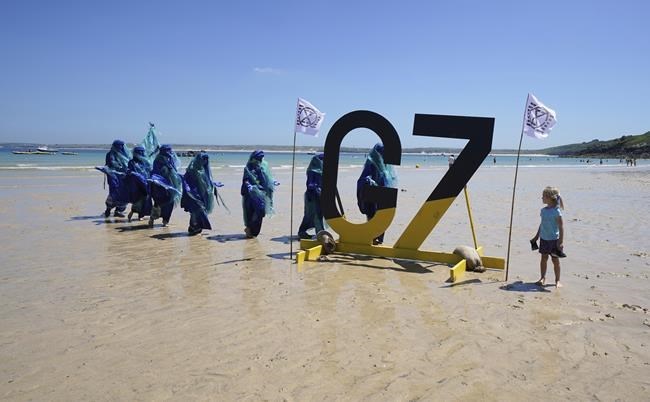
A small girl watches as climate activists demonstrate in costume on a beach outside the G7 meeting in St. Ives, Cornwall, England, Sunday, June 13, 2021. Leaders of the G7 wrap up three days of meetings in Carbis Bay Sunday, in which they discussed such topics as COVID-19, climate, foreign policy and the economy. (AP Photo/Jon Super)

VACCINE SHARING

The presidents and prime ministers committed to sharing at least 1 billion vaccine shots with struggling countries over the next year, with deliveries starting in August. U.S. President Joe Biden pledged 500 million doses. Britain and Canada committed to 100 million shots each, and France said it would pitch in with 60 million doses.

However, the World Health Organization has said that 11 billion doses are needed to truly end the pandemic. Public health advocates also argue that promising vaccine doses isn’t enough, and that money and logistical help are needed to get shots into the arms of people in poorer countries.

THE ENVIRONMENT

Leaders committed to ending new direct government support for “unabated international thermal coal power generation” — the use of coal without technology to reduce carbon emissions – by the end of the year, and backed a $2-billion coal transition fund.

They also pledged to conserve or protect at least 30% of their countries’ land and marine areas by 2030 as part of global biodiversity targets. And they agreed to increase financing for projects to curb climate change until 2025 and reaffirmed their support for a target of producing net-zero carbon emissions no later than 2050.

Leading climate groups said the summit fell far short of delivering meaningful details. They urged rich countries to go beyond reiterating existing obligations and to put concrete new climate financing on the table.

CHINA

The G-7 leaders said they would work together to challenge China’s “non-market policies.” They also agreed to call on Beijing to respect human rights in Xinjiang, the remote western region where Chinese authorities are accused of committing serious rights abuses against the Uyghur minority, and in the semi-autonomous city of Hong Kong.

U.S. President Joe Biden had wanted to persuade fellow democratic leaders to present a more unified front to compete economically with Beijing and to strongly call out China’s “nonmarket policies and human rights abuses.”

The leaders committed to remove forced labor in global supply chains, “including state-sponsored forced labor of vulnerable groups and minorities.” This section of their meeting communique did not mention China by name, but the White House said the language was aimed at the main supply chains of concern in the Xinjiang region.

CORPORATION TAX

G-7 leaders endorsed a global minimum tax of at least 15% on multinational corporations, a measure meant to stop businesses from using tax havens to shift profits and to avoid taxes.

Their agreement backed a plan outlined earlier by G-7 finance ministers. The seven countries hope many more will sign on, but that’s a fraught proposal in nations with economies based on using low corporate taxes to attract businesses.

GLOBAL INFRASTRUCTURE

Leaders agreed to an infrastructure proposal called “Build Back Better for the World” that calls for spending hundreds of billions of dollars in collaboration with the private sector to finance greener infrastructure projects in poorer countries.

It is designed to compete with China’s multi-trillion-dollar “Belt and Road” initiative, which funds a vast network of infrastructure covering large portions of the world, primarily Asia and Africa.

FUTURE PANDEMIC PREPAREDNESS

Leaders said that in the event of a future pandemic, they will seek to ensure the availability of safe and effective vaccines, treatment and diagnostic tests within the first 100 days.

Patrick Vallance, the British government’s chief scientific adviser, said a “100 Day Mission” report gave leaders recommendations for speeding up responses to another pandemic but acknowledged that any such response must be global and include countries that don’t belong to the G-7.

GIRLS’ EDUCATION

The leaders said COVID-19 has exacerbated underlying inequalities and led to an education crisis, especially for girls. They backed a target of getting 40 million more girls in school by 2026 in poorer countries, and committed to a combined $2.75 billion in funding over the next five years for the Global Partnership for Education.

Report Error Submit a Tip

More Stories

Desperate Poilievre wants Canadians to believe the sky is falling when it’s just cloudy outside

Tom Brodbeck 5 minute read Preview

Desperate Poilievre wants Canadians to believe the sky is falling when it’s just cloudy outside

Tom Brodbeck 5 minute read Yesterday at 12:47 PM CDT

Pierre Poilievre has a problem.

Canadians just don’t seem to be paying much attention to him anymore.

So, naturally, the Conservative Opposition leader has decided to turn up the volume.

At a recent party caucus retreat in Penticton, B.C., Poilievre delivered the familiar message: Canada is in trouble, Canadians are hurting and the Liberal government is making everything worse.

Read
Yesterday at 12:47 PM CDT

Give-and-take relationship of Roman leaders takes centre stage in Harris’s historical fiction

Reviewed by Kathryne Cardwell 4 minute read Preview

Give-and-take relationship of Roman leaders takes centre stage in Harris’s historical fiction

Reviewed by Kathryne Cardwell 4 minute read 2:01 AM CDT

British novelist Robert Harris’s latest work is a reflection on tyranny, corruption and betrayal among all-powerful political leaders.

You might be forgiven for thinking it’s a contemporary thriller — it’s actually historical fiction set in ancient Rome.

A former BBC journalist, Harris debuted as a novelist in 1992 with Fatherland, an alternative history where Nazi Germany won the Second World War.

Since then, the prolific author has become best-known for his works of historical fiction, especially his ancient Rome trilogy released from 2006-2015 and the novel Conclave, which was published in 2016 and was made into the film of the same name in 2024.

Read
2:01 AM CDT

Steinbach Credit Union member warns others after scammer steals $10K

Scott Billeck 5 minute read Preview

Steinbach Credit Union member warns others after scammer steals $10K

Scott Billeck 5 minute read Yesterday at 5:19 PM CDT

A Winnipeg single mother whose bank account was drained of nearly $10,000 says Steinbach Credit Union needs to warn its members about what she believes is a broader security problem.

The woman, who is not being named to protect her identity, said a scammer gained access to her account earlier this week after calling SCU’s contact centre, claiming to be her and successfully completing the credit union’s authentication process.

She said she knows of at least six others who have experienced similar incidents in which callers impersonate SCU account holders and pass the authentication checks.

The woman discovered something was wrong when her minor son asked why money had been transferred out of an account they jointly hold.

Read
Yesterday at 5:19 PM CDT

Family account spiced with magic realism, geopolitical intrigue and a ghost story

Reviewed by Zilla Jones 4 minute read Preview

Family account spiced with magic realism, geopolitical intrigue and a ghost story

Reviewed by Zilla Jones 4 minute read 2:01 AM CDT

Tom Lin’s second novel Babylon, South Dakota moves beyond a historical account of an immigrant family’s struggle, delightfully blending and bending genres.

Lin is a Chinese-born novelist whose family emigrated to the U.S. when he was four years old. His debut novel, The Thousand Crimes of Ming Tsu, won the 2022 Andrew Carnegie Medal for Excellence in Fiction, making him the youngest ever recipient of that award. He earned a PhD in English from the University of California Davis and is currently an assistant professor of English and creative writing at the University of Iowa.

Babylon, South Dakota takes place in an unspecified time period that can be understood to be during the Mao era — likely the 1950s or ’60s. A young Chinese couple, the Hsuis, immigrate to the rural community that gives the book its title. They take the names Saul and Mei and settle on a 160-acre homestead left to them by a distant relative.

Saul’s dream is to breed and sell chrysanthemums from seeds he brought from China, while Mei wants to raise livestock. They speak no English, know nothing of life in the United States, are unprepared for the harshness of winter and the isolation of the farm and bring nothing with them except some gold, which Mei hides around the house for emergencies. Their only link to the outside world is a discarded and marginally functioning TV set, which Saul rescues and rigs up.

Read
2:01 AM CDT

Hellebuyck standoff caused by… Nathan MacKinnon?

Mike McIntyre 6 minute read Preview

Hellebuyck standoff caused by… Nathan MacKinnon?

Mike McIntyre 6 minute read Yesterday at 6:34 PM CDT

Looking for someone to blame in the Connor Hellebuyck fiasco and cast as public enemy No. 1? How about long-time Winnipeg Jets nemesis Nathan MacKinnon?

Allow us to explain as we fire up the time machine and head back to February in Italy.

Oh, what could have been if MacKinnon had been able to score on what appeared to be an open net late in the third period of the men’s gold medal game with Hellebuyck down and seemingly out of position.

Instead, the star forward fired wide, keeping the score deadlocked at 1-1 as the clock ticked down on regulation.

Read
Yesterday at 6:34 PM CDT

Canada must not accept another Iranian autocracy

David Matas 5 minute read 2:01 AM CDT

Iran is a state run by a radical government victimizing its citizens and its neighbours. How do we change that? Any regime change that repeats the mistakes of the past is not a solution.

What went wrong in the past which led to the current regime? One answer is the U.K. and American aided coup which led to the ouster in 1953 of a democratically elected government headed at the time by Mohammad Mossadegh and its replacement with an American friendly autocrat, the Shah of Iran, Mohammad Reza Pahlavi.

The Shah imposed his rule through the Iranian National Intelligence and Security Organization — SAVAK, the acronym of its Persian name. SAVAK systematically inflicted torture, arbitrary killings and extra-judicial killings on perceived opponents of the regime. It was only a matter of time before repression of a regime directed to serving foreign interests would be overthrown.

What replaced the regime of the Shah, in 1979, the current regime of the mullahs, is a regime as intolerant and violent as the regime of the Shah and then some. That was not inevitable. But neither was it surprising. The vicious nature of the current regime, following the example set by the Shah, and its hatred for the United States, reacting to the U.S. aided imposition of the Shah, both echoes and reacts to the past. In 1979, the U.S. reaped what it sowed in 1953.