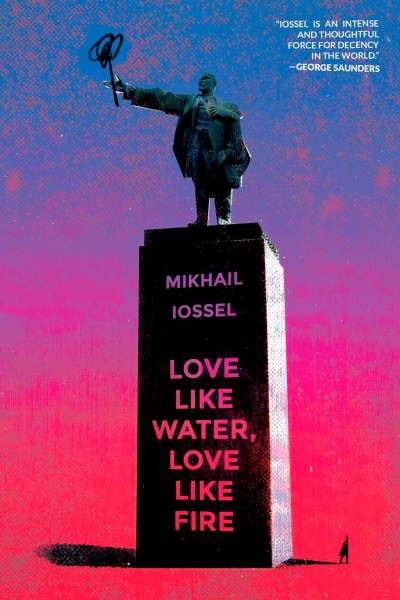
Stories scour author’s Russian upbringing
Advertisement
Read this article for free:
or
Already have an account? Log in here »
To continue reading, please subscribe:

Digital Subscription
One year of digital access for only $205*
- Enjoy unlimited reading on winnipegfreepress.com
- Read the E-Edition, our digital replica newspaper
- Access News Break, our award-winning app
- Play interactive puzzles
*First annual payment billed as $205.00 + GST for one year. This annual subscription will automatically renew at $233.00 + GST every 52 weeks (10% off the regular annual price of $259.35). Offer available to new and qualified returning subscribers only. Cancel any time.
To continue reading, please subscribe:
Add Free Press access to your Brandon Sun subscription for only an additional
$1 for the first 4 weeks*
- Enjoy unlimited reading on winnipegfreepress.com
- Read the E-Edition, our digital replica newspaper
- Access News Break, our award-winning app
- Play interactive puzzles
*Your next Brandon Sun subscription payment will increase by $1.00 and you will be charged $17.95 plus GST for four weeks. After four weeks, your payment will increase to $24.95 plus GST every four weeks.
Read unlimited articles for free today:
or
Already have an account? Log in here »
Hey there, time traveller!
This article was published 10/07/2021 (1900 days ago), so information in it may no longer be current.
This short story collection by Mikhail Iossel, a Jewish, Russian-born, Montreal-based professor at Concordia University, is peppered with many deaths.
These deaths — whether of Soviet leaders Leonid Brezhnev and Yuri Andropov, close family members, or even of the actor Aleksey Batalov in The Cranes Are Flying — mark abrupt transformations in the book. They signal Iossel’s appreciation for, and understanding of, the often-contradictory and brutal reality of 20th-century Soviet life that shaped his identity in childhood, adulthood and right through to his emigration to the United States and residency in Canada.
With humour and compassion, several of the stories in Love Like Water, Love Like Fire narrate Iossel’s early childhood in Leningrad and his transformation from a sensitive and sheltered child of well-educated parents — enamoured with his surroundings, his family, his country and Lenin — to a young man acutely aware of the difficult history of his Communist-Jewish grandparents (living in shtetls and through pogroms and then Stalin’s purges) and the Soviet anti-Semitism he experiences first-hand.

In spite of (and maybe because of) this, Iossel sees the beauty in the absurdities of everyday Soviet life. In one of the stories, A Soviet Twelve Days of Christmas, he meticulously lists what his 120-rubles-a-month salary as an entry-level engineer could afford him in 1979-80.
The intermitted stories gesturing to his early writing satirize, yet they also give the reader clues as to how he ends up becoming fascinated by experimental American writers and matures into a samizdat (underground) writer, aspiring émigré and a “traitor to the motherland” who works as a security guard at Leningrad’s amusement park.
While several stories are longer, with the shorter pieces Iossel experiments with form — some of his stories are lists or interviews, others are almost postcard-length short. In contrast, he uses long, descriptive sentences; a four-page piece titled Sentence is just that — one long sentence.
And so there’s a breathlessness and richness in the prose; one is forced to return and re-read sentences, parse out their various meanings. Inevitably this works to slow the reader down to absorb the complexity of what gestures, ideas and descriptions may be juxtaposed or layered upon each other.
Making this work on the sentencelevel takes confidence and skill, but Iossel also possesses depth of ideas, passions and a sharp eye for detail, so such construction almost never feels forced. Rather, it is a vehicle for Iossel to express complex sentiments, such as both loving and hating one’s home city or nation at the same time.
Of the 20 stories, highlights include Moscow Windows, Our Entire Nation and Flying Cranes. They are love letters to the cities of Moscow and Leningrad — their neighbourhoods, their metro stations, their monuments, bridges and their communal and crowded dwellings — and explore how these surroundings affect and enhance the often harsh, absurd and beautiful interactions and unique eastern European cosmopolitanism of their inhabitants.
“The ceaseless flow of trucks and automobiles along the Prospect of Peace ten floors below manifested splashes of light shifting slowly, languorously on the dusky low-slung stucco ceiling in random, kaleidoscopic patterns,” Iossel writes. “It was a comforting sight to behold.”
Iossel’s fiction is at heart political. It helps us to better understand Soviet Union, now Russia — a country that fascinates and frightens outsiders at the same time. Yet his lens is honest and compassionate. If there’s one takeaway from Love Like Water, Love Like Fire, it’s that this compassion may be necessary today more than ever — especially in a world where, as pandemic deaths continue to climb, we’ve become desensitized to death and to other people’s and nations’ struggles, and cannot see the profound transformations our societies are undergoing.
Barbara Romanik resides in Winnipeg and is a fiction writer and an editor.
History
Updated on Saturday, July 10, 2021 10:48 AM CDT: Corrects web formatting error; adds copy to article.