EXPLAINER: Stalefish, nollie and other skateboarding lingo

Advertisement

Advertise with us

TOKYO (AP) — At the Tokyo Olympics, it’s best to distinguish salad grinds from stalefish.

Read this article for free:


or

Already have an account? Log in here »

To continue reading, please subscribe:

Subscribe and receive a limited-edition Free Press branded hat or tote.

Digital Subscription

One year of digital access for only $205*

  • Enjoy unlimited reading on winnipegfreepress.com
  • Read the E-Edition, our digital replica newspaper
  • Access News Break, our award-winning app
  • Play interactive puzzles

*First annual payment billed as $205.00 + GST for one year. This annual subscription will automatically renew at $233.00 + GST every 52 weeks (10% off the regular annual price of $259.35). Offer available to new and qualified returning subscribers only. Cancel any time.

To continue reading, please subscribe:

Add Free Press access to your Brandon Sun subscription for only an additional

$1 for the first 4 weeks*

  • Enjoy unlimited reading on winnipegfreepress.com
  • Read the E-Edition, our digital replica newspaper
  • Access News Break, our award-winning app
  • Play interactive puzzles
Start now

*Your next Brandon Sun subscription payment will increase by $1.00 and you will be charged $17.95 plus GST for four weeks. After four weeks, your payment will increase to $24.95 plus GST every four weeks.

Hey there, time traveller!
This article was published 24/07/2021 (1850 days ago), so information in it may no longer be current.

TOKYO (AP) — At the Tokyo Olympics, it’s best to distinguish salad grinds from stalefish.

Not tasty Japanese delicacies, but choice morsels from the rich lexicon of skateboarding. The new Olympic sport — competition starts Sunday — comes with a language all of its own.

For skaters, the jargon these athletes use to describe their acrobatic tricks allows them to understand each other, regardless of where they’re from. An ollie, for example, is an ollie in Paris, Portland or Perth.

Asia Lanzi from Italy attends a street skateboarding practice session at the 2020 Summer Olympics, Friday, July 23, 2021, in Tokyo, Japan. (AP Photo/Markus Schreiber)

“You can meet friends skateboarding really fast because of that,” says U.S. skater Alexis Sablone. “Even if you can’t say much of anything else, you can still skate together and cheer each other on (because) you know the names of the tricks.”

Skate-speak saves time, too. Far easier to say “ollie” than “skating’s basic trick where the athlete makes the board take off by pushing down hard on its tail and, once airborne, then levels it out before landing.”

And a nollie? Basically the same trick, with the take-off impulsion applied via the nose. Nose. Nollie. Get it? There’s a logic to much of the lingo. Olympic fans will be speaking skating in no time at all.

__

THE ABCs: In the “street” competition, skaters will rattle over stairs, rails, ledges and other urban furniture. The men go Sunday, followed by the women, including Sablone, on Monday.

The 20 contestants will be judged for their skills and style over two runs of 45 seconds and five individual tricks. The top eight then go again in the final. In the “park” competition, in week two, skaters will roll around a giant, feature-filled bowl.

Some, like Sablone, skate “goofy,” with right foot forward, as opposed to left-foot forward “regular” skaters. Unless, of course, they skate “switch,” riding against their natural preference. Either way, they’ll need stunts that are “gnarly” — both risky and amazing.

TALKING THE TALK: Sometimes, the names of tricks tell their story. Scraping one or both “trucks” — the sturdy axles on the underside of the board — along a rail, curb or other obstacle is a “grind,” evoking the screech of metal on metal or metal on concrete.

But it’s a “slide” when the surface doing the scraping is the wooden board itself, including its mid-section between the wheels (“boardslide”), the underside of the nose (“noseslide”), or tail (“tailslide”).

Also somewhat self-explanatory are names of some tricks that include degrees of rotation. Like the “frontside 180 ollie,” with skater and board rotating half a turn whilst airborne, or doing a full rotation for the “frontside 360 ollie.”

And there are all sorts of “grabs,” clutching the skateboard in mid-air with a hand. The stalefish, grabbed between the heels, is one.
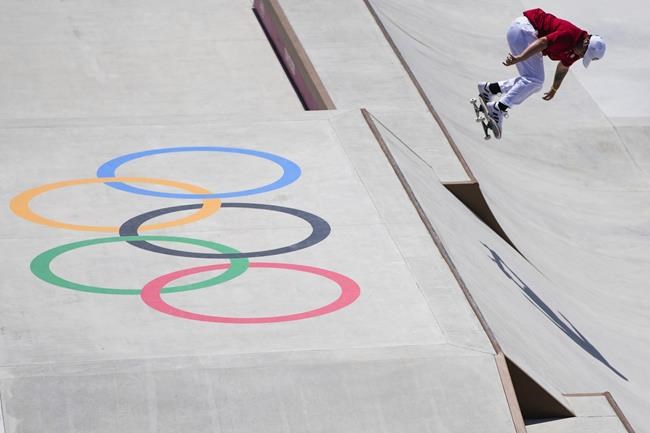
Alana Smith of the United States trains during a street skateboarding practice session at the 2020 Summer Olympics, Friday, July 23, 2021, in Tokyo, Japan. (AP Photo/Markus Schreiber)

From there, the variations are almost endless.

WHAT’S IN A NAME?

Some tricks pay homage to their creators. The 360-rotated “caballerial,” ridden backwards, is named after Steve Caballero. The salad grind owes a debt to the surname of skater Eric Dressen, which sounds like the dressings that go on salad. That play on words inspired the name.

When it comes to naming tricks, “there are no rules,” says Greg Poissonnier, who’ll be commenting on Olympic skateboarding for French TV and contributed to an illustrated guide, or “tricktionary,” of skating stunts.

“Sometimes, it’s just what they called it at the moment it happened,” he says. “They’re like, ‘We’ve done this, now what are we going to call it?’ And they give it a name.”

___

More AP Olympics: https://apnews.com/hub/2020-tokyo-olympics and https://twitter.com/AP_Sports

Report Error Submit a Tip

More Stories

Men’s recovery home dedicated to ‘homeless hero’ Faron Hall’s memory

Scott Billeck 14 minute read Preview

Men’s recovery home dedicated to ‘homeless hero’ Faron Hall’s memory

Scott Billeck 14 minute read Friday, Aug. 14, 2026

Faron Hall never got the chance to begin recovery. Once heralded as Winnipeg’s “homeless hero” after twice plunging into the Red River to save strangers from drowning, Hall told St. Boniface Street Links executive director Marion Willis shortly before his death in 2014 that he wanted help for his alcoholism.

Read
Friday, Aug. 14, 2026

Lasting legacy or pining for a pipe dream?

Laura Cameron 5 minute read 2:00 AM CDT

The federal government is investing in major infrastructure, promising to expedite “projects of national interest” and pitching them to private investors at a summit in September.

The Manitoba government has its sights set on a pipeline and LNG export terminal at Churchill. Instead, Manitoba should be putting forward feasible, future-facing infrastructure proposals that would leave a positive lasting legacy of energy affordability, independence and security for Manitobans.

A pipeline and LNG terminal at Churchill are not viable for several reasons — the technical challenges of building a pipeline over thawing permafrost; the prohibitive cost of ice-breaking tankers to move LNG through the Arctic; and a forecasted global oversupply of LNG and uncertain long-term export markets.

Given these challenges, a private company coming out of the woodwork to invest seems exceptionally unlikely. Private proponents are also not interested in building oil pipelines to the west, and Prime Minister Mark Carney has now made clear his priority to work with Premier Danielle Smith on a West Coast pipeline, which would cost upwards of $35 billion (on top of the over $34 billion in public funds already spent on the Trans Mountain pipeline). It would seem this pours more cold water on the idea of a third publicly funded pipeline to Hudson Bay.

Manitoba family finalist for cattle producers environmental award

Aaron Epp 4 minute read Preview

Manitoba family finalist for cattle producers environmental award

Aaron Epp 4 minute read Saturday, Aug. 15, 2026

A family in western Manitoba is one of seven finalists for a national environmental award honouring beef cattle producers.

Connor and Kyla English, alongside Connor’s parents, Brian and Leanne English, are nominated for the Canadian Cattle Association’s Environmental Stewardship Award. The 30-year-old award is presented to beef farmers and ranchers who explore innovative ways to protect, preserve and enhance their operations and the environment simultaneously.

This year’s recipient will be announced on Wednesday during a banquet at the Canadian Beef Industry Conference in Winnipeg.

The English family’s roots near Bradwardine — about 265 kilometres west of Winnipeg — date back to 1898. Today, Connor, Kyla, Brian and Leanne manage a herd of about 320 breeding cows on nearly 445 hectares (1,100 acres) of owned and rented pasture and forage land.

Read
Saturday, Aug. 15, 2026

Puzzles Palace

1 minute read Monday, Jul. 27, 2026

To solve our puzzles, please subscribe with this special offer: |

Hometown hero hits CEBL championship clinching shot

Taylor Allen 5 minute read Preview

Hometown hero hits CEBL championship clinching shot

Taylor Allen 5 minute read Yesterday at 6:34 PM CDT

Chapter 1 of Winnipeg Sea Bears basketball was capped by hometown hero Chad Posthumus.

It was May 27, 2023, and the late, great centre out of River East Collegiate had a put-back basket off a Teddy Allen miss to give the Sea Bears a 90-85 victory over the Vancouver Bandits in Winnipeg’s inaugural game, in front of what was then a record crowd of 7,303.

So, on Saturday, it was rather poetic that Simon Hildebrandt — another Winnipegger and a player Posthumus used to mentor — was the one to put an exclamation mark on the franchise’s latest and greatest chapter.

Hildebrandt drilled a wide-open three in Target Score Time to crown the Sea Bears as the 2026 CEBL champions.

Read
Yesterday at 6:34 PM CDT

Take advantage of hydroelectric potential

Jerry Storie 5 minute read Preview

Take advantage of hydroelectric potential

Jerry Storie 5 minute read 2:00 AM CDT

Manitoba Hydro tells us that we are going to need significant new electricity generation over the coming decades.

Hydro, like every other utility in the world has recognized this fact. Around the world, new generating capacity is being built. Countries that have access to hydroelectric potential are building dams and planning for the future. Other countries, without the natural advantage rivers provide, are building nuclear energy capacity. And yes, in almost all those countries solar and wind generating capacity are being developed as quickly as possible.

All that additional energy capacity is needed to fuel our endless need for technology, data storage and a thousand other things. Quickly moving to electric vehicles from combustion engines will also drive up demand.

Although it is tempting to think that ever larger and better battery storage will help, it will only help in how energy is distributed. The introduction of more and better battery storage is not likely to limit the total demand for energy. The enthusiasm for battery storage is understandable, but it is certainly possible that battery storage will effectively increase our use of energy, simply because it can be so reliably accessed from our battery storage systems.

Read
2:00 AM CDT