Robotic police dogs: Useful hounds or dehumanizing machines?
Advertisement
Read this article for free:
or
Already have an account? Log in here »
To continue reading, please subscribe:

Digital Subscription
One year of digital access for only $205*
- Enjoy unlimited reading on winnipegfreepress.com
- Read the E-Edition, our digital replica newspaper
- Access News Break, our award-winning app
- Play interactive puzzles
*First annual payment billed as $205.00 + GST for one year. This annual subscription will automatically renew at $233.00 + GST every 52 weeks (10% off the regular annual price of $259.35). Offer available to new and qualified returning subscribers only. Cancel any time.
To continue reading, please subscribe:
Add Free Press access to your Brandon Sun subscription for only an additional
$1 for the first 4 weeks*
- Enjoy unlimited reading on winnipegfreepress.com
- Read the E-Edition, our digital replica newspaper
- Access News Break, our award-winning app
- Play interactive puzzles
*Your next Brandon Sun subscription payment will increase by $1.00 and you will be charged $17.95 plus GST for four weeks. After four weeks, your payment will increase to $24.95 plus GST every four weeks.
Read unlimited articles for free today:
or
Already have an account? Log in here »
Hey there, time traveller!
This article was published 30/07/2021 (1897 days ago), so information in it may no longer be current.
HONOLULU (AP) — If you’re homeless and looking for temporary shelter in Hawaii’s capital, expect a visit from a robotic police dog that will scan your eye to make sure you don’t have a fever.
That’s just one of the ways public safety agencies are starting to use Spot, the best-known of a new commercial category of robots that trot around with animal-like agility.
The handful of police officials experimenting with the four-legged machines say they’re just another tool, like existing drones and simple wheeled robots, to keep emergency responders out of harm’s way as they scout for dangers. But privacy watchdogs — the human kind — warn that police are secretly rushing to buy the robots without setting safeguards against aggressive, invasive or dehumanizing uses.
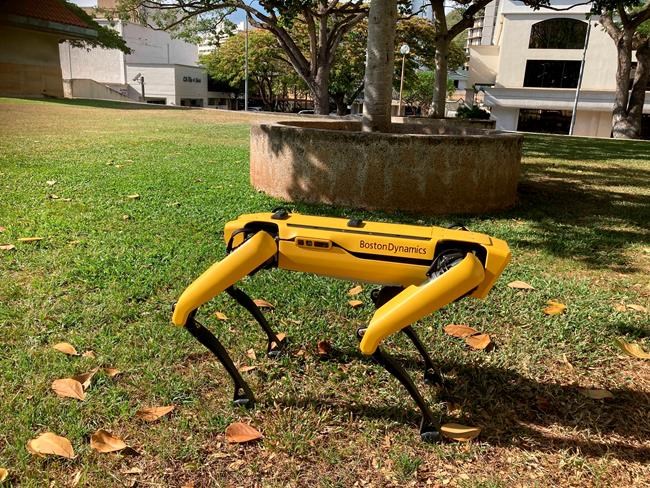
In Honolulu, the police department spent about $150,000 in federal pandemic relief money to buy their Spot from robotics firm Boston Dynamics for use at a government-run tent city near the airport.
“Because these people are houseless it’s considered OK to do that,” said Jongwook Kim, legal director at the American Civil Liberties Union of Hawaii. “At some point it will come out again for some different use after the pandemic is over.”
Acting Lt. Joseph O’Neal of the Honolulu Police Department’s community outreach unit defended the robot’s use in a media demonstration earlier this year. He said it has protected officers, shelter staff and residents by scanning body temperatures between meal times at a shelter where homeless people could quarantine and get tested for COVID-19. The robot is also used to remotely interview individuals who have tested positive.
“We have not had a single person out there that said, ‘That’s scary, that’s worrisome,’” O’Neal said. “We don’t just walk around and arbitrarily scan people.”
Police use of such robots is still rare and largely untested — and hasn’t always gone over well with the public. Honolulu officials faced a backlash when a local news organization, Honolulu Civil Beat, revealed that the Spot purchase was made with federal relief money.
Late last year, the New York Police Department starting using Spot after painting it blue and renaming it “Digidog.” It went mostly unnoticed until New Yorkers starting spotting it in the wild and posting videos to social media. Spot quickly became a sensation, drawing a public outcry that led the police department to abruptly return Digidog to its maker.
“This is some Robocop stuff, this is crazy,” was the reaction in April from Democratic U.S. Rep. Jamaal Bowman. He was one of several New York politicians to speak out after a widely shared video showed the robot strutting with police officers responding to a domestic-violence report at a high-rise public housing building in Manhattan.
Days later, after further scrutiny from elected city officials, the department said it was terminating its lease and returning the robot. The expensive machine arrived with little public notice or explanation, public officials said, and was deployed to already over-policed public housing. Use of the high-tech canine also clashed with Black Lives Matter calls to defund police operations and reinvest in other priorities.
The company that makes the robots, Boston Dynamics, says it’s learned from the New York fiasco and is trying to do a better job of explaining to the public — and its customers — what Spot can and cannot do. That’s become increasingly important as Boston Dynamics becomes part of South Korean carmaker Hyundai Motor Company, which in June closed an $880 million deal for a controlling stake in the robotics firm.
“One of the big challenges is accurately describing the state of the technology to people who have never had personal experience with it,” Michael Perry, vice president of business development at Boston Dynamics, said in an interview. “Most people are applying notions from science fiction to what the robot’s doing.”
For one of its customers, the Dutch national police, explaining the technology includes emphasizing that Spot is a very good robot — well-behaved and not so smart after all.
“It doesn’t think for itself,” Marjolein Smit, director of the special operations unit of the Dutch national police, said of the remote-controlled robot. “If you tell it to go to the left, it will go to the left. If you tell it to stop, it will stop.”
Earlier this year, her police division sent its Spot into the site of a deadly drug lab explosion near the Belgian border to check for dangerous chemicals and other hazards.
Perry said the company’s acceptable use guidelines prohibit Spot’s weaponization or anything that would violate privacy or civil rights laws, which he said puts the Honolulu police in the clear. It’s all part of a year-long effort by Boston Dynamics, which for decades relied on military research grants, to make its robots seem friendlier and thus more palatable to local governments and consumer-oriented businesses.
By contrast, a lesser-known rival, Philadelphia-based Ghost Robotics, has no qualms about weaponization and supplies its dog-like robots to several branches of the U.S. military and its allies.
“It’s just plug and play, anything you want,” said Ghost Robotics CEO Jiren Parikh, who was critical of Boston Dynamics’ stated ethical principles as “selective morality” because of the company’s past involvement with the military.
Parikh added that his company doesn’t market its four-legged robots to police departments, though he said it would make sense for police to use them. “It’s basically a camera on a mobile device,” he said.
There are roughly 500 Spot robots now in the wild. Perry said they’re commonly used by utility companies to inspect high-voltage zones and other hazardous areas. Spot is also used to monitor construction sites, mines and factories, equipped with whatever sensor is needed for the job.
It’s still mostly controlled by humans, though all they have to do is tell it which direction to go and it can intuitively climb stairs or cross over rough terrain. It can also operate autonomously, but only if it’s already memorized an assigned route and there aren’t too many surprise obstacles.

“The first value that most people see in the robot is taking a person out of a hazardous situation,” Perry said.
Kim, of the ACLU in Hawaii, acknowledged that there might be many legitimate uses for such machines, but said opening the door for police robots that interact with people is probably not a good idea. He pointed to how Dallas police in 2016 stuck explosives on a wheeled robot to kill a sniper, fueling an ongoing debate about “killer robots” in policing and warfighting.
“There’s the potential for these robots to increase the militarization of police departments and use it in ways that are unacceptable,” Kim said. “Maybe it’s not something we even want to let law enforcement have.”
—-
AP Technology Writer Matt O’Brien reported from Providence, Rhode Island.