Justin, take the wheel: experts tell Canada to show tough love at White House

Advertisement

Advertise with us

WASHINGTON - The federal Liberal government was lulled into a false sense of security by the results of last year's U.S. election, say business leaders who want Prime Minister Justin Trudeau to take a harder line with President Joe Biden when he visits the White House this week.

Read this article for free:


or

Already have an account? Log in here »

To continue reading, please subscribe:

Subscribe and receive a limited-edition Free Press branded hat or tote.

Digital Subscription

One year of digital access for only $205*

  • Enjoy unlimited reading on winnipegfreepress.com
  • Read the E-Edition, our digital replica newspaper
  • Access News Break, our award-winning app
  • Play interactive puzzles

*First annual payment billed as $205.00 + GST for one year. This annual subscription will automatically renew at $233.00 + GST every 52 weeks (10% off the regular annual price of $259.35). Offer available to new and qualified returning subscribers only. Cancel any time.

To continue reading, please subscribe:

Add Free Press access to your Brandon Sun subscription for only an additional

$1 for the first 4 weeks*

  • Enjoy unlimited reading on winnipegfreepress.com
  • Read the E-Edition, our digital replica newspaper
  • Access News Break, our award-winning app
  • Play interactive puzzles
Start now

*Your next Brandon Sun subscription payment will increase by $1.00 and you will be charged $17.95 plus GST for four weeks. After four weeks, your payment will increase to $24.95 plus GST every four weeks.

Hey there, time traveller!
This article was published 15/11/2021 (1769 days ago), so information in it may no longer be current.

WASHINGTON – The federal Liberal government was lulled into a false sense of security by the results of last year’s U.S. election, say business leaders who want Prime Minister Justin Trudeau to take a harder line with President Joe Biden when he visits the White House this week.

Canadians might have expected a smoother ride following Donald Trump’s defeat, but experts say the events of the last 10 months — beginning with Biden’s Day 1 cancellation of the Keystone XL pipeline project — suggest the Canada-U.S. relationship has drifted off the road.

“We had, collectively, somewhat of a cruise-control approach to this relationship,” said Goldy Hyder, president and CEO of the Business Council of Canada.
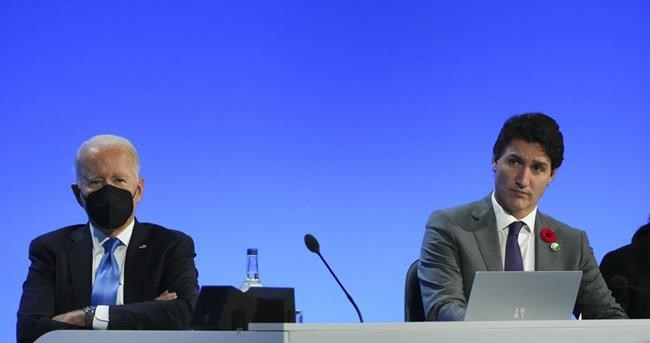
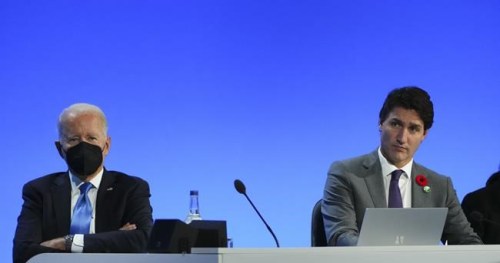
Prime Minister Justin Trudeau, right, sits beside U.S. President Joe Biden at an event about the Global Methane Pledge at COP26 in Glasgow, Scotland on Tuesday, Nov. 2, 2021. Business leaders in Canada are urging Trudeau to show some tough love when he visits the White House this week. THE CANADIAN PRESS/Sean Kilpatrick

“We all succumbed to a sense of, ‘Life’s going to be perfect again, it’s going to be good again, they love us, we love them and it’s going to be a really happy relationship.’ The facts suggest that it’s quite the contrary.”

Those facts comprise a long list of sore spots for Canada that only seems to be getting longer.

In addition to Keystone XL, the Biden administration has shown little enthusiasm for Line 3 and Line 5, two key cross-border upgrade projects spearheaded by Calgary-based Enbridge Inc. that have been the targets of widespread protests and legal action in the U.S.

And the president frequently uses protectionist “Buy American” rhetoric to assure working-class voters that his government’s infrastructure overhaul will rely primarily on U.S. contractors and suppliers, with stringent conditions for any foreign involvement.

That language showed up again Monday as Biden signed into law his $1.2-trillion infrastructure bill, which included a separate set of executive marching orders calling on the government to “buy American and increase the competitiveness of the U.S. economy, including through implementing the act’s made-in-America requirements and bolstering domestic manufacturing and manufacturing supply chains.”

Heading off U.S. protectionism will be a top priority, Trudeau suggested Monday.

Buy American “poses a particular challenge not only for companies and workers here in Canada, but also in the United States, because of the integration of our supply chains and our economies in general,” he said in French.

“It really is counterproductive for Americans to put in place even more barriers and limitations on trade between our two countries.”

Canada’s auto industry is also up in arms over a proposed U.S. tax credit for electric vehicles, worth up to $12,500 to would-be buyers, that critics — including foreign automakers — say is unfairly geared toward American-made vehicles built with union labour.

Hyder also cited a lack of advance notice on the chaotic U.S. pullout from Afghanistan, a deal with Australia to provide nuclear-powered submarines that appeared to cut Canada out of the loop and the three-month disconnect on the reopening of the Canada-U.S. land border.

None of that points to a healthy bilateral relationship, Hyder said.

“I’m far more interested in the state of the relationship coming out of an event like this then I am whether we made progress on this piece of legislative action or that piece of legislative action,” he said.

“Friends are supposed to be able to have straight talk, honest talk. I’m not measuring the relationship based on is it buddy-buddy, chum-chum, are they high-fiving. I want outcomes for the Canadian people and our Canadian interests. That’s what I’m looking for.”

Democrats are facing political headwinds at home that won’t help matters.

Inflation in the U.S. now exceeds six per cent and gasoline prices across the country are spiking, thanks in part to a lingering COVID-19 hangover and related supply-chain issues that are hitting Americans just as the holiday shopping season shifts into high gear.

Biden’s approval ratings are dismal, and strong Republican performances in recent gubernatorial elections in Virginia and New Jersey make it clear they will face an uphill battle next year in maintaining control of Capitol Hill, to say nothing of the White House in 2024.

Given that, it might be wise for Canadians and Mexicans alike to temper their expectations of Thursday’s meeting, said Duncan Wood, a Wilson Center vice-president and senior adviser to the centre’s Mexico Institute.

All three countries are still in the process of repairing the damage that was done during the Trump era — and progress on that front might be the single most important goal, Wood said.

“There’s value in just having a conversation,” he said. “It’s just that what that conversation will produce in the short term — I think there’s not a lot that can be expected there.”

It’s long been the nature of the relationship that Canada must voice its priorities in order to get U.S. attention — and align those priorities with American goals in order to get action, said Maryscott Greenwood, CEO of the Canadian American Business Council.

“In Washington, when the dialogue is dominated by internal politics, Canada and Mexico are left on the sidelines. The truth of the matter is, Canada and Mexico can help solve some of the internal U.S. political challenges, like infrastructure, like energy co-operation,” Greenwood said.

“It may be remarkable to Canadians that you’ve got to keep reminding, but we’ve got to keep reminding. We’ve got to have that conversation.”

This report by The Canadian Press was first published Nov. 15, 2021.

Report Error Submit a Tip

More Stories

Day 1 of Jets training camp in the books with pairings essentially cemented

Ken Wiebe 7 minute read Preview

Day 1 of Jets training camp in the books with pairings essentially cemented

Ken Wiebe 7 minute read Thursday, Sep. 17, 2026

Nearly six minutes into his question-and-answer session, Scott Arniel took a welcome detour from the news of the day.

After exhausting the discussion around the goalie who wasn’t in training camp, the head coach of the Winnipeg Jets finally got a query about the line combinations and defensive pairings that were unveiled in training camp.

And unlike past years, when exhibition games were more frequent and the training camp wasn’t this condensed, Arniel conceded these groupings were intentional and were likely staying together for some time.

The expansion to an 84-game regular season brings with it a reduction to four pre-season games and a much shorter training camp, which could limit the amount of experimentation that Arniel can do during the next two weeks.

Read
Thursday, Sep. 17, 2026

Time for tough love with U.S., experts urge Canada

James McCarten, The Canadian Press 5 minute read Preview

Time for tough love with U.S., experts urge Canada

James McCarten, The Canadian Press 5 minute read Monday, Nov. 15, 2021

WASHINGTON - The federal Liberal government was lulled into a false sense of security by the results of last year's U.S. election, say business leaders who want Prime Minister Justin Trudeau to take a harder line with President Joe Biden when he visits the White House this week.

Canadians might have expected a smoother ride following Donald Trump's defeat, but experts say the events of the last 10 months — beginning with Biden's Day 1 cancellation of the Keystone XL pipeline project — suggest the Canada-U.S. relationship has drifted off the road.

"We had, collectively, somewhat of a cruise-control approach to this relationship," said Goldy Hyder, president and CEO of the Business Council of Canada.

"We all succumbed to a sense of, 'Life's going to be perfect again, it's going to be good again, they love us, we love them and it's going to be a really happy relationship.' The facts suggest that it's quite the contrary."

Read
Monday, Nov. 15, 2021

A quick look at where provinces and territories stand on time changes

The Canadian Press 2 minute read Preview

A quick look at where provinces and territories stand on time changes

The Canadian Press 2 minute read Updated: Yesterday at 6:28 AM CDT

WINNIPEG - Manitoba's government said Thursday the province will be sticking with daylight time year-round, making it the latest jurisdiction to move away from twice-annual time changes. Here's a look at where things stand across Canada:

British Columbia said in March that it was moving to permanent Pacific daylight time. The change also means that parts of northeastern B.C., which have been on mountain standard time year round, are now in alignment with the rest of the province.

Alberta also switched to permanent daylight time this year in what it calls Alberta time. The change means it now has the same time as Saskatchewan year round.

Saskatchewan has been on permanent central standard time since 1966.

Read
Updated: Yesterday at 6:28 AM CDT

Hellebuyck standoff caused by… Nathan MacKinnon?

Mike McIntyre 6 minute read Preview

Hellebuyck standoff caused by… Nathan MacKinnon?

Mike McIntyre 6 minute read Yesterday at 6:34 PM CDT

Looking for someone to blame in the Connor Hellebuyck fiasco and cast as public enemy No. 1? How about long-time Winnipeg Jets nemesis Nathan MacKinnon?

Allow us to explain as we fire up the time machine and head back to February in Italy.

Oh, what could have been if MacKinnon had been able to score on what appeared to be an open net late in the third period of the men’s gold medal game with Hellebuyck down and seemingly out of position.

Instead, the star forward fired wide, keeping the score deadlocked at 1-1 as the clock ticked down on regulation.

Read
Yesterday at 6:34 PM CDT

Canada-U.S. trade relationship is broken, but the damage can — and will — be repaired

Tom Brodbeck 5 minute read Preview

Canada-U.S. trade relationship is broken, but the damage can — and will — be repaired

Tom Brodbeck 5 minute read Thursday, Sep. 17, 2026

Canada needs to get serious about diversifying its trade beyond the United States. But at the same time, Canadians should expect relations with the U.S. to normalize after Donald Trump is no longer in the White House.

For generations, Canada-U.S. trade was considered almost a fact of geography. The two countries share the world’s longest undefended border, deeply integrated supply chains and a century of commercial relationships.

Canadian manufacturers depend on American customers. American manufacturers depend on Canadian suppliers. Energy, agriculture, automotive production and countless other industries operate across the border as though it barely exists.

That isn’t going to change dramatically, even in the midst of a bitter trade war unleashed by the U.S. president.

Read
Thursday, Sep. 17, 2026

Cabernet Sauvignon star of wine festival

Ben Sigurdson 5 minute read Preview

Cabernet Sauvignon star of wine festival

Ben Sigurdson 5 minute read 3:00 AM CDT

The Winnipeg Wine Festival will celebrate the king of red wine grapes next weekend — the theme of this year’s festival, which takes place Sept. 25 and 26 at the RBC Convention Centre, is Cabernet Sauvignon.

Cab Sauv, as it’s also known, is the world’s most widely planted wine grape of any colour, first coming to prominence in the 1800s in France’s Bordeaux region, where the grape is still popular. Rather than single-variety wines, Bordeaux reds tend to be blends, with those coming from the left bank of the Gironde estuary being Cabernet-dominant, while right-bank wines are Merlot-dominant, with Cabernet Sauvignon playing a supporting role. Cabernet and Merlot work well together and many other countries have followed suit in blending the two.

A team at University of California Davis put Cabernet Sauvignon through a DNA test in 1996 and discovered its parent grapes are Cabernet Franc and Sauvignon Blanc — it’s likely that at some point the two varieties, planted next to each other in some vineyard, crossed and mutated and became the grape we know today. (Someone growing grapes in the 19th century must have had an inkling of what was up, as the grape has been called Cabernet Sauvignon since long before the DNA test.)

Flavour-wise, most Cabernet Sauvignon wines are big and bold, with a core of deep dark berry flavours, some graphite and spice notes and relatively bright acidity. It’s a grape that is well-suited to barrel aging, with most examples seeing at least some time in wood.

Read
3:00 AM CDT