But it’s a dry cold…
Chinese director embraces Winnipeg’s winter weather as vital component of chilly drama

Advertisement
Read this article for free:
or
Already have an account? Log in here »
To continue reading, please subscribe:

Digital Subscription
One year of digital access for only $205*
- Enjoy unlimited reading on winnipegfreepress.com
- Read the E-Edition, our digital replica newspaper
- Access News Break, our award-winning app
- Play interactive puzzles
*First annual payment billed as $205.00 + GST for one year. This annual subscription will automatically renew at $233.00 + GST every 52 weeks (10% off the regular annual price of $259.35). Offer available to new and qualified returning subscribers only. Cancel any time.
To continue reading, please subscribe:
Add Free Press access to your Brandon Sun subscription for only an additional
$1 for the first 4 weeks*
- Enjoy unlimited reading on winnipegfreepress.com
- Read the E-Edition, our digital replica newspaper
- Access News Break, our award-winning app
- Play interactive puzzles
*Your next Brandon Sun subscription payment will increase by $1.00 and you will be charged $17.95 plus GST for four weeks. After four weeks, your payment will increase to $24.95 plus GST every four weeks.
Read unlimited articles for free today:
or
Already have an account? Log in here »
Hey there, time traveller!
This article was published 17/02/2022 (1702 days ago), so information in it may no longer be current.
Even after they wrapped the Manitoba component of production on Feb. 4, the producers and the director of the Chinese-American co-production Unspoken were unaware that Winnipeg can lay claim to a little piece of Chinese cinema history.
This connection relates to Stanley Tong, the director of hit Jackie Chan films such as Supercop and Rumble in the Bronx. Decades ago, Tong was studying for a non-film career at the University of Manitoba when a penchant for doing doughnuts in his car on the icy U of M parking lot literally steered him toward work as a stuntman and eventually as a very successful director and producer of Hong Kong films.
One of Unspoken’s producers, Mark Ordesky from the L.A.-based production company Court Five, can himself lay some credit for introducing Chan to western audiences with the debut of Rumble in the Bronx, back when he worked for the upstart studio New Line, but he admits he didn’t know about Tong.
“But that wouldn’t surprise me at all,” he says on a Zoom call from Los Angeles alongside Court Five partner/producer Jane Fleming.
“Even better, we flipped a car in that very parking lot,” says Fleming, referring to a movie stunt in Unspoken.
“But we did it on purpose,” she says.
● ● ●
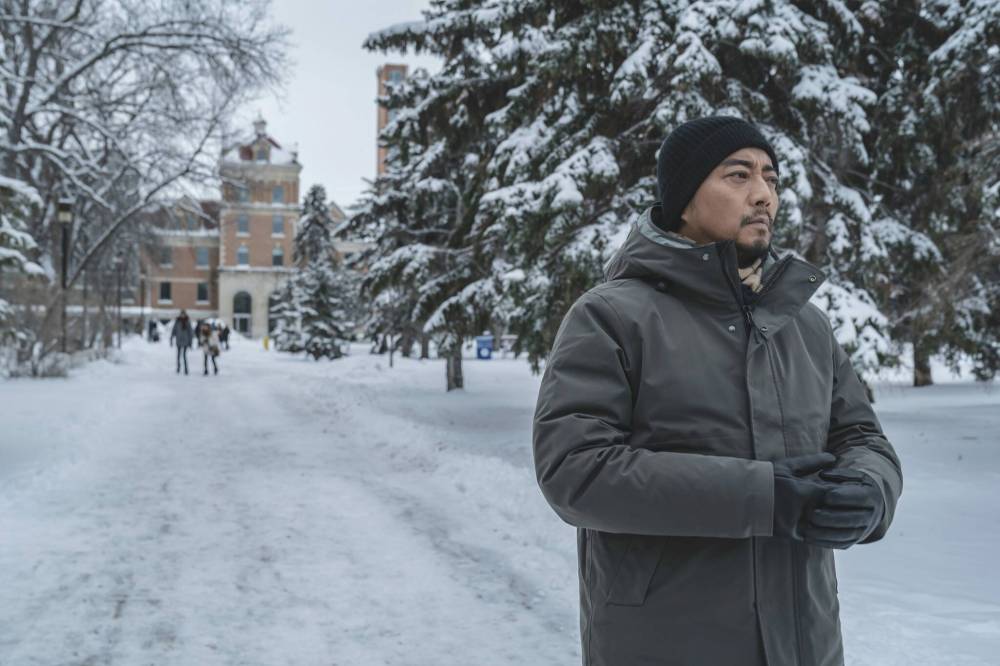
Scripted and directed by Chinese-based filmmaker Daming Chen, Unspoken is decidedly not an action movie in the Jackie Chan mode. The film features award-winning actor Hanyu Zhang as Xu, a bereaved father who comes to a town in the U.S. — Winnipeg is standing in for the fictional town of Xavier, Minn. — to investigate the death of his deaf daughter under suspicious circumstances. Chinese American actress Vivienne Tien plays a translator who aids Xu.
The cast includes American actors such as Michael Cudlitz (The Walking Dead) and Jake Abel (Supernatural), as well as local actors including Paul Essiembre, Sarah Luby and Bradley Sawatzky.
The film shot for a total of 40 days through December and January before wrapping last week. It will resume shooting in China, once Chen, Zhang and Chinese crew members come out of quarantine.
Shooting took place in bitter cold and snowy conditions. But that was precisely what the director was seeking. Speaking over a Zoom call from Shanghai, where he is still in quarantine after the shoot, Chen says the script he wrote was first titled Cold.
“So that tells you something about what the movie is about,” Chen says.
Chen originally pictured the setting as something more akin to upstate New York, but changed his mind after seeing Manitoba’s prairie.
“I’ve never seen a landscape like that in terms of the look in terms of the city,” says Chen. “There’s barely a hill to offer. It fit into my movie quite well.
“The location plays an important role in my movie because it’s about a Chinese father who speaks no English going to a foreign land and it’s something he has never seen,” Chen says. “Through his eyes, he sees what happened to his daughter.
“The environment he’s going to enter had to be something unique and striking.”
The fact that the film landed in Winnipeg has to do with line producer/executive producer Victor Moyers, who worked on those same positions on the film Orphan: First Kill, which shot in Manitoba in November and December 2020.
“We approached (Moyers) with the story because we think very highly of him professionally,” says Fleming. “And he said he had this amazing experience in Manitoba.
“Between the (tax) rebate, the currency, the possibility of extending the budget and the professionals being so extraordinary, he sold us on it,” says Fleming. “Plus it was guaranteed snow, which this movie really needed.
“Our director was very excited about the sure-fire snow.”
It is common to hear from offshore filmmakers about how dire it can be to endure a Manitoba winter during a film shoot. But Chen, Fleming and Ordesky all agree it was a lovely experience, notwithstanding frequent -30 C temperatures and ramped-up COVID-19 protocols.
“Both my star and my crew members came back to Shanghai two days ago and they said they found it colder in Shanghai than Winnipeg,” Chen says. “Shanghai is a wet cold; it’s very humid. But in Shanghai I really feel cold in my bones. In Winnipeg, if you’re well dressed and you’re prepared mentally, I actually enjoyed the cold weather, to be honest with you.
“It’s the kind of weather I like. I wanted snow in the movie and I got everything I wanted.”

Even the Los Angeles-based producers say they enjoyed the experience. (Ordesky once spent five years in New Zealand in his capacity as executive producer of the Lord of the Rings trilogy.)
“I just dressed like an astronaut,” says Ordesky. “There are photographs of me that are basically: I’m a giant puff of blue with my glasses poking out.
“We love embedding in cultures and meeting new people,” he adds. “That really is one of the joys of making films and television.”
randall.king.arts@gmail.com
Twitter: @FreepKing
Our newsroom depends on a growing audience of readers to power our journalism. If you are not a paid reader, please consider becoming a subscriber.
Our newsroom depends on its audience of readers to power our journalism. Thank you for your support.
Our newsroom depends on a growing audience of readers to power our journalism. If you are not a paid reader, please consider becoming a subscriber.
Our newsroom depends on its audience of readers to power our journalism. Thank you for your support.
Advertisement Advertise With Us
Advertisement Advertise With Us