Changing snowfall makes it harder to fight fire with fire

Advertisement

Advertise with us

DECKERS, Colo. (AP) — Dripping flaming fuel as they go, a line of workers slowly descends a steep, snow-covered hillside above central Colorado’s South Platte River, torching piles of woody debris that erupt into flames shooting two stories high.

Read this article for free:


or

Already have an account? Log in here »

To continue reading, please subscribe:

Subscribe and receive a limited-edition Free Press branded hat or tote.

Digital Subscription

One year of digital access for only $205*

  • Enjoy unlimited reading on winnipegfreepress.com
  • Read the E-Edition, our digital replica newspaper
  • Access News Break, our award-winning app
  • Play interactive puzzles

*First annual payment billed as $205.00 + GST for one year. This annual subscription will automatically renew at $233.00 + GST every 52 weeks (10% off the regular annual price of $259.35). Offer available to new and qualified returning subscribers only. Cancel any time.

To continue reading, please subscribe:

Add Free Press access to your Brandon Sun subscription for only an additional

$1 for the first 4 weeks*

  • Enjoy unlimited reading on winnipegfreepress.com
  • Read the E-Edition, our digital replica newspaper
  • Access News Break, our award-winning app
  • Play interactive puzzles
Start now

*Your next Brandon Sun subscription payment will increase by $1.00 and you will be charged $17.95 plus GST for four weeks. After four weeks, your payment will increase to $24.95 plus GST every four weeks.

Hey there, time traveller!
This article was published 09/03/2022 (1662 days ago), so information in it may no longer be current.

DECKERS, Colo. (AP) — Dripping flaming fuel as they go, a line of workers slowly descends a steep, snow-covered hillside above central Colorado’s South Platte River, torching piles of woody debris that erupt into flames shooting two stories high.

It’s winter in the Rocky Mountains, and fresh snow cover allowed the crew of 11 to safely confine the controlled burn.

Such operations are a central piece of the Biden administration’s $50 billion plan to reduce the density of western forests that have been exploding into firestorms as climate change bakes the region.
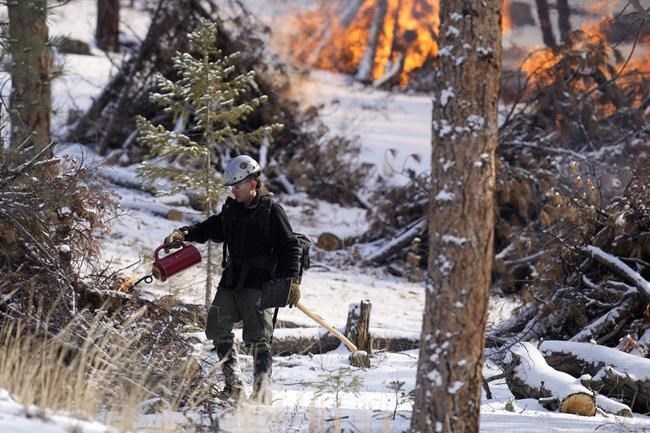
Mile High Youth Corps member John Knudsen set fire to a pile of tree debris alongside U.S. Forest Service firefighters near the Bridge Crossing picnic grounds in Hatch Gulch Wednesday, Feb. 23, 2022, near Deckers, Colo. In Colorado, climate change means snow is not always on the ground when needed so that crews can safely burn off debris piles and vegetation to help keep future wildfires from becoming catastrophic. (AP Photo/David Zalubowski)

But the same warming trends that worsen wildfires will also challenge the administration’s attempts to guard against them.

Increasingly erratic weather means snow is not always there when needed to safely burn off tall debris piles like those on Colorado’s Pike-San Isabel National Forest. And that seriously complicates the job of exhausted firefighters, now forced into service year-round.

Their goal is to cut and burn enough vegetation that the next fires won’t be as catastrophic as ones that leveled vast forestland and neighborhoods in Colorado, California, Oregon, Montana and elsewhere.

Western wildfires have become more volatile as climate change dries forests already thick with vegetation from years of intensive fire suppression. And the window for controlled burns is shrinking.

“It’s been a little bit harder just because of shorter winters,” said David Needham, a U.S. Forest Service ranger who led the Colorado burn operation in late February when the thermometer hovered around zero degrees Fahrenheit (minus 18 Celsius). Surrounding hillsides showed barren scars from past wildfires, including a 2002 blaze that destroyed 133 homes and at the time was the largest in state history.

“On days like this, we capitalize on temperature being in the negatives,” Needham said, “Even small snow storms coming in definitely helps us with that.”

Across the Rockies, piles of slash and trees cleared to reduce fire hazards span some 100,000 acres (40,500 hectares), waiting to be burned once the right amount of snow is on the ground. Sometimes there’s too much, making the piles inaccessible. Other times there’s not enough snow and prescribed burns get canceled so they don’t get out of hand like a previous one that led to fatalities.

An overnight snow in central Colorado meant the crew from the forest service and Mile High Youth Corps could burn debris from twice the area they planned. Yet officials said climate change is making it more difficult to find that sweet spot for safe burning.

Spring is arriving earlier and snow-covered ground is disappearing two weeks sooner, according to Rutgers University researcher and New Jersey state Climatologist David Robinson, who has examined more than 50 years of snow cover data collected through satellite imagery.

“One thing we know about climate change is it is increasing the variability and the extremes we are experiencing,” said Robinson. “Out West, once the season shifts, you get very dry, very quickly and it stays dry for months. So you have a real tight window there.”

2020 was the worst wildfire season on record in Colorado, where summers and falls also have been warmer and drier, said Assistant State Climatologist Becky Bolinger. It’s “a completely different ball game in terms of wildfires,” she said.

For parts of the Rockies, this winter brought too much snow, forcing officials to delay burns. Meanwhile, parts of Wyoming haven’t received enough snow to moisten the ground and allow fuel piles to be torched. Even when there is snow, that doesn’t mean it will last until the debris stops smoldering, said Brian Keating with the Forest Service’s Rocky Mountain region.

When pile burns turn into wildfires, Keating said it’s usually because snow around when the burn started disappears. The next wind storm can kick up embers and ignite landscape that days earlier seemed fireproof.

Putting off pile burning carries consequences, too. Until the piles are gone, forest managers won’t begin another kind of controlled fire called broadcast burning, which consumes vegetation within stands previously thinned with chainsaws and other equipment.

“If we don’t burn the piles, … that can get kicked down the road another year or two,” said Keating. “And every year, we keep building this backlog of piles because we can’t get to them all.”
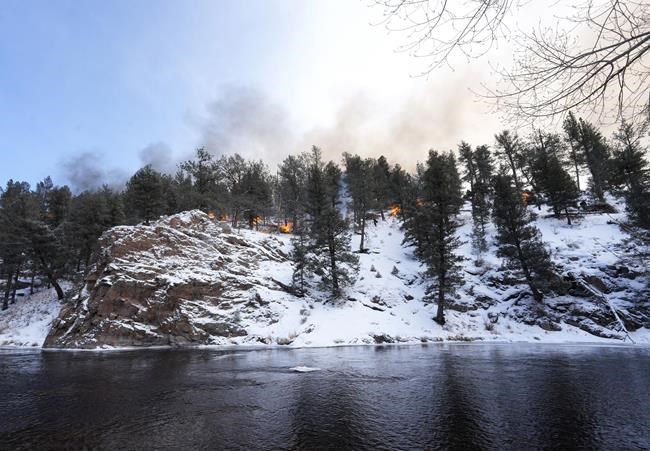
Fires burn tree debris near the Bridge Crossing picnic grounds in Hatch Gulch on Wednesday, Feb. 23, 2022, near Deckers, Colo. In Colorado, climate change means snow is not always on the ground when needed so that crews can safely burn off debris piles and vegetation to help keep future wildfires from becoming catastrophic. (AP Photo/David Zalubowski)

Another problem is smoke: Burns can be delayed if the smoke will exacerbate poor air quality.

Despite such hurdles, burns are crucial to the Biden administration’s 10-year plan to reduce wildfire hazards across almost 80,000 square miles (200,000 square kilometers) of public, private and tribal lands. The recently passed infrastructure bill includes $500 million for controlled burns over five years.

Prescribed burns and logging were used to reduce wildfire hazards last year on about 4,050 square miles (10,500 square kilometers) of forest — the most in a decade. By ramping that up, officials hope to get ahead of the problem and use less logging in future years, said Frankie Romero, who oversees the forest service’s prescribed burn program.

“Once we get into a maintenance cycle and we can continue to treat that same area while it’s in its preferred condition with a lot less fuel, then it becomes a lot easier,” Romero said. ”We’re going to experience wildfires in the future … and they’re going to cause problems. The difficult part is trying to remember what those problems would have looked like had we not intervened earlier.”

Environmental advocates warn that the scale of work being proposed could allow excessive logging that will harm forests and do little to prevent catastrophic fires.

But Oregon State University forestry professor John Bailey said the choice is between unchecked wildfires raging across the landscape and aggressive steps to at least partially counteract the forces of climate change.

“Not to embrace this challenge is choosing a future with a lot of wildfire in it and almost no control over where they start and where they spread and how much smoke is in the air and for how long,” Bailey said.

___

On Twitter follow Brittany Peterson: @BrittanyKPeters and Matthew Brown: @MatthewBrownAP

___

Associated Press climate and environmental coverage receives support from several private foundations. See more about AP’s climate initiative here. The AP is solely responsible for all content.

Report Error Submit a Tip

More Stories

U of W marks 10 years of Indigenous education requirement

Maggie Macintosh 5 minute read Preview

U of W marks 10 years of Indigenous education requirement

Maggie Macintosh 5 minute read Yesterday at 2:00 AM CDT

The University of Winnipeg is collecting course outlines, historic concerns about systemic racism on campus and related records to mark the 10-year anniversary of mandating Indigenous studies.

The unveiling of a new archive drew nearly 200 people to Centennial Hall on Thursday afternoon to reflect on how the Indigenous course requirement, also known as “the ICR,” came to be.

University archivist Brett Lougheed told the crowd its inception is “an amazing story” of student activism that, until now, wasn’t accurately reflected in U of W records.

“What little material we had told the story of administration’s role in developing the ICR as though it was the ultimate driver… and not a student-led response to racism,” Lougheed said.

Read
Yesterday at 2:00 AM CDT

WSO kicks off season pairing Beethoven, Tchaikovsky

Conrad Sweatman 5 minute read Preview

WSO kicks off season pairing Beethoven, Tchaikovsky

Conrad Sweatman 5 minute read 2:01 AM CDT

French fries and milkshake, watermelon and feta cheese … Beethoven’s Fifth and Tchaikovsky’s Fifth?

Few events mark the beginning of the classical concert season like the Winnipeg Symphony Orchestra’s season-opener and this year they kick things off with an unusual but satisfying pairing.

“I think that for me, the combination of these two pieces is, first of all, a celebration of great masterworks that have withstood 100 years of being probed by time for their relevancy,” says conductor Daniel Raiskin, the WSO’s music director. “It’s the quality of music, it’s the quality of narrative that attracts us to these masterworks again and again.”

Both symphonies are so hefty and canonical, one might have expected half of the concert would be devoted to a concerto, tone poem or something smaller or lesser known.

Read
2:01 AM CDT

Whether it’s coffee or tea, think of what’s holy

John Longhurst 5 minute read Preview

Whether it’s coffee or tea, think of what’s holy

John Longhurst 5 minute read 2:01 AM CDT

I was an instructor at a week-long event for aspiring Catholic journalists in Toronto in August. Whenever journalists gather, there will be conversation — and coffee. Lots of coffee. In this case, Catholic coffee.

“Catholic coffee?” you ask. “What is that?”

Catholic Coffee is the name of a small family business in Charlotte, N.C. Its goal is to use a daily habit of drinking coffee, especially in the morning, to focus attention on God through devotion and prayer.

The idea for using coffee in this way came to the founders through their Catholic faith.

Read
2:01 AM CDT

Public versus private schooling

John R. Wiens 5 minute read 2:01 AM CDT

A Recent Maggie Macintosh piece (Enrolment up at alternative schools, Sept. 7) and several letters to the editor touted the benefits and values of private schooling. The executive director of the Manitoba Federation of Independent Schools, Andrew Micklefield, emphasized schools of choice and governmental cost-saving. A private, formerly public, schoolteacher emphasized finances, academics and parental support.

None are wrong in their arguments, but they are missing the main reasons for the existence of public schools, which has less to do with money and academics than with inclusion and equality. Nor do they adequately acknowledge the downsides of exclusion and elitism fostered by some aspects of choice and inequality. The increase in numbers of private schools and their attendees is a cause for some public concern.

Micklefield’s assertion is that private schools save the government money. Letter-writer Paulo Borges intimates he saves the province $52,500 ($15,000 each for three home-schooled children and $7500 for one private-school tuition), further suggesting that the savings are not used wisely by governments in supporting public schools.

In the front-page article, Micklefield and others go further to suggest that the main reason parents choose private schools is to receive an education in a Christian setting. That is a very limited rationale and certainly does not include the much larger variety of reasons why people choose private schooling or an even more restricted version of schools of choice, home schooling.

Court hears woman’s statement detailing pain, trauma after boyfriend shot her in the face

Dean Pritchard 6 minute read Preview

Court hears woman’s statement detailing pain, trauma after boyfriend shot her in the face

Dean Pritchard 6 minute read Thursday, Sep. 24, 2026

A.W. thought she had found love with Machuor Akau.

That was before Akau put a loaded Luger handgun to the 26-year-old woman’s head last November and told her he should “kill her now.”

Akau shot her, shattering her jaw and embedding teeth in the bones of her mouth and leaving her fighting for her life.

Now A.W. wakes up every morning in pain and sees the scars on her face and neck.

Read
Thursday, Sep. 24, 2026

Happy email debt forgiveness day

Tory McNally 8 minute read Preview

Happy email debt forgiveness day

Tory McNally 8 minute read 2:01 AM CDT

There are few things more capable of producing an immediate feeling of guilt than opening your inbox and seeing an email you have not answered.

You know the one. It has been sitting there for three days or three months or perhaps long enough that responding now feels less like answering an email and more like reopening a historical case. You read it, think, “I really need to deal with that,” and then close it again.

The next week you see it, feel slightly worse and tell yourself you will answer it when you have more time. A month later, you are considering whether it would be less embarrassing to change your name and move to another province.

Fortunately, there is a solution: Sept. 30 is Email Debt Forgiveness Day, and I think it may be one of the most compassionate holidays we have invented.

Read
2:01 AM CDT