EXPLAINER: What is monkeypox and where is it spreading?

Advertisement

Advertise with us

LONDON (AP) — European and American health authorities have identified a number of monkeypox cases in recent days, mostly in young men. It's a surprising outbreak of a disease that rarely appears outside Africa.

Read this article for free:

or

Already have an account? Log in here »

To continue reading, please subscribe:

Subscribe and receive a limited-edition Free Press branded hat or tote.

Digital Subscription

One year of digital access for only $205*

  • Enjoy unlimited reading on winnipegfreepress.com
  • Read the E-Edition, our digital replica newspaper
  • Access News Break, our award-winning app
  • Play interactive puzzles

*First annual payment billed as $205.00 + GST for one year. This annual subscription will automatically renew at $233.00 + GST every 52 weeks (10% off the regular annual price of $259.35). Offer available to new and qualified returning subscribers only. Cancel any time.

To continue reading, please subscribe:

Add Free Press access to your Brandon Sun subscription for only an additional

$1 for the first 4 weeks*

  • Enjoy unlimited reading on winnipegfreepress.com
  • Read the E-Edition, our digital replica newspaper
  • Access News Break, our award-winning app
  • Play interactive puzzles
Start now

*Your next Brandon Sun subscription payment will increase by $1.00 and you will be charged $17.95 plus GST for four weeks. After four weeks, your payment will increase to $24.95 plus GST every four weeks.

Hey there, time traveller!
This article was published 19/05/2022 (1541 days ago), so information in it may no longer be current.

LONDON (AP) — European and American health authorities have identified a number of monkeypox cases in recent days, mostly in young men. It’s a surprising outbreak of a disease that rarely appears outside Africa.

Health officials around the world are keeping watch for more cases because, for the first time, the disease appears to be spreading among people who didn’t travel to Africa. They stress, however, that the risk to the general population is low.

WHAT IS MONKEYPOX?
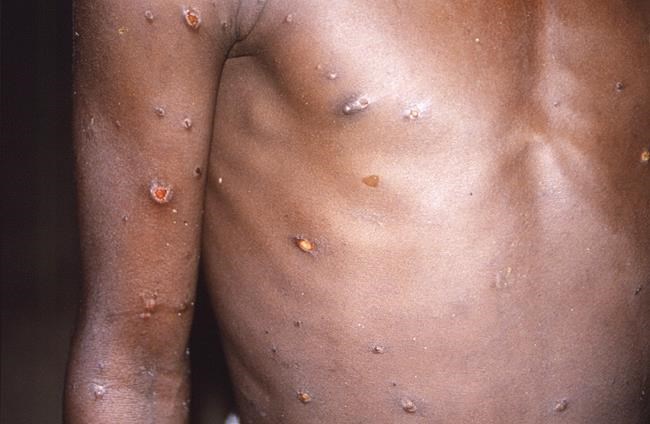
This 1997 image provided by CDC, shows the right arm and torso of a patient, whose skin displayed a number of lesions due to what had been an active case of monkeypox. As more cases of monkeypox are detected in Europe and North America in 2022, some scientists who have monitored numerous outbreaks in Africa say they are baffled by the unusual disease's spread in developed countries. (CDC via AP)

Monkeypox is a virus that originates in wild animals like rodents and primates, and occasionally jumps to people. Most human cases have been in central and west Africa, where the disease is endemic.

The illness was first identified by scientists in 1958 when there were two outbreaks of a “pox-like” disease in research monkeys — thus the name monkeypox. The first known human infection was in 1970, in a 9-year-old boy in a remote part of Congo.

WHAT ARE THE SYMPTOMS AND HOW IS IT TREATED?

Monkeypox belongs to the same virus family as smallpox but causes milder symptoms.

Most patients only experience fever, body aches, chills and fatigue. People with more serious illness may develop a rash and lesions on the face and hands that can spread to other parts of the body.

The incubation period is from about five days to three weeks. Most people recover within about two to four weeks without needing to be hospitalized.

Monkeypox can be fatal for up to one in 10 people and is thought to be more severe in children.

People exposed to the virus are often given one of several smallpox vaccines, which have been shown to be effective against monkeypox. Anti-viral drugs are also being developed.

On Thursday, the European Centre for Disease Prevention and Control recommended all suspected cases be isolated and that high-risk contacts be offered the smallpox vaccine.

HOW MANY MONKEYPOX CASES ARE THERE TYPICALLY?

The World Health Organization estimates there are thousands of monkeypox infections in about a dozen African countries every year. Most are in Congo, which reports about 6,000 cases annually, and Nigeria, with about 3,000 cases a year.

Patchy health monitoring systems mean many infected people are likely missed, experts say.

Isolated cases of monkeypox are occasionally spotted outside Africa, including in the U.S. and Britain. The cases are typically associated with travel to Africa or contact with animals from areas where the disease is more common.

In 2003, 47 people in six U.S. states had confirmed or probable cases. They caught the virus from pet prairie dogs that been housed near imported small mammals from Ghana.

WHAT’S DIFFERENT ABOUT THESE CASES?

It’s the first time monkeypox appears to be spreading among people who didn’t travel to Africa. Most of the cases involve men who have had sex with men.
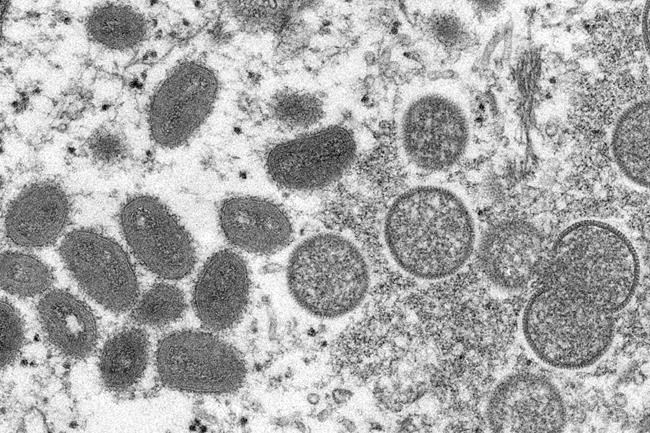
This 2003 electron microscope image made available by the Centers for Disease Control and Prevention shows mature, oval-shaped monkeypox virions, left, and spherical immature virions, right, obtained from a sample of human skin associated with the 2003 prairie dog outbreak. On Wednesday, May 18, 2022, Portuguese health authorities confirmed five cases of monkeypox in young men, marking an unusual outbreak in Europe of a disease typically limited to Africa. (Cynthia S. Goldsmith, Russell Regner/CDC via AP)

In Europe, infections have been reported in Britain, Italy, Portugal, Spain and Sweden.

Britain’s Health Security Agency said its cases are not all connected, suggesting that there are multiple chains of transmission happening. The infections in Portugal were picked up at a sexual health clinic, where the men sought help for lesions on their genitals.

On Wednesday, U.S. officials reported a case of monkeypox in a man who had recently traveled to Canada. The Public Health Agency of Canada also confirmed two cases related to that positive test. Health officials in Quebec earlier said they suspected 17 cases in the Montreal area.

IS MONKEYPOX BEING SPREAD THROUGH SEX?

It’s possible, but it’s unclear at the moment.

Monkeypox has not previously been documented to have spread through sex, but it can be transmitted through close contact with infected people, their body fluids and their clothing or bedsheets.

Michael Skinner, a virologist at Imperial College London, said it’s still too early to determine how the men in the U.K. were infected.

“By nature, sexual activity involves intimate contact, which one would expect to increase the likelihood of transmission, whatever a person’s sexual orientation and irrespective of the mode of transmission,” Skinner said.

Francois Balloux of University College London said monkeypox said sex qualifies as the kind of close contact needed to transmit the disease.

The U.K. cases “do not necessarily imply any recent change in the virus’ route of transmission,” Balloux said.

___

Barry Hatton in Lisbon, Portugal, contributed to this report.

Report Error Submit a Tip

More Stories

Time-travel mystery a hallucinogenic trip

Alison Gillmor 4 minute read Preview

Time-travel mystery a hallucinogenic trip

Alison Gillmor 4 minute read 3:00 AM CDT

Here’s a spooky premise: A fishing boat, the Rose of Nevada, that disappeared along with its crew 30 years ago, makes a mysterious return — empty but unchanged — to a small village in Cornwall, on England’s southwest coast.

“She’s back,” the boat’s owner says ominously. Even more ominously, he doesn’t sound particularly surprised. It feels as if this has happened before.

There’s something unsettling going on in this strange and singular film. Cornish writer-director Mark Jenkin (Bait, Enys Men) has crafted a ghostly time-travel tale that collapses past and present, leaving his characters — and the audience — in haunting emotional and moral quandaries.

If the film’s sense of time can be deliberately hazy, its sense of place is very clear. All three of Jenkin’s features have been set in Cornwall, and there’s an intimate, immediate sense of connection to this coastal town, which is depressed and dwindling, its inhabitants beset by economic precarity. The harbour is deserted, the pub is empty, shop windows are boarded up and the young people are leaving. It seems as if the disappearance of that boat and crew broke not just the men’s grieving families but the whole community.

Read
3:00 AM CDT

The true costs of your pet — for everyone

Jerry Storie 5 minute read Preview

The true costs of your pet — for everyone

Jerry Storie 5 minute read 2:00 AM CDT

Pets are a problem, but few will discuss the downsides of pet ownership.

Read
2:00 AM CDT

City puts Osborne Village lot up for sale third time

Joyanne Pursaga 5 minute read Preview

City puts Osborne Village lot up for sale third time

Joyanne Pursaga 5 minute read Yesterday at 4:57 PM CDT

The city is making a third attempt to sell a seemingly prime Osborne Street property, after an offer for the surface parking lot fell through earlier this year.

The 772-square-metre space at 145 Osborne St., which formerly operated as an official paid city parking lot, has been posted for sale once again.

It may puzzle some Winnipeggers to see the site in the heart of Osborne Village remain empty so long after the city declared it surplus in 2020.

However, a few different challenges may limit its appeal to potential buyers, alocal real estate agent said.

Read
Yesterday at 4:57 PM CDT

They’re not horsing around in Brandon

Connor McDowell 5 minute read Preview

They’re not horsing around in Brandon

Connor McDowell 5 minute read 2:01 AM CDT

BRANDON — Contestants from across the continent are trotting into Brandon’s Keystone Centre for Canada’s National Arabian Championship.

The championship is reserved for Arabian and Arabian-derived horse breeds and involves more than 300 horses as well as riders and trainers.

While the competition began Thursday and runs until Aug. 15, the event really ramps up on Monday when it expands into the main arena.

Taryn Weiss, a youth rider from Michigan who won a judged exhibition Thursday morning on a horse from Silver Sands Performance Horses, said the annual event tests skills that have implications for her future.

Read
2:01 AM CDT

Former teacher sent more than 150 ‘romantic’ messages to teen student, court told

Dean Pritchard 4 minute read Preview

Former teacher sent more than 150 ‘romantic’ messages to teen student, court told

Dean Pritchard 4 minute read Wednesday, Aug. 5, 2026

A former Catholic school teacher who sent inappropriate “romantic” messages to a teenage student, professing he loved her, should go to prison for 30 months, a judge was told Tuesday.

Ketan Badiani, 59, previously pleaded guilty to one count of child luring connected to more than 150 messages he sent the girl between October 2024 and March 2025 while a teacher at St. Maurice School.

“It’s very clear the communications were beyond what’s appropriate and by pleading guilty he’s admitting his intention was to further a secondary offence,” Crown attorney Brett Rach told provincial court Judge Tim Killeen, arguing Badiani was grooming the girl so he could sexually exploit her.

Badiani communicated with the girl over the school’s Microsoft Teams account, messaging her at all times of the day and night and during holidays.

Read
Wednesday, Aug. 5, 2026

Winnipeggers hoping for shorter waits in rural ERs delay care for all, Selkirk nurse says

Nicole Buffie 5 minute read Preview

Winnipeggers hoping for shorter waits in rural ERs delay care for all, Selkirk nurse says

Nicole Buffie 5 minute read Updated: Yesterday at 8:38 PM CDT

Nurses and union leaders say Winnipeggers — who are frustrated with wait times at city hospitals — head to rural emergency rooms instead, but the facilities don’t have enough staff to meet the extra demand.

As a result, patients in the Selkirk Regional Health Centre emergency department have waited up to 18 hours during peak times, said one nurse who works there.

The nurse, who spoke to the Free Press on the condition of anonymity, said in recent years they have noted more Winnipeg patients who’ve driven the 25 kilometres north to Selkirk’s ER, believing the wait for treatment would be shorter than in the three emergency departments inside the Perimeter.

“They’re all trying to access health care, right? And everybody deserves health care. And I feel bad, because people have to come out here thinking that the wait times are less,” the nurse said. “I can’t blame people for wanting to seek care, and they’re desperate to see someone.”

Read
Updated: Yesterday at 8:38 PM CDT