‘Too hyperbolic’? School board parental rights push falters
Advertisement
Read this article for free:
or
Already have an account? Log in here »
To continue reading, please subscribe:

Digital Subscription
One year of digital access for only $205*
- Enjoy unlimited reading on winnipegfreepress.com
- Read the E-Edition, our digital replica newspaper
- Access News Break, our award-winning app
- Play interactive puzzles
*First annual payment billed as $205.00 + GST for one year. This annual subscription will automatically renew at $233.00 + GST every 52 weeks (10% off the regular annual price of $259.35). Offer available to new and qualified returning subscribers only. Cancel any time.
To continue reading, please subscribe:
Add Free Press access to your Brandon Sun subscription for only an additional
$1 for the first 4 weeks*
- Enjoy unlimited reading on winnipegfreepress.com
- Read the E-Edition, our digital replica newspaper
- Access News Break, our award-winning app
- Play interactive puzzles
*Your next Brandon Sun subscription payment will increase by $1.00 and you will be charged $17.95 plus GST for four weeks. After four weeks, your payment will increase to $24.95 plus GST every four weeks.
Read unlimited articles for free today:
or
Already have an account? Log in here »
Hey there, time traveller!
This article was published 14/11/2022 (1365 days ago), so information in it may no longer be current.
WASHINGTON (AP) — Conservative groups that sought to get hundreds of “parents’ rights” activists elected to local school boards largely fell short in last week’s midterm elections, notching notable wins in some Republican strongholds but failing to gain a groundswell of support among moderate voters.
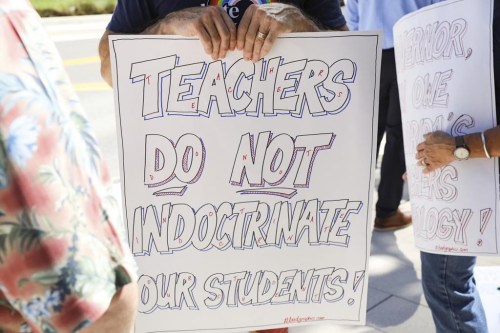
Traditionally nonpartisan, local school boards have become fiercely political amid entrenched battles over the teaching of race, history and sexuality. Candidates opposing what they see as “woke” ideology in public schools have sought to gain control of school boards across the U.S. and overturn policies deemed too liberal.
The push has been boosted by Republican groups including the 1776 Project PAC, which steered millions of dollars into local school races this year amid predictions of a red wave. But on Tuesday, just a third of its roughly 50 candidates won.

Moms for Liberty, another conservative political group, endorsed more than 250 candidates, with about half winning so far. And despite resounding victories for Republicans including Florida Gov. Ron DeSantis and Texas Gov. Greg Abbott, several gubernatorial candidates who leaned heavily on parents’ rights fell short, including in Michigan, Wisconsin, Kansas and Maine.
The results raise doubts about the movement’s widespread political strength and pose a potential obstacle for Republican lawmakers hoping to rally behind proposed legislation on the issue. With the GOP poised to take a narrow majority in the U.S. House, Leader Kevin McCarthy has already issued plans for a “Parents Bill of Rights,” though its details are vague.
Teachers unions and liberal grassroots groups also have been pushing back with money and messaging of their own, casting conservative activists as fearmongers intent on turning parents against public schools.
The parents’ rights movement demands transparency around teaching but also includes a wide range of cultural stances, calling for schools to remove certain books dealing with race or sexuality, for example, and an end to history lessons that aren’t “patriotic.”
In hindsight, activists this election should have had a stronger emphasis on academic issues, said Ryan Girdusky, founder of the 1776 Project PAC.
“The messaging needs to be more positive,” he said. “Sometimes you lose moderate voters because you’re too hyperbolic and you’re not speaking truth to something very local to them.”
The midterms marked a reversal from previous elections that saw parents’ rights proponents land major victories. Virginia Gov. Glenn Youngkin, a Republican, hammered the importance of parents’ rights in his successful campaign last year, winning crucial support from suburban voters — one year after the state voted for Democratic President Joe Biden.
Before Tuesday, the 1776 PAC had won roughly 75% of its races in the two previous years, putting dozens of school boards across the nation in control of conservative candidates.
Those victories have been attributed largely to parents’ anger over schools’ handling of the pandemic, including long closures and mask mandates. This year, the message pivoted to the cultural divides that have sparked battles around transgender rights, racism and sexuality.
In New Buffalo, Michigan, in the state’s purple southwest corner, four candidates supported by the 1776 PAC took on four candidates favored by a teachers union. The conservatives took out full-page ads in two local newspapers accusing their opponents of supporting a school program that promotes critical race theory, sexually inappropriate material and “anti-parent content.”
“NO Critical Race Theory,” the ad read. “NO biological boys in girls sports.”
Later, local residents began to raise worries about “furries” — a baseless myth spread by some conservatives alleging that students at some U.S. schools have been allowed to use litter boxes and given other special treatment if they identify as animals.
The level of misinformation was startling to Denise Churchill, one of the candidates endorsed by the teachers union. But on Tuesday, she and her three running mates won by wide margins, with the city also voting for Democrats at the state level.
“Truth prevails, and hate loses,” said Churchill, who has two children in the district. She said the district has always invited parent involvement. “But parental rights does not mean that you get to cherrypick what’s taught in the schools.”
The county that houses New Buffalo was a prized target for the 1776 group, having voted for Republican candidates for president and governor in recent elections. The group campaigned for 20 candidates across eight districts, but just four were elected. Many were defeated by union-backed candidates.
The group also fell short in its attempt to win majorities on boards in conservative Bentonville, Arkansas, and purple Round Rock, Texas. Its biggest victory was in right-leaning Carroll County, Maryland, where its candidates won three seats. All four of its candidates won in Florida, which has become a stronghold for the movement.
Despite the losses, some conservatives saw hopeful signs in DeSantis and Abbott’s high-profile victories. And even picking up scattered school board seats across the country should be viewed as progress for a Republican Party that has long neglected education as a priority, said Rory Cooper, a GOP strategist and former congressional staffer.
“We’re not seeing Democratic opponents go unopposed like they used to,” he said. “I’m counting this year as a victory.”
Democrats see the losses as proof that rhetoric around critical race theory and gender issues may play well in Republican primaries, but it has limited appeal for moderate Americans.
“In general elections, voters don’t want to hear about it,” said Stephanie Cutter, a Democratic strategist and former senior adviser to President Barack Obama. “The overwhelming majority of parents support their kids’ teachers, believe in their public schools and want accurate history being taught in their classrooms.”
As conservative groups increasingly inject themselves into local school board races, Democrats have responded in kind. State teachers unions have increased spending on their candidates, and grassroots groups including Red Wine and Blue have rallied liberal suburban parents.
But in many areas, school board members facing conservative challengers have aimed to distance themselves from any political affiliation.
In Coloma, Michigan, a town near New Buffalo, four incumbents opted not to accept outside money as they ran against three challengers supported by the 1776 PAC. All four incumbents won.

“We did not speak about them. We spoke about us,” said Heidi Ishmael, president of the school board. “I am a firm believer the school board is nonpartisan. We are there to listen to and represent our entire community.”
Democratic strategists have held up that approach — de-escalating the role of politics in education — as a winning tactic. Candidates who draw attention to any perceived bias run the risk of looking like they’re the ones looking for political fights, said Guy Molyneux of Hart Research, a Democratic polling firm.
“I don’t think people want either the left or the right to triumph here,” Molyneux said. “They really want politics out of their schools.”
___
The Associated Press education team receives support from the Carnegie Corporation of New York. The AP is solely responsible for all content.