Drone advances in Ukraine could bring dawn of killer robots
Advertisement
Read this article for free:
or
Already have an account? Log in here »
To continue reading, please subscribe:

Digital Subscription
One year of digital access for only $205*
- Enjoy unlimited reading on winnipegfreepress.com
- Read the E-Edition, our digital replica newspaper
- Access News Break, our award-winning app
- Play interactive puzzles
*First annual payment billed as $205.00 + GST for one year. This annual subscription will automatically renew at $233.00 + GST every 52 weeks (10% off the regular annual price of $259.35). Offer available to new and qualified returning subscribers only. Cancel any time.
To continue reading, please subscribe:
Add Free Press access to your Brandon Sun subscription for only an additional
$1 for the first 4 weeks*
- Enjoy unlimited reading on winnipegfreepress.com
- Read the E-Edition, our digital replica newspaper
- Access News Break, our award-winning app
- Play interactive puzzles
*Your next Brandon Sun subscription payment will increase by $1.00 and you will be charged $17.95 plus GST for four weeks. After four weeks, your payment will increase to $24.95 plus GST every four weeks.
Read unlimited articles for free today:
or
Already have an account? Log in here »
Hey there, time traveller!
This article was published 03/01/2023 (1321 days ago), so information in it may no longer be current.
KYIV, Ukraine (AP) — Drone advances in Ukraine have accelerated a long-anticipated technology trend that could soon bring the world’s first fully autonomous fighting robots to the battlefield, inaugurating a new age of warfare.
The longer the war lasts, the more likely it becomes that drones will be used to identify, select and attack targets without help from humans, according to military analysts, combatants and artificial intelligence researchers.
That would mark a revolution in military technology as profound as the introduction of the machine gun. Ukraine already has semi-autonomous attack drones and counter-drone weapons endowed with AI. Russia also claims to possess AI weaponry, though the claims are unproven. But there are no confirmed instances of a nation putting into combat robots that have killed entirely on their own.

Experts say it may be only a matter of time before either Russia or Ukraine, or both, deploy them. The sense of inevitability extends to activists, who have tried for years to ban killer drones but now believe they must settle for trying to restrict the weapons’ offensive use.
Ukraine’s digital transformation minister, Mykhailo Fedorov, agrees that fully autonomous killer drones are “a logical and inevitable next step” in weapons development. He said Ukraine has been doing “a lot of R&D in this direction.”
“I think that the potential for this is great in the next six months,” Fedorov told The Associated Press in a recent interview.
Ukrainian Lt. Col. Yaroslav Honchar, co-founder of the combat drone innovation nonprofit Aerorozvidka, said in a recent interview near the front that human war fighters simply cannot process information and make decisions as quickly as machines.
Ukrainian military leaders currently prohibit the use of fully independent lethal weapons, although that could change, he said.
“We have not crossed this line yet – and I say ‘yet’ because I don’t know what will happen in the future,” said Honchar, whose group has spearheaded drone innovation in Ukraine, converting cheap commercial drones into lethal weapons.
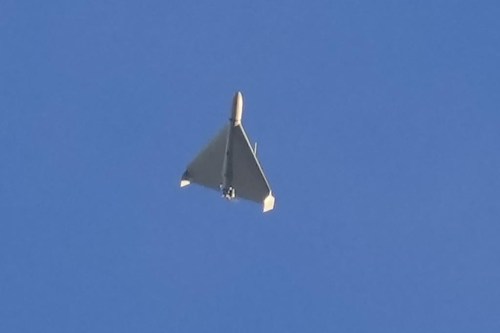
Russia could obtain autonomous AI from Iran or elsewhere. The long-range Shahed-136 exploding drones supplied by Iran have crippled Ukrainian power plants and terrorized civilians but are not especially smart. Iran has other drones in its evolving arsenal that it says feature AI.
Without a great deal of trouble, Ukraine could make its semi-autonomous weaponized drones fully independent in order to better survive battlefield jamming, their Western manufacturers say.
Those drones include the U.S.-made Switchblade 600 and the Polish Warmate, which both currently require a human to choose targets over a live video feed. AI finishes the job. The drones, technically known as “loitering munitions,” can hover for minutes over a target, awaiting a clean shot.
“The technology to achieve a fully autonomous mission with Switchblade pretty much exists today,” said Wahid Nawabi, CEO of AeroVironment, its maker. That will require a policy change — to remove the human from the decision-making loop — that he estimates is three years away.
Drones can already recognize targets such as armored vehicles using cataloged images. But there is disagreement over whether the technology is reliable enough to ensure that the machines don’t err and take the lives of noncombatants.

The AP asked the defense ministries of Ukraine and Russia if they have used autonomous weapons offensively – and whether they would agree not to use them if the other side similarly agreed. Neither responded.
If either side were to go on the attack with full AI, it might not even be a first.
An inconclusive U.N. report suggested that killer robots debuted in Libya’s internecine conflict in 2020, when Turkish-made Kargu-2 drones in full-automatic mode killed an unspecified number of combatants.
A spokesman for STM, the manufacturer, said the report was based on “speculative, unverified” information and “should not be taken seriously.” He told the AP the Kargu-2 cannot attack a target until the operator tells it to do so.
Honchar believes Russia, whose attacks on Ukrainian civilians have shown little regard for international law, would have used killer autonomous drones by now if the Kremlin had them.
“I don’t think they’d have any scruples,” agreed Adam Bartosiewicz, vice president of WB Group, which makes the Warmate.
AI is a priority for Russia. President Vladimir Putin said in 2017 that whoever dominates that technology will rule the world. In a Dec. 21 speech, he expressed confidence in the Russian arms industry’s ability to embed AI in war machines, stressing that “the most effective weapons systems are those that operate quickly and practically in an automatic mode.” Russian officials already claim their Lancet drone can operate with full autonomy.
An effort to lay international ground rules for military drones has so far been fruitless. Nine years of informal United Nations talks in Geneva made little headway, with major powers including the United States and Russia opposing a ban. The last session, in December, ended with no new round scheduled.
Toby Walsh, an Australian academic who campaigns against killer robots, hopes to achieve a consensus on some limits, including a ban on systems that use facial recognition and other data to identify or attack individuals or categories of people.
“If we are not careful, they are going to proliferate much more easily than nuclear weapons,” said Walsh, author of “Machines Behaving Badly.” “If you can get a robot to kill one person, you can get it to kill a thousand.”
Multiple countries, and every branch of the U.S. military, are developing drones that can attack in deadly synchronized swarms, according to Zachary Kallenborn, a George Mason University weapons innovation analyst.

So will future wars become a fight to the last drone?
That’s what Putin predicted in a 2017 televised chat with engineering students: “When one party’s drones are destroyed by drones of another, it will have no other choice but to surrender.”
___
Frank Bajak reported from Boston. Associated Press journalists Tara Copp in Washington, Garance Burke in San Francisco and Suzan Fraser in Turkey contributed to this report.
___
Follow the AP’s coverage of the war at https://apnews.com/hub/russia-ukraine
___
This story has been updated to correct when the U.N. report was issued. It came out in 2021, not last year.