Minnesota Buddhist temple opens up sacred dance troupe
Advertisement
Read this article for free:
or
Already have an account? Log in here »
To continue reading, please subscribe:

Digital Subscription
One year of digital access for only $205*
- Enjoy unlimited reading on winnipegfreepress.com
- Read the E-Edition, our digital replica newspaper
- Access News Break, our award-winning app
- Play interactive puzzles
*First annual payment billed as $205.00 + GST for one year. This annual subscription will automatically renew at $233.00 + GST every 52 weeks (10% off the regular annual price of $259.35). Offer available to new and qualified returning subscribers only. Cancel any time.
To continue reading, please subscribe:
Add Free Press access to your Brandon Sun subscription for only an additional
$1 for the first 4 weeks*
- Enjoy unlimited reading on winnipegfreepress.com
- Read the E-Edition, our digital replica newspaper
- Access News Break, our award-winning app
- Play interactive puzzles
*Your next Brandon Sun subscription payment will increase by $1.00 and you will be charged $17.95 plus GST for four weeks. After four weeks, your payment will increase to $24.95 plus GST every four weeks.
Read unlimited articles for free today:
or
Already have an account? Log in here »
Hey there, time traveller!
This article was published 11/02/2023 (1289 days ago), so information in it may no longer be current.
HAMPTON, Minn. (AP) — The Buddhist community anchored by an ornate temple complex here in the Minnesota farmland is trying a new way to ensure its faith and ancestral culture stay vibrant for future generations — an open call for the sacred dance troupe.
Founded by refugees fleeing the Khmer Rouge regime, which sought to eradicate most religious institutions, Watt Munisotaram and its troupe hope that teaching young children sacred dance will strengthen their ties to both Buddhism and Cambodian traditions.
“The connection is stronger when I dance,” said Sabrina Sok, 22, a Wattanak Dance Troupe leader. “The thing that stays in my head is this dance form almost disappeared with the Khmer Rouge.”
During their 1975-79 regime, the Khmer Rouge caused the deaths of an estimated 1.7 million in Cambodia. Hundreds of thousands fled, first to neighboring Thailand and later the United States, where Southeast Asians are one of the largest refugee communities.
They carried this sacred dance tradition with them. On a frigid early February evening, Sok rehearsed for the upcoming Cambodian New Year holiday with fellow troupe leader Garrett Sour and his sister Gabriella, whose parents were among those refugees.
Practice used to be held at the temple, whose golden spires outshine the red barn roofs and silos in the snow-covered fields about 30 miles (48 kilometers) south of the Twin Cities. But it was recently moved to a Minneapolis studio to make it easier for families to participate.
While recruitment was by word of mouth, this winter’s enrollment — open to anybody eager to learn the dance form — brought in the highest number ever after being posted on the temple’s Facebook page.
Clothed in traditional thick silk shirts and pants from Cambodia, the three dancers sinuously stretched and bent every part of their bodies, from joint-defying toe curls on up. Each movement helps tell ancient stories about gods, the cycle of life and other spiritual tales that intertwine elements of Buddhism, Hinduism and Animism.
“We’re never ourselves, we’re just physical embodiments of higher spirits,” said Garrett Sour, 20, as he meticulously coached the poses, urging a smaller step here, a deeper calf tilt there. “Dance was seen not as entertainment but a medium between heaven and earth.”
The marketing student at a Twin Cities university started dancing when he was six and has learned Khmer to better delve into the sacred storytelling. He will be one of the teachers for the incoming dancers – about 20, which nearly doubles the troupe, and most of them younger than teens.
“For me, to see the kids perform these traditional dances is verification they cherish and take seriously our tradition and our religion,” said Garrett’s mother, Sophia Sour, who has long been a volunteer at Watt Munisotaram.
In the temple’s ornate higher room, where the ten monks in residence chant and meditate daily surrounded by sacred books and large Cambodian-made paintings of Buddha’s life, the Venerable Vicheth Chum also highlighted the importance of what he called “blessed dance.”
“Very important to have, and to keep our ancestral tradition even when moved to (Minnesota),” said Chum, who came to the United States more than 20 years ago from Cambodia. “Buddhist teaching is practice for peace and happiness, no matter the nation.”
Monks at Watt Munisotaram – which roughly means the place to enjoy learning from wise men – practice Theravada, one of the oldest forms of Buddhism rooted in Southeast Asian cultures.
During the Khmer Rouge regime, and the communist Vietnamese rule that followed it, religious institutions were targeted by violence and repression, but Cambodian refugees kept traditions alive, said John Marston, an expert in Cambodian Buddhism at the Mexican university Colegio de Mexico.
Dance in particular, which dates back nearly 1,000 years and was linked to the royal court as well as temples, has become “a marker of Cambodian identity” in the U.S. diaspora, he added.
That’s why the dance troupe was started at Watt Munisotaram, which has grown into a 40-acre complex with golden Buddha statues, a stupa with relics and a meditation pond that lay frozen under knee-high snow on that early February weekend.
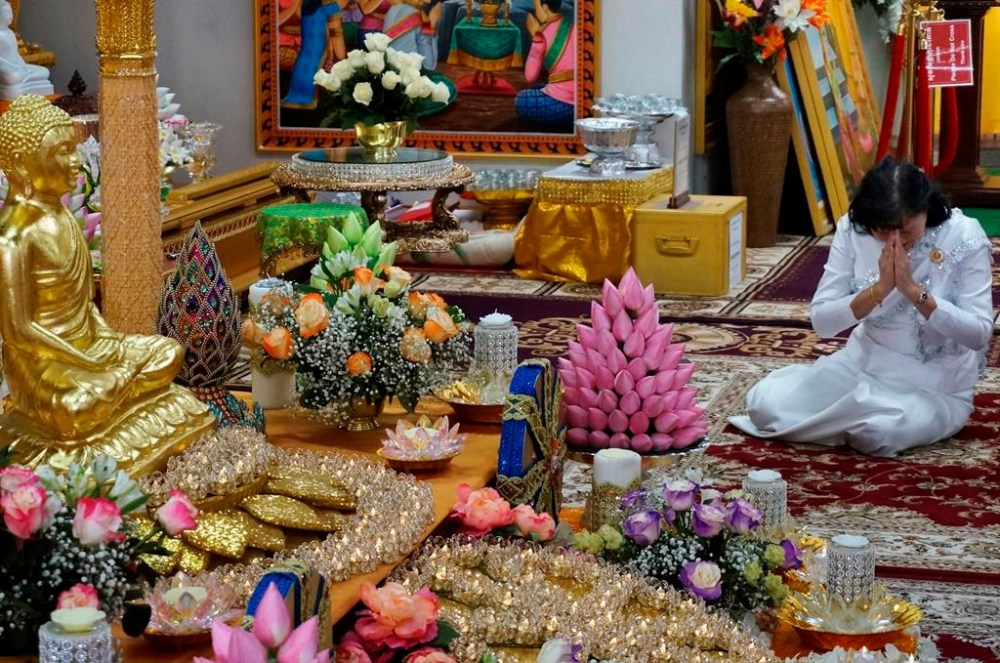
Dozens of faithful in equally bright white outfits met then to celebrate Magha Puja, a holiday marking the gathering of 1,250 of Buddha’s first disciples and the establishment of his rules for the new community.
Chum and seven other monks in elaborately folded, bright orange robes led a candlelit procession multiple times past an altar with several golden Buddha statues, glittery decorations and a profusion of flowers including lotus blossoms – most artificial, though in more clement weather some are grown locally or shipped from Florida.
Several children marched along, carrying the U.S. flag and Cambodia’s state and Buddhist flags, before everyone sat in neat rows on the carpeted floor for two hours of chanting in Khmer.
Chum said the monks worry about young people’s growing disenchantment with religion but believe that life’s inevitable struggles will eventually bring most back to the temple for guidance from Buddha’s teachings.
“It’s like learning a map and then taking action,” he said.
Garrett Sour, who grew up going frequently with his family to the temple, said he’s still figuring out how Buddhism applies to his life culturally and religiously.
But he’s fully embraced sacred dancing, and is eager to share what he learned from his teachers – including an aunt who danced in refugee camps before moving to Minnesota – with children, so the tradition can continue through generations.
The troupe’s main goal “is to preserve dances that were already there,” he said, adding that each summer they perform in a special ceremony honoring the spirits of previous dancers with altars replete with dancing ornaments and offerings.
Watching the recent rehearsal, Garrett’s mother beamed with pride.
“The world is using them to educate the other communities, I keep on reminding them,” Sophia Sour said.
She hopes to take Garrett and Gabriella to Cambodia to learn even more about the roots of their spirituality, whose fundamental values she listed as respect for the elders and good deeds.
“If you do good, good will come to you,” she said. “I’m not sure if that’s religion, or just life.”
—
Associated Press religion coverage receives support through the AP’s collaboration with The Conversation US, with funding from Lilly Endowment Inc. The AP is solely responsible for this content.
The Free Press acknowledges the financial support it receives from members of the city’s faith community, which makes our coverage of religion possible.