Doctors, patient advocates hope simulation ‘suit’ will raise heart failure awareness
Advertisement
Read this article for free:
or
Already have an account? Log in here »
To continue reading, please subscribe:

Digital Subscription
One year of digital access for only $205*
- Enjoy unlimited reading on winnipegfreepress.com
- Read the E-Edition, our digital replica newspaper
- Access News Break, our award-winning app
- Play interactive puzzles
*First annual payment billed as $205.00 + GST for one year. This annual subscription will automatically renew at $233.00 + GST every 52 weeks (10% off the regular annual price of $259.35). Offer available to new and qualified returning subscribers only. Cancel any time.
To continue reading, please subscribe:
Add Free Press access to your Brandon Sun subscription for only an additional
$1 for the first 4 weeks*
- Enjoy unlimited reading on winnipegfreepress.com
- Read the E-Edition, our digital replica newspaper
- Access News Break, our award-winning app
- Play interactive puzzles
*Your next Brandon Sun subscription payment will increase by $1.00 and you will be charged $17.95 plus GST for four weeks. After four weeks, your payment will increase to $24.95 plus GST every four weeks.
Read unlimited articles for free today:
or
Already have an account? Log in here »
Hey there, time traveller!
This article was published 22/02/2023 (1305 days ago), so information in it may no longer be current.
Marc Bains was an active 23-year-old when he got what he thought was the flu or bronchitis.
He couldn’t climb the stairs without getting out of breath. When he finally made it up to his bed, he couldn’t lie down flat without coughing.
When he started getting chest pains, he went to the ER in Richmond, B.C.
After a series of tests, his doctor told him he had heart failure.
“It was shocking,” said Bains, who is now 37.
“My life essentially stopped where everyone’s life kept going.”
Heart failure means that the heart can’t pump out enough blood to circulate fresh oxygen and nutrients throughout the body, usually because the muscle has become either too weak or too stiff, said Patrice Lindsay, director of health systems at the Heart and Stroke Foundation.
Heart failure usually affects people much older than Bains – and as the population ages, it’s become “a major Canadian health issue,” she said.
There are many causes or underlying risk factors for heart failure, according to the foundation.
Although it’s good news that more people are surviving heart attacks, the resulting damage to the heart muscle puts them at higher risk for heart failure. Coronary artery disease and high blood pressure are other common causes.
Heart arrhythmias (irregular heartbeat), heart valve disease and viral infections that attack the heart can also cause heart failure.
About 750,000 people are currently living with the condition in Canada, with about 100,000 new cases diagnosed every year.
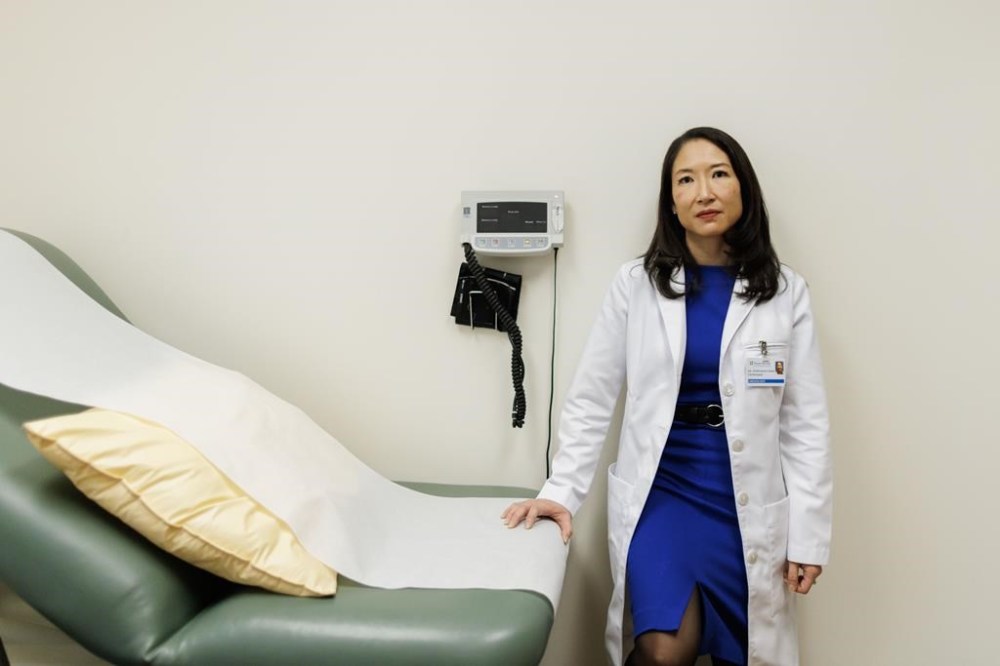
Yet many people don’t understand what heart failure is or recognize the symptoms, said Dr. Stephanie Poon, cardiologist and heart failure specialist at Sunnybrook Health Sciences Centre in Toronto.
The most common symptoms of heart failure include shortness of breath, fatigue and swelling in the legs and abdomen due to severe fluid retention, Poon said.
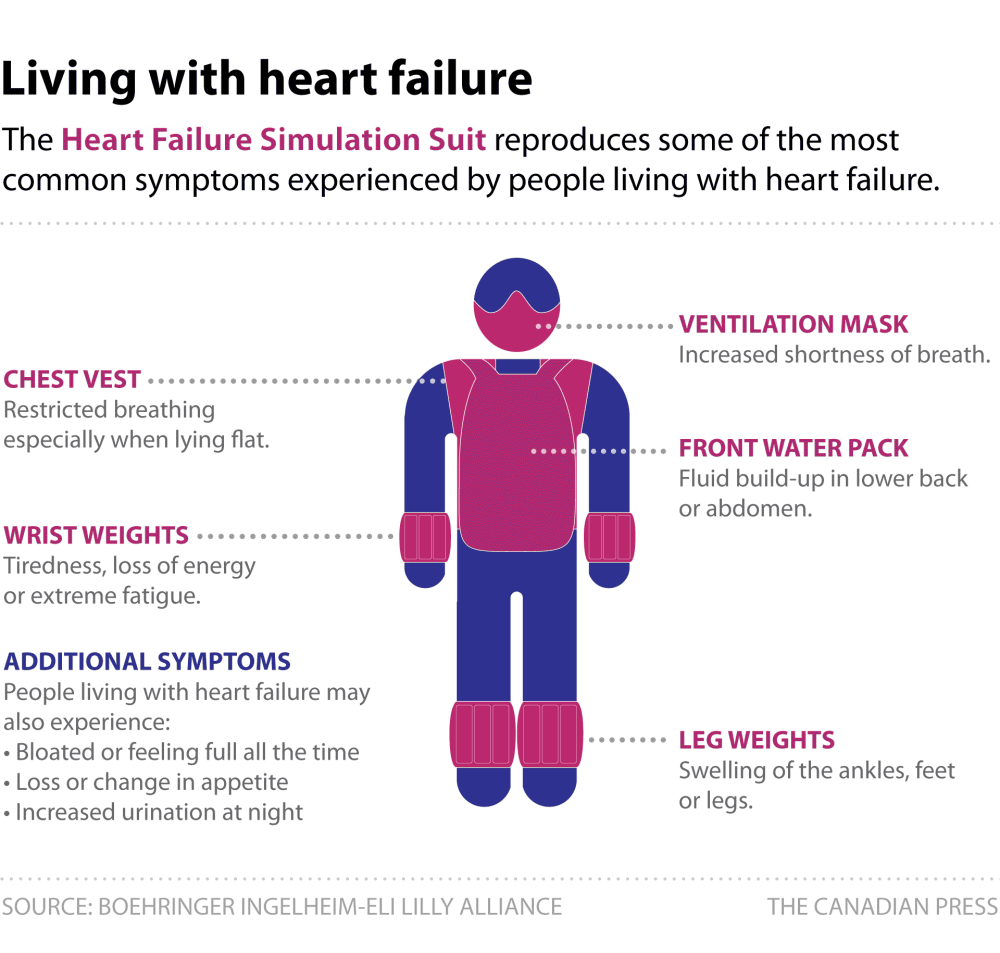
Those symptoms are meant to be replicated with a new heart failure “suit,” developed by the Meyer-Hentschel Institute in Germany, along with pharmaceutical companies Boehringer Ingelheim and Eli Lilly.
The companies are touring the suit to hospitals across Canada with the aim of raising awareness among media, health-care providers and caregivers about the symptoms of heart failure — and what it’s like to live with them.
The “suit” is comprised of leg weights to mimic the difficulty of walking, especially up and down stairs, when the ankles, feet and legs are swollen; a chest vest, topped with a large water pack, to simulate the pressure a patient feels on their chest when lying down and the extra weight they carry; and a mask that makes it difficult to breathe. The suit also incorporates wrist weights to add to the overall feeling of fatigue.
Poon tried on the suit and said she hopes other doctors and caregivers will do the same.
“(The suit) allows people to get a hands-on experience of what our patients with heart failure are going through on a day-to-day basis in a way that no words could ever describe to you,” Poon said.
“I’m a health-care provider, a heart failure specialist. I know to the Nth degree how to list off those symptoms but when I tried on the suit it was just eye-opening as to how much it could truly impact your day-to-day activities.
“Easy things like you take for granted. Walking up the stairs. Tying your shoes. You know, I couldn’t even imagine trying to do laundry like that,” she said.
“But also as the suit came off and the components came off, just realizing how much of a relief that you can actually get if you’re diagnosed early, started on the right medications … you can start feeling better almost instantaneously.”
Bains, who co-founded a patient support and advocacy group called HeartLife, said he hopes the suit helps generate more public awareness about the signs and symptoms, noting it can be an “invisible disease.”
There are likely many Canadians who have heart failure but haven’t been diagnosed, he said.
Trying on the simulation suit could also go a long way in fostering an “empathetic approach” to care, Bains said.
“You’re tired a lot. You know, your heart’s not pumping as well so your body’s not getting the blood and oxygen that it needs. And so you’re fatigued.”
There is no cure for heart failure but the right medications can help alleviate the symptoms, Poon said.
Those medications include angiotensin receptors (ARNI), angiotensin blockers/ACE inhibitors, beta blockers, mineralocorticoid antagonists and SGLT inhibitors, she said. They’re used to make the heart pump more normally and get rid of the extra water weight patients are carrying.
Depending on how much damage there is to the heart, some people need implanted pacemakers or defibrillators.
With medication and an implanted defibrillator (which shocks the heart back into a normal pumping rhythm if it starts to fail), Bains was able to work, play sports and travel again.
But friends and family need to understand that heart failure patients need to stay vigilant about their condition, he said.
“You look up a place to go overseas, it’s not about attractions, it’s about where are the right hospitals to go to if something were to happen,” Bains said.
Bains’ friends and family all learned to perform CPR after he was diagnosed, he said — and he had to be resuscitated four times.

Lindsay of the Heart and Stroke Foundation said family and friends can also support heart failure patients by realizing they’ll have good days and bad days. Sometimes they will be able to do normal activities, but other times they may need to rest, she said.
Bains was one of about 10 per cent of patients who had “advanced heart failure” — and so he was placed on a transplant list. He got a new heart in 2018 and no longer suffers from heart failure symptoms.
Advanced heart failure “means that conventional heart failure therapies and symptom management strategies are no longer working; we start thinking about giving people heart transplants only when they’ve reached the advanced heart failure stage,” said Poon, who is not Bains’ cardiologist.
This report by The Canadian Press was first published Feb. 22, 2023.
Canadian Press health coverage receives support through a partnership with the Canadian Medical Association. CP is solely responsible for this content.