Bhangra has health benefits for kids, but more school programs needed: Doctor
Advertisement
Read this article for free:
or
Already have an account? Log in here »
To continue reading, please subscribe:

Digital Subscription
One year of digital access for only $205*
- Enjoy unlimited reading on winnipegfreepress.com
- Read the E-Edition, our digital replica newspaper
- Access News Break, our award-winning app
- Play interactive puzzles
*First annual payment billed as $205.00 + GST for one year. This annual subscription will automatically renew at $233.00 + GST every 52 weeks (10% off the regular annual price of $259.35). Offer available to new and qualified returning subscribers only. Cancel any time.
To continue reading, please subscribe:
Add Free Press access to your Brandon Sun subscription for only an additional
$1 for the first 4 weeks*
- Enjoy unlimited reading on winnipegfreepress.com
- Read the E-Edition, our digital replica newspaper
- Access News Break, our award-winning app
- Play interactive puzzles
*Your next Brandon Sun subscription payment will increase by $1.00 and you will be charged $17.95 plus GST for four weeks. After four weeks, your payment will increase to $24.95 plus GST every four weeks.
Read unlimited articles for free today:
or
Already have an account? Log in here »
Hey there, time traveller!
This article was published 28/02/2023 (1309 days ago), so information in it may no longer be current.
VANCOUVER – When nine-year-old Viaan Deol goes to bhangra lessons twice a week, his favourite part is seeing all the friends he’s made from different schools in Surrey, B.C.
His mom, Raj Kaur, is thrilled he’s getting more physically fit and connecting to his Punjabi roots during the hour-long, high-energy classes at a dance school.
“If they stay home, they just watch TV and sit and eat. They don’t do any other activity,” Kaur said of Viaan and his five-year-old brother Jaivir Deol, who was eager to follow his older sibling into the world of bhangra, a folk dance that originated in the Punjab province of India to celebrate the harvest.
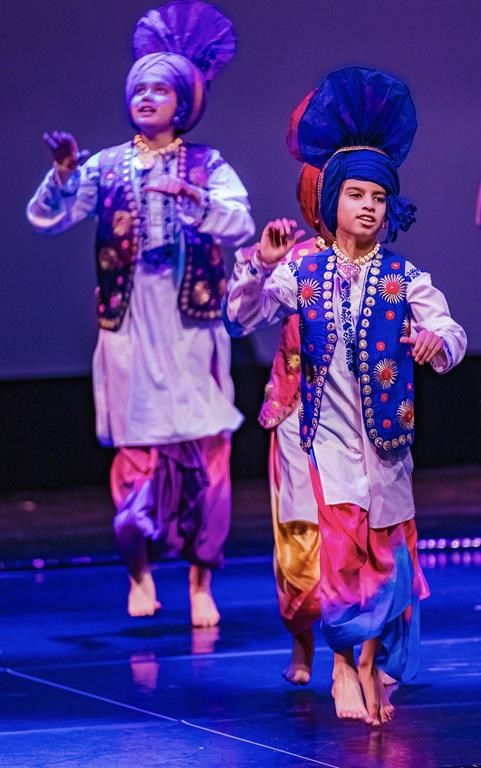
Viaan was initially more into the music than the moves of the traditional dance he started at age four but has since performed in some local shows and likes jumping in on the bhangra action at weddings and parties, he said.
“You have to get every step right. I feel like I get a good workout.”
Kaur said she thinks both of her sons are getting big fitness benefits from bhangra lessons at a local dance academy.
While Viaan’s parents enrolled him in lessons outside of school, the results of a pilot project at four elementary schools suggest bhangra provides aerobic benefits.
Dr. Tricia Tang, a research investigator with the BC Children’s Hospital Research Institute, led the pilot that had 156 students attending twice-weekly bhangra lessons for seven months.
The small pilot was part of an after-school program at three schools in Surrey and another in neighbouring Delta, a region with a high South Asian population, which is at higher risk than other groups for heart disease and Type 2 diabetes.
Results published last June in the journal Childhood Obesity show improvement in aerobic fitness, which was measured using a 20-metre shuttle run test, vertical jump heights, waist circumference and body mass index, or BMI.
“The average laps our group as a whole was able to complete was 19. After the seven-month intervention, the mean number of laps was 26, which is phenomenal,” Tang said of the pilot between November 2017 and May 2018.
However, a pilot study does not show causation so what’s needed is a randomized control trial to provide empirical evidence of the early intervention involving far more schools and students, she said.
Research is lacking in Canada on the cardiovascular health of South Asians, the fastest-growing immigrant group that also has the highest rates of death and illness associated with heart disease.
Studies done mostly in the United Kingdom show South Asians have higher blood sugar levels, waist circumference and body mass index, or BMI, compared with those in the general population.
“We already know that kids who are nine to 10 years old, they’re already at a disadvantage. This disadvantage widens and magnifies over time if they don’t engage in behaviours that reduce the risk,” said Tang, who is also an associate professor in the division of endocrinology at the University of British Columbia.
The aim of the pilot at the four schools was to improve South Asian children’s fitness early in the hope they’d adopt exercise as a lifelong habit. Bhangra lessons were offered because the dance is part of the kids’ culture and history and their parents could relate to it for the same reasons.
“It’s fun,” Tang said. “For me, it was more about when we’re trying to engage families, what are the best forms of exercise we can use where parents are equally excited about it as the kids.”
Along with free lessons, students between the ages of eight and 12 also received six instructional videos of beginner, intermediate and advanced levels of bhangra, directed and produced by top bhangra dancers in British Columbia, so kids could practise at home and involve their parents, Tang said.
Tang said the fun factor was an important part of the pilot because people of all ages are more likely to stick to an activity they enjoy.
“I would love to do a study in Richmond using K-pop,” she said of the British Columbia city with a high Chinese population, which is also at greater risk of diabetes compared with their white Canadian counterparts.
“It’s the visceral body fat that’s around the organs that is the dangerous fat. It’s not like the Homer Simpson fat around the waist. East Asians are at greater risk than whites but the South Asians are by far at more greater risk than East Asians.”

Some families face barriers to fitness, including the cost of classes, she said, noting dances such as bhangra can promote fitness in children and could be part of school programs in various communities.
“Some parents don’t have the luxury of taking two hours of their weekend to drive their kids to lessons and drive back. When you look at neighbourhoods where the median household income is lower, those are the schools that don’t have the funding for programs like this,” Tang said.
“There’s just a lot of disadvantage in certain areas where kids would benefit the most but they have the least resources.”
This report by The Canadian Press was first published Feb. 28, 2023.
Canadian Press health coverage receives support through a partnership with the Canadian Medical Association. CP is solely responsible for this content.