Lawmakers back Paris Olympic law despite surveillance fears

Advertisement

Advertise with us

PARIS (AP) — A proposed French law for the 2024 Paris Olympics that critics contend will open the door for privacy-busting video surveillance technology in France and elsewhere in Europe passed an important hurdle on Tuesday with lawmakers overwhelmingly voting for it.

Read this article for free:


or

Already have an account? Log in here »

To continue reading, please subscribe:

Subscribe and receive a limited-edition Free Press branded hat or tote.

Digital Subscription

One year of digital access for only $205*

  • Enjoy unlimited reading on winnipegfreepress.com
  • Read the E-Edition, our digital replica newspaper
  • Access News Break, our award-winning app
  • Play interactive puzzles

*First annual payment billed as $205.00 + GST for one year. This annual subscription will automatically renew at $233.00 + GST every 52 weeks (10% off the regular annual price of $259.35). Offer available to new and qualified returning subscribers only. Cancel any time.

To continue reading, please subscribe:

Add Free Press access to your Brandon Sun subscription for only an additional

$1 for the first 4 weeks*

  • Enjoy unlimited reading on winnipegfreepress.com
  • Read the E-Edition, our digital replica newspaper
  • Access News Break, our award-winning app
  • Play interactive puzzles
Start now

*Your next Brandon Sun subscription payment will increase by $1.00 and you will be charged $17.95 plus GST for four weeks. After four weeks, your payment will increase to $24.95 plus GST every four weeks.

Hey there, time traveller!
This article was published 28/03/2023 (1275 days ago), so information in it may no longer be current.

PARIS (AP) — A proposed French law for the 2024 Paris Olympics that critics contend will open the door for privacy-busting video surveillance technology in France and elsewhere in Europe passed an important hurdle on Tuesday with lawmakers overwhelmingly voting for it.

The bill will legalize the temporary use of so-called intelligent surveillance systems to safeguard the Paris Games, which run next year from July 26-Aug. 11, and the Paralympics that follow. The systems combine cameras with artificial intelligence software to flag potential security concerns, such as abandoned packages or crowd surges. Human operators would decide whether action is needed.

French authorities insist the surveillance wouldn’t involve facial recognition. Supporters of the bill argue that the technology could help avert disasters like the deadly crowd crush that killed nearly 160 people during Halloween festivities in South Korea in October.
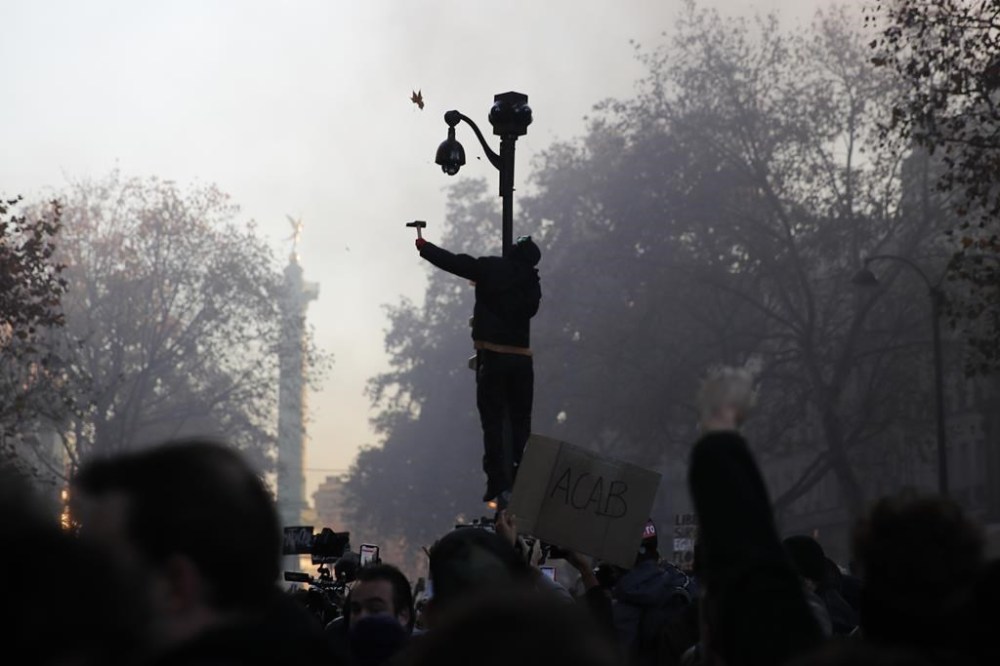
FILE - A protester uses a hammer to break a CCTV camera during a demonstration against a security law that would restrict sharing images of police, Saturday, Nov. 28, 2020 in Paris. A proposed French law for the 2024 Paris Olympics that critics contend will open the door for privacy busting video surveillance technology in France and elsewhere in Europe faces an important hurdle Tuesday March 28, 2023 with lawmakers set to vote on it. The bill would legalize the temporary use of so-called
FILE - A protester uses a hammer to break a CCTV camera during a demonstration against a security law that would restrict sharing images of police, Saturday, Nov. 28, 2020 in Paris. A proposed French law for the 2024 Paris Olympics that critics contend will open the door for privacy busting video surveillance technology in France and elsewhere in Europe faces an important hurdle Tuesday March 28, 2023 with lawmakers set to vote on it. The bill would legalize the temporary use of so-called "intelligent" surveillance systems to safeguard the Games and Paralympics. (AP Photo/Francois Mori, File)

“It’s not about recognizing ‘Mr. X’ in a crowd,” Interior Minister Gérald Darmanin told National Assembly lawmakers last week when they were debating the measures. “It’s about recognizing situations.”

The Senate overwhelmingly approved the draft in January, by 245 votes to 28. The National Assembly followed suit Tuesday with a 400-93 vote that the French government’s sports minister, Amélie Oudéa-Castéra, hailed as “an essential step.”

The draft is now slated for further fine-tuning by assembly members and senators before its final adoption, expected in April.

Digital rights watchdog groups argue that France will violate international human rights law by becoming the first of the European Union’s 27 countries to legalize AI-powered surveillance, even if just temporarily. The bill says the technology can be used on an experimental basis to the end of 2024 to safeguard sporting and cultural events in France that are particularly at risk of being targeted by terror attacks.

The technology’s use “risks permanently transforming France into a dystopian surveillance state” and “will lead to an all-out assault on the rights to privacy, protest, and freedom of assembly and expression,” said Mher Hakobyan, an Amnesty International adviser on AI regulation.

“It has also been well-documented that hostile surveillance technologies are disproportionately used to target marginalized groups, including migrants and Black and brown people,” Hakobyan added.

Even though the draft law says the cameras won’t use facial recognition, they are still liable to scrutinize physical traits including people’s postures, walks and gestures, critics contend. Opponents also are concerned that the technology risks zeroing-in on people who spend a lot of time in public spaces, such as the homeless. The bill also clears the way for the technology’s use with cameras mounted on drones.

___

More AP coverage of the Paris Olympics: https://apnews.com/hub/2024-paris-olympic-games and https://twitter.com/AP_Sports


Report Error Submit a Tip

More Stories

Disgraced former law dean arrested, facing extradition to Canada: report

Morgan Modjeski 2 minute read Preview

Disgraced former law dean arrested, facing extradition to Canada: report

Morgan Modjeski 2 minute read Yesterday at 10:26 PM CDT

Jonathan Black-Branch, the disgraced former dean of law at the University of Manitoba, has been arrested in Europe and is awaiting extradition to Canada on fraud charges, according to a media report.

Black-Branch, who failed to defend himself in a lawsuit filed by the U of M and his disbarment proceedings, was ordered in May 2025 to repay more than $682,000 in misspent expense funds.

Winnipeg police confirmed his arrest and pending extradition, CTV Winnipeg reported Tuesday.

Black-Branch left the university in 2020 amid allegations he had misspent public dollars and schemed to evade oversight while running Robson Hall from 2016 to 2020.

Read
Yesterday at 10:26 PM CDT

Letters, Sept. 23

7 minute read 2:00 AM CDT

Banning gambling ads

Re: Sweeney’s sexist U.S. gambling-site ad isn’t the real problem, Sept. 16

I applaud Dan Lett’s opinion piece regarding online gambling.

Reporting of increasing social issues due to the proliferation of gambling addictions has been thin. Online gambling (not just sports gambling) is super-charging this serious and growing problem.

Lawmakers back Paris Olympic law despite surveillance fears

John Leicester, The Associated Press 3 minute read Preview

Lawmakers back Paris Olympic law despite surveillance fears

John Leicester, The Associated Press 3 minute read Tuesday, Mar. 28, 2023

PARIS (AP) — A proposed French law for the 2024 Paris Olympics that critics contend will open the door for privacy-busting video surveillance technology in France and elsewhere in Europe passed an important hurdle on Tuesday with lawmakers overwhelmingly voting for it.

The bill will legalize the temporary use of so-called intelligent surveillance systems to safeguard the Paris Games, which run next year from July 26-Aug. 11, and the Paralympics that follow. The systems combine cameras with artificial intelligence software to flag potential security concerns, such as abandoned packages or crowd surges. Human operators would decide whether action is needed.

French authorities insist the surveillance wouldn't involve facial recognition. Supporters of the bill argue that the technology could help avert disasters like the deadly crowd crush that killed nearly 160 people during Halloween festivities in South Korea in October.

“It’s not about recognizing ‘Mr. X’ in a crowd,” Interior Minister Gérald Darmanin told National Assembly lawmakers last week when they were debating the measures. “It’s about recognizing situations.”

Read
Tuesday, Mar. 28, 2023

Far-right gaining foothold in Germany

Kyle Volpi Hiebert 5 minute read 2:00 AM CDT

By capturing 39 of 83 parliamentary seats in Saxony-Anhalt, a poorer area of east Germany with two million people, it’s closer to power than any German far-right party since the Nazi era.

Oilers stymie Jets again

Ken Wiebe 6 minute read Preview

Oilers stymie Jets again

Ken Wiebe 6 minute read Yesterday at 10:46 PM CDT

Were this a game that actually counted in the standings, the reaction from Winnipeg Jets head coach Scott Arniel probably wouldn’t have been nearly as composed.

The video evidence suggests the Edmonton Oilers had at least four players on the ice during a line change that turned into a two-on-one rush that finished with Zack Hyman setting up Viljami Marjala for a goal at 1:26 of overtime.

That left the Jets on the receiving end of a 2-1 overtime loss to sit with a pre-season record of 1-1-1.

“It was a pretty good jump,” said Arniel, who was more concerned about the shot from defenceman Dylan Samberg that helped spring the Oilers on the odd-man rush. “I’m not real keen on the slapper missing the net and going all the way down. I’m more concerned about that. It is what it is. Tough one for (Jets goaltender) Dom (DiVincentiis), because he was fantastic.”

Read
Yesterday at 10:46 PM CDT

Hepatitis A case detected at Winnipeg school

2 minute read Yesterday at 3:55 PM CDT

A case of hepatitis A was recently diagnosed at Shaughnessy Park School in northwest Winnipeg, with parents, guardians, students and staff advised to monitor for symptoms until Nov 3.

An immunization clinic will be held at the school, the Winnipeg Regional Health Authority said in a letter to parents, guardians and staff Friday. The school has students in nursery to Grade 8.

Manitoba Health has been monitoring an increase in cases of hepatitis A — an acute liver infection — with 1,004 reported between September 2024 and Sept. 10, 2026. The province said 257 hospitalizations, eight intensive care unit admissions and seven deaths were reported during that period.

"While the rate of cases in the Winnipeg health region increased in the spring and has remained stable since then, there has been a decreasing trend in the rest of the province," a provincial spokesperson said in a statement.