Dinosaur species laid eggs like reptiles, brooded like birds, new study finds

Advertisement

Advertise with us

EDMONTON - The birds we see today are the descendants of a dinosaur that learned to fly and survived mass extinction 66 million years ago, but little is known about their transition.

Read this article for free:


or

Already have an account? Log in here »

To continue reading, please subscribe:

Subscribe and receive a limited-edition Free Press branded hat or tote.

Digital Subscription

One year of digital access for only $205*

  • Enjoy unlimited reading on winnipegfreepress.com
  • Read the E-Edition, our digital replica newspaper
  • Access News Break, our award-winning app
  • Play interactive puzzles

*First annual payment billed as $205.00 + GST for one year. This annual subscription will automatically renew at $233.00 + GST every 52 weeks (10% off the regular annual price of $259.35). Offer available to new and qualified returning subscribers only. Cancel any time.

To continue reading, please subscribe:

Add Free Press access to your Brandon Sun subscription for only an additional

$1 for the first 4 weeks*

  • Enjoy unlimited reading on winnipegfreepress.com
  • Read the E-Edition, our digital replica newspaper
  • Access News Break, our award-winning app
  • Play interactive puzzles
Start now

*Your next Brandon Sun subscription payment will increase by $1.00 and you will be charged $17.95 plus GST for four weeks. After four weeks, your payment will increase to $24.95 plus GST every four weeks.

Hey there, time traveller!
This article was published 03/04/2023 (1265 days ago), so information in it may no longer be current.

EDMONTON – The birds we see today are the descendants of a dinosaur that learned to fly and survived mass extinction 66 million years ago, but little is known about their transition.

While they were the only species to survive the Cretaceous period, there also wasn’t much known about how similar the dinosaurs and modern-day birds could be.

A tiny piece of a dinosaur eggshell, about the size of a fingernail, was central in an international study published Monday in the Proceedings of the National Academy of Sciences journal, helping reconstruct the prehistoric creature’s reproductive system and establish its physiology, metabolism and body temperature.
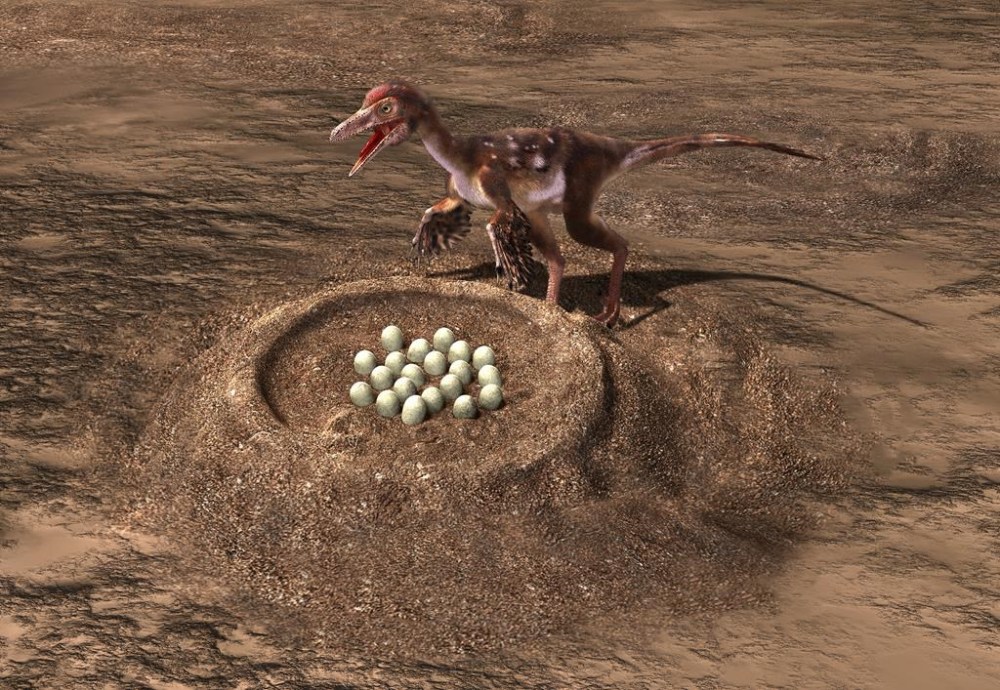
A Troodon stands near a nest in this illustration provided by Masato Hattori. The birds we see today are a form of meat-eating dinosaurs that learned to fly and survived mass extinction 66 million years ago, but little is known about their transition. THE CANADIAN PRESS/HO-Masato Hattori **MANDATORY CREDIT **

The Troodon, believed to be a meter-long meat-eating dinosaur, is considered to have given rise to birds, said François Therrien, a paleontologist at the Royal Tyrrell Museum in Drumheller, Alta., who is one the authors of the study.

The study, he said, “can give us a lot of information about what occurred during that transformation from a typical meat-eating dinosaur to a bird, (like) answering questions about whether the birds really inherit most of the characteristics from meat-eating dinosaurs.”

Therrien added the transition was a gradual one, something researchers found by looking at similarities the dinosaur had to modern-day reptiles and birds.

The study found that Troodons were warm-blooded animals with a reproductive system similar to today’s reptiles, but they also had the ability to moderate their body temperature similar to birds.

While Troodon eggs resembled a bird’s egg in shape and surface, the female dinosaurshad two ovaries and could lay two eggs at a time, like that of reptiles.

This also means a female Troodon could lay four to six eggs per clutch, said Darla Zelenitsky, a dinosaur paleobiology professor at the University of Calgary.

“We were able to figure out the dinosaur produced its eggs very slowly, which is typical of modern reptiles,” said Zelenitsky, who also is one of the authors of the study.

Female birds have one ovary and can lay an egg every one or two days. Researchers aren’t clear if the evolutionary loss of an ovary happened among non-avian dinosaurs or after the transition into birds.

The study used a technique called dual clumpedisotope thermometry to measure the heavier varieties of oxygen and carbonin the eggshell fossils to determine the body temperatures of Troodons and to better understand the dinosaur’s reproductive system.

The findings were then matched with eggshells of modern-day reptiles, such as crocodiles, alligators and certain species of a turtle, as well as birds like chickens, sparrows, wrens and ostriches.

The dinosaur nestlings, some found at two sites in southern Alberta, had up to 24 eggs, suggesting female Troodons laid eggs in communal nests, which is seen among birds including ostriches.

“It’s possible that some (Troodon) mothers congregated together to build communal nests and lay all their eggs, and then share duties of guarding and brooding all the eggs in turns,” Therrien said.

The nests also reflected intelligence among the Troodons, Therrien and Zelenitsky said. The dinosaurs buried the eggs in the nest vertically with the pointy down and the blunt side up, which could have improved incubation.

The eggshell fossils, which are stored at the Royal Tyrrell Museum, helped scientists reconstruct the Earth’s surface temperature to understand better the body temperature of the dinosaur and the mineralization processes of the fossils.

The isotope clumping of oxygen and carbon crystallization, which depends on temperature, also revealed the body temperature of the species.

Troodon dinosaurs were believed to lay eggs at between 30 C and42 C. The species had a resting body temperature of 42 C, which could be lowered to 30 C, depending on their environment, similar to birds.

Scientists are now looking into whether Troodons could have survived in humid areas in different parts of the world, as opposed to the semi-arid regions where the eggs were first discovered.

“Most people think that you need to find complete dinosaur skeletons to be able to say something about its biology and the animals when they were alive,” Therrien said.

“With the study, we truly can go into how an animal functioned by studying the isotopic composition of the eggshell that you can’t obtain from the study of bones alone.”

Researchers are now looking into Troodon eggs from different sites and from periods to see if the patterns found in this study continue to be consistent with other eggs.

This report by The Canadian Press was first published April 3, 2023.

This story was produced with the financial assistance of the Meta and Canadian Press News Fellowship.


Report Error Submit a Tip

More Stories

Jets vets weigh in on franchise goalie Hellebuyck not reporting to training camp

Mike McIntyre 7 minute read Preview

Jets vets weigh in on franchise goalie Hellebuyck not reporting to training camp

Mike McIntyre 7 minute read Thursday, Sep. 17, 2026

Hockey is the ultimate team sport, where it’s supposed to be about the crest on your chest rather than the name on your back.

So how is Connor Hellebuyck’s trade request and subsequent training camp strike playing out inside the Winnipeg Jets locker room — particularly among other core players he’s gone to battle with over the years?

“Obviously the news is heartbreaking,” Jets forward Kyle Connor said Thursday.

“It feels like we had such a special group here and for whatever reason — I can’t speak to the reason until we hear from the man, I’m not going to speculate on what it is but I know that a lot of guys in that room that are heartbroken.”

Read
Thursday, Sep. 17, 2026

Manitoba abandoning spring, fall clock changes

Carol Sanders 8 minute read Preview

Manitoba abandoning spring, fall clock changes

Carol Sanders 8 minute read Updated: Yesterday at 8:48 AM CDT

Time’s up for the time change in Manitoba.

Manitobans won’t be setting their clocks back an hour in November. The province has decided to permanently stay on daylight time after surveying residents on the twice annual clock adjustment.

“We heard from Manitobans loud and clear — no more changing the clocks in Manitoba,” Premier Wab Kinew said in a news release Thursday.

Most of the 72,000 votes submitted in an online EngageMB survey — 92 per cent — said they would like to see the practice end. The survey asked if they preferred earlier sunrises in winter with standard time or the later sunsets in summer with daylight time. More than half of survey participants (58 per cent) indicated a preference to stay on permanent daylight time; 34 per cent voted to eliminate the time change but stay on standard time.

Read
Updated: Yesterday at 8:48 AM CDT

A life’s story: activist, educator, organizer knew the true meaning of community

Janine LeGal 7 minute read Preview

A life’s story: activist, educator, organizer knew the true meaning of community

Janine LeGal 7 minute read 3:00 AM CDT

Somewhere between a love for sharing stories and a love of community connections, Michael (Mike) Maunder lived his life. Giving voice to people and neighbourhoods was a passion for the natural-born community organizer.

An author, teacher and principal, Maunder lived in a one-bedroom apartment in West Broadway and devoted himself to community development, education and neighbourhood renewal.

He maintained a connection with Augustine United Church, whose commitment to social justice he appreciated, volunteered at the Sandy-Saulteaux Spiritual Centre, and found comfort in a Buddhist prayer community.

Maunder died on July 15 at the age of 80.

Read
3:00 AM CDT

Near-future U.S. the setting for surreal dual-world storyline

Reviewed by Morley Walker 4 minute read Preview

Near-future U.S. the setting for surreal dual-world storyline

Reviewed by Morley Walker 4 minute read 2:01 AM CDT

It’s not every day you encounter a seriously intended literary novel that attempts to dramatize a mind-bending physics theory like quantum entanglement.

But then the B.C.-born-and-raised Emily St. John Mandel is not your everyday Canadian literary writer.

In her late 40s, she has lived in the U.S. for her entire writing career. She is best known for her 2014 dystopian novel Station Eleven, about a Shakespearean acting troupe navigating a pandemic-ravaged America.

Her new outing, her seventh, Exit Party, shares DNA with detective and sci-fi genres more than with conventional literary fiction.

Read
2:01 AM CDT

Hellebuyck standoff caused by… Nathan MacKinnon?

Mike McIntyre 6 minute read Preview

Hellebuyck standoff caused by… Nathan MacKinnon?

Mike McIntyre 6 minute read Yesterday at 6:34 PM CDT

Looking for someone to blame in the Connor Hellebuyck fiasco and cast as public enemy No. 1? How about long-time Winnipeg Jets nemesis Nathan MacKinnon?

Allow us to explain as we fire up the time machine and head back to February in Italy.

Oh, what could have been if MacKinnon had been able to score on what appeared to be an open net late in the third period of the men’s gold medal game with Hellebuyck down and seemingly out of position.

Instead, the star forward fired wide, keeping the score deadlocked at 1-1 as the clock ticked down on regulation.

Read
Yesterday at 6:34 PM CDT

Canada must not accept another Iranian autocracy

David Matas 5 minute read 2:01 AM CDT

Iran is a state run by a radical government victimizing its citizens and its neighbours. How do we change that? Any regime change that repeats the mistakes of the past is not a solution.

What went wrong in the past which led to the current regime? One answer is the U.K. and American aided coup which led to the ouster in 1953 of a democratically elected government headed at the time by Mohammad Mossadegh and its replacement with an American friendly autocrat, the Shah of Iran, Mohammad Reza Pahlavi.

The Shah imposed his rule through the Iranian National Intelligence and Security Organization — SAVAK, the acronym of its Persian name. SAVAK systematically inflicted torture, arbitrary killings and extra-judicial killings on perceived opponents of the regime. It was only a matter of time before repression of a regime directed to serving foreign interests would be overthrown.

What replaced the regime of the Shah, in 1979, the current regime of the mullahs, is a regime as intolerant and violent as the regime of the Shah and then some. That was not inevitable. But neither was it surprising. The vicious nature of the current regime, following the example set by the Shah, and its hatred for the United States, reacting to the U.S. aided imposition of the Shah, both echoes and reacts to the past. In 1979, the U.S. reaped what it sowed in 1953.