Light, sound show transforms Berlin museum’s exhibits

Advertisement

Advertise with us

BERLIN (AP) — Hadad, the ancient weather god at Berlin's Pergamon Museum, growls deeply as he casts his neon-blue gaze on visitors, his body bathed in pulsating orange light.

Read this article for free:


or

Already have an account? Log in here »

To continue reading, please subscribe:

Subscribe and receive a limited-edition Free Press branded hat or tote.

Digital Subscription

One year of digital access for only $205*

  • Enjoy unlimited reading on winnipegfreepress.com
  • Read the E-Edition, our digital replica newspaper
  • Access News Break, our award-winning app
  • Play interactive puzzles

*First annual payment billed as $205.00 + GST for one year. This annual subscription will automatically renew at $233.00 + GST every 52 weeks (10% off the regular annual price of $259.35). Offer available to new and qualified returning subscribers only. Cancel any time.

To continue reading, please subscribe:

Add Free Press access to your Brandon Sun subscription for only an additional

$1 for the first 4 weeks*

  • Enjoy unlimited reading on winnipegfreepress.com
  • Read the E-Edition, our digital replica newspaper
  • Access News Break, our award-winning app
  • Play interactive puzzles
Start now

*Your next Brandon Sun subscription payment will increase by $1.00 and you will be charged $17.95 plus GST for four weeks. After four weeks, your payment will increase to $24.95 plus GST every four weeks.

Hey there, time traveller!
This article was published 04/04/2023 (1265 days ago), so information in it may no longer be current.

BERLIN (AP) — Hadad, the ancient weather god at Berlin’s Pergamon Museum, growls deeply as he casts his neon-blue gaze on visitors, his body bathed in pulsating orange light.

What seems like a scene from a horror movie is in fact the product of a light and sound installation by British contemporary artist Liam Gillick, part of the show Filtered Time that opened Tuesday at one of the German capital’s most popular museums.

The exhibition at the Museum of the Ancient Near East in the south wing of the Pergamon Museum uses unexpected layers of sound, light and color to breathe new life into iconic sculptures and artifacts that are thousands of years old.
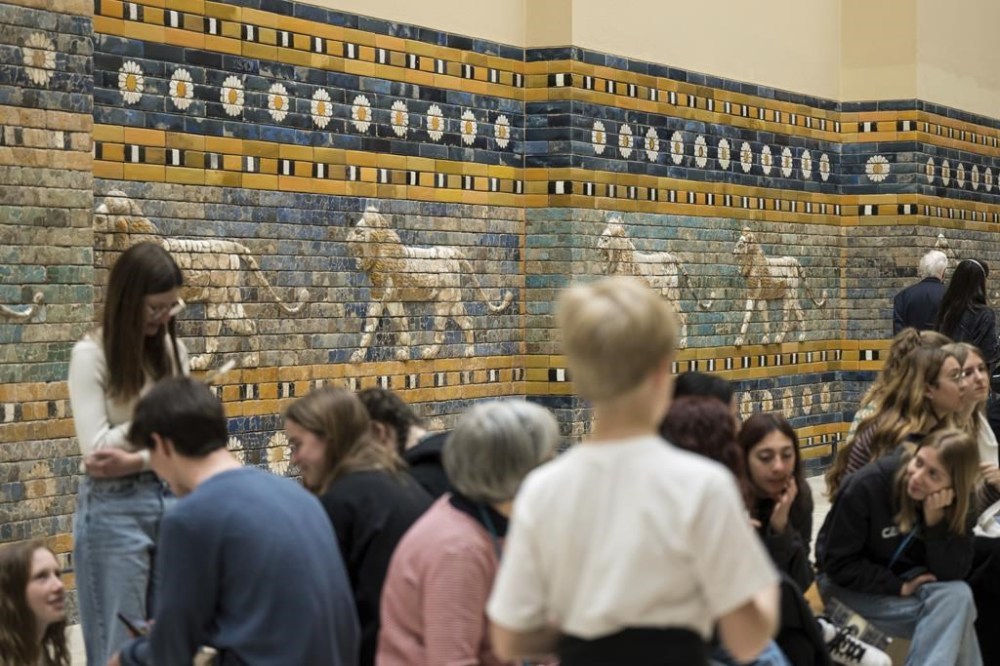
Visitors in front of Processional Way of Babylon at Pergamon Museum in Berlin, Tuesday, April 4, 2023. A new light and sound installation by British contemporary artist Liam Gillick, part of the show Filtered Time, opened Tuesday at one of the German capital's most popular museums. (AP Photo/Stefanie Loos)

It comes as the Pergamon Museum, which is based on the city’s famous Museum Island, prepares to close its gates for several years on October 23 for renovation. The show Filtered Light will end a week before the museum’s closure.

While the north wing of the Pergamon Museum is expected to open again in 2027, the south wing will only be open to the public again in 2037.

The weather god from Sam’al in what is today Turkey’s Gaziantep Province, is 3.4 meters (11 feet) tall and was created from black basalt in the 8th century BC. It is the first object to capture visitors with its unusual colors and sounds as they enter the museum’s galleries.

Gillick, who was present at the opening of his show, said he wanted to bring “an emotional quality to life in this object and gently bring warmth back,” as originally the weather god would have been standing outside in the sun.

He created the soundscape with the noise of shipping and construction from contemporary Syria and Iraq.

“But it’s slowed down. It’s made unclear. It’s sort of rendered into this soundscape, which becomes more emotional, suggestive of movement of machinery, of construction,” Gillick explained.

“But it could also be the sounds of an ancient God moaning and murmuring,” he added.

Gillick also attached a shining blue light above the museum’s renowned Ishtar Gate from the ancient city of Babylon with its characteristic blue-glazed bricks and depictions of lions, bulls and dragons. The light rises and fades while faint thunderclaps can be heard — sounds that in fact are a slowed-down recording of clay being knocked out of brick molds, the artist explained.

Gillick’s show was curated by the Museum of the Ancient Near East in cooperation with the city’s museum for contemporary art, the Hamburger Bahnhof.

Sam Bardaouil, the director of the Hamburger Bahnhof, explained how the sound installations help bring back energy to some of the antique objects.

“Many times when we come to these museums, the objects, unfortunately, become relics,” though they once existed in cities as living space, on avenues where people used them in different ways, walked through them or sat on them, Bardaouil said.

“So the sound, in a sense, is a way of bringing back some of the commotion, some of the energy, some of the life in which these objects existed,” he added.

The curators of the exhibition said they also wanted to make a point of showing that the artifacts Gillick engaged with come from places such as Syria and Iraq to which civilization owes much — even if today they’ve become associated with conflict and grief.

Visitors planning to catch a glimpse of Gillick’s show and the Pergamon’s treasures before it closes for renovation should book online tickets as waiting times can last up to two hours, according to the museum.

Built between 1910 and 1930, the museum and four others nearby were designated a UNESCO World Heritage site in 1999.

Even before the Pergamon Museum’s temporary closure was announced, it attracted more than a million visitors each year. During the renovation period, the museum is planning to show some of the objects in other exhibition spaces and will also offer virtual tours.

However, the Ishtar Gate, which was built in 575 BC, will be wrapped up and closed to the public until 2037.


Report Error Submit a Tip

More Stories

Elmwood–East Kildonan candidate promises to tackle ‘inefficiency’ in government

Gabrielle Piché 3 minute read Preview

Elmwood–East Kildonan candidate promises to tackle ‘inefficiency’ in government

Gabrielle Piché 3 minute read Yesterday at 6:17 PM CDT

The former assistant of late Elmwood–East Kildonan councillor Jason Schreyer is again running for the seat.

Chris Sweryda officially launched his campaign Saturday. He did so with the backdrop of a grocery program he runs, where food is sold near-cost out of St. Gerard School’s gym.

Rows of cereal, pasta sauce and chips filled tables ahead of the program’s afternoon opening. Sweryda created the pop-up with Schreyer months ahead of the former councillor’s April 2025 death.

The program sees roughly 500 people each day it’s open (which is every other week on Saturday), Sweryda said.

Read
Yesterday at 6:17 PM CDT

Cabernet Sauvignon star of wine festival

Ben Sigurdson 5 minute read Preview

Cabernet Sauvignon star of wine festival

Ben Sigurdson 5 minute read Yesterday at 3:00 AM CDT

The Winnipeg Wine Festival will celebrate the king of red wine grapes next weekend — the theme of this year’s festival, which takes place Sept. 25 and 26 at the RBC Convention Centre, is Cabernet Sauvignon.

Cab Sauv, as it’s also known, is the world’s most widely planted wine grape of any colour, first coming to prominence in the 1800s in France’s Bordeaux region, where the grape is still popular. Rather than single-variety wines, Bordeaux reds tend to be blends, with those coming from the left bank of the Gironde estuary being Cabernet-dominant, while right-bank wines are Merlot-dominant, with Cabernet Sauvignon playing a supporting role. Cabernet and Merlot work well together and many other countries have followed suit in blending the two.

A team at University of California Davis put Cabernet Sauvignon through a DNA test in 1996 and discovered its parent grapes are Cabernet Franc and Sauvignon Blanc — it’s likely that at some point the two varieties, planted next to each other in some vineyard, crossed and mutated and became the grape we know today. (Someone growing grapes in the 19th century must have had an inkling of what was up, as the grape has been called Cabernet Sauvignon since long before the DNA test.)

Flavour-wise, most Cabernet Sauvignon wines are big and bold, with a core of deep dark berry flavours, some graphite and spice notes and relatively bright acidity. It’s a grape that is well-suited to barrel aging, with most examples seeing at least some time in wood.

Read
Yesterday at 3:00 AM CDT

Former Bombers linebacker Gauthier enjoying career as electrician

Taylor Allen 6 minute read Preview

Former Bombers linebacker Gauthier enjoying career as electrician

Taylor Allen 6 minute read Friday, Sep. 18, 2026

Most professional football players don’t ride off into the sunset on their own terms.

Shayne Gauthier was well aware of that, but it didn’t make it sting any less when the Winnipeg Blue Bombers informed the veteran linebacker that they weren’t bringing him back for 2026.

“I was really hoping to play one more (season) because it would have been my 10th season, so, I’d say it didn’t really end the way I wanted,” Gauthier recently told the Free Press.

“It left a little sour taste in my mouth, but that’s part of pro sports. If everybody got the ending that they wanted, then it wouldn’t really work.”

Read
Friday, Sep. 18, 2026

Family account spiced with magic realism, geopolitical intrigue and a ghost story

Reviewed by Zilla Jones 4 minute read Preview

Family account spiced with magic realism, geopolitical intrigue and a ghost story

Reviewed by Zilla Jones 4 minute read Yesterday at 2:01 AM CDT

Tom Lin’s second novel Babylon, South Dakota moves beyond a historical account of an immigrant family’s struggle, delightfully blending and bending genres.

Lin is a Chinese-born novelist whose family emigrated to the U.S. when he was four years old. His debut novel, The Thousand Crimes of Ming Tsu, won the 2022 Andrew Carnegie Medal for Excellence in Fiction, making him the youngest ever recipient of that award. He earned a PhD in English from the University of California Davis and is currently an assistant professor of English and creative writing at the University of Iowa.

Babylon, South Dakota takes place in an unspecified time period that can be understood to be during the Mao era — likely the 1950s or ’60s. A young Chinese couple, the Hsuis, immigrate to the rural community that gives the book its title. They take the names Saul and Mei and settle on a 160-acre homestead left to them by a distant relative.

Saul’s dream is to breed and sell chrysanthemums from seeds he brought from China, while Mei wants to raise livestock. They speak no English, know nothing of life in the United States, are unprepared for the harshness of winter and the isolation of the farm and bring nothing with them except some gold, which Mei hides around the house for emergencies. Their only link to the outside world is a discarded and marginally functioning TV set, which Saul rescues and rigs up.

Read
Yesterday at 2:01 AM CDT

National Black Canadians Summit celebrates culture, combats racism

Gabrielle Piché 4 minute read Preview

National Black Canadians Summit celebrates culture, combats racism

Gabrielle Piché 4 minute read Yesterday at 6:06 PM CDT

Despite the event’s name — the National Black Canadians Summit — Bruce Miller felt he should attend.

He booked a ticket. And so, this weekend, the Indigenous Manitoban joined roughly 1,500 people flocking to the RBC Convention Centre.

It’s a full schedule — addresses from a former Canadian governor general, sessions on Black mental health and anti-Black racism.

The annual event draws politicians, artists and other professionals from across the country.

Read
Yesterday at 6:06 PM CDT

Canada must not accept another Iranian autocracy

David Matas 5 minute read Yesterday at 2:01 AM CDT

Iran is a state run by a radical government victimizing its citizens and its neighbours. How do we change that? Any regime change that repeats the mistakes of the past is not a solution.

What went wrong in the past which led to the current regime? One answer is the U.K. and American aided coup which led to the ouster in 1953 of a democratically elected government headed at the time by Mohammad Mossadegh and its replacement with an American friendly autocrat, the Shah of Iran, Mohammad Reza Pahlavi.

The Shah imposed his rule through the Iranian National Intelligence and Security Organization — SAVAK, the acronym of its Persian name. SAVAK systematically inflicted torture, arbitrary killings and extra-judicial killings on perceived opponents of the regime. It was only a matter of time before repression of a regime directed to serving foreign interests would be overthrown.

What replaced the regime of the Shah, in 1979, the current regime of the mullahs, is a regime as intolerant and violent as the regime of the Shah and then some. That was not inevitable. But neither was it surprising. The vicious nature of the current regime, following the example set by the Shah, and its hatred for the United States, reacting to the U.S. aided imposition of the Shah, both echoes and reacts to the past. In 1979, the U.S. reaped what it sowed in 1953.