Experts link graves to one of nation’s oldest Black churches

Advertisement

Advertise with us

Three men whose graves were found at the original site of one of the nation’s oldest Black churches were members of its congregation in the early 19th century, a team of archaeologists and scientists in Virginia announced Thursday.

Read this article for free:


or

Already have an account? Log in here »

To continue reading, please subscribe:

Subscribe and receive a limited-edition Free Press branded hat or tote.

Digital Subscription

One year of digital access for only $205*

  • Enjoy unlimited reading on winnipegfreepress.com
  • Read the E-Edition, our digital replica newspaper
  • Access News Break, our award-winning app
  • Play interactive puzzles

*First annual payment billed as $205.00 + GST for one year. This annual subscription will automatically renew at $233.00 + GST every 52 weeks (10% off the regular annual price of $259.35). Offer available to new and qualified returning subscribers only. Cancel any time.

To continue reading, please subscribe:

Add Free Press access to your Brandon Sun subscription for only an additional

$1 for the first 4 weeks*

  • Enjoy unlimited reading on winnipegfreepress.com
  • Read the E-Edition, our digital replica newspaper
  • Access News Break, our award-winning app
  • Play interactive puzzles
Start now

*Your next Brandon Sun subscription payment will increase by $1.00 and you will be charged $17.95 plus GST for four weeks. After four weeks, your payment will increase to $24.95 plus GST every four weeks.

Hey there, time traveller!
This article was published 06/04/2023 (1263 days ago), so information in it may no longer be current.

Three men whose graves were found at the original site of one of the nation’s oldest Black churches were members of its congregation in the early 19th century, a team of archaeologists and scientists in Virginia announced Thursday.

The First Baptist Church was formed in 1776 by free and enslaved Black people in Williamsburg, Virginia’s colonial capital. Members initially gathered in fields and under trees in defiance of laws that prevented African Americans from congregating.

The church’s original brick foundation was uncovered in 2021 by archaeologists at Colonial Williamsburg, a living history museum that now owns the land. The excavation of graves began last year in partnership with First Baptist’s descendant community.
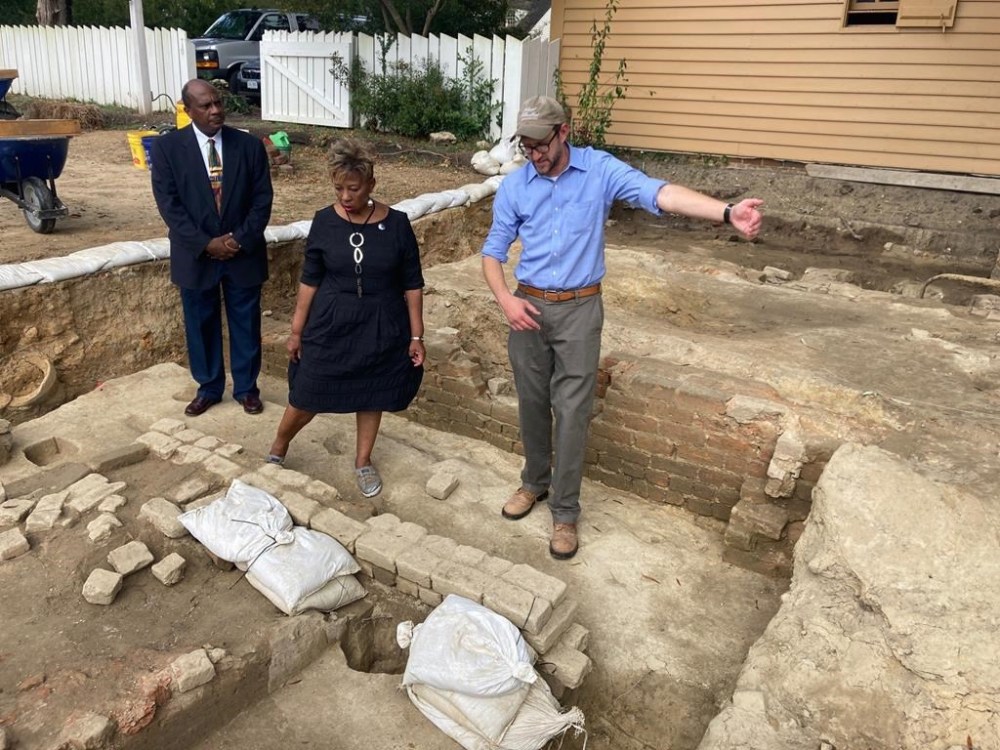
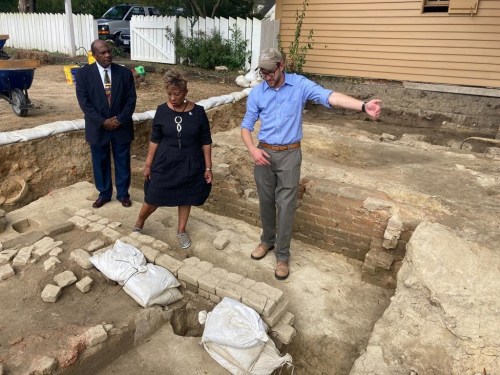
FILE - From left, Reginald F. Davis, pastor of First Baptist Church, Connie Matthews Harshaw, a member of First Baptist, and Jack Gary, Colonial Williamsburg's director of archaeology, stand at the brick-and-mortar foundation of one the oldest Black churches in the U.S. on Oct. 6, 2021, in Williamsburg, Va. Experts announced Thursday, April 6, 2023, that three men whose graves were found at the site were members of the church in the early 19th Century. (AP Photo/Ben Finley, File)

More than 60 burial plots have been identified. Thursday’s announcement confirmed what oral histories had long told — that previous generations were buried on the land before it was paved over in the 20th century.

“Now we know they’re ours — they’re ours,” church member Connie Matthews Harshaw said Thursday. “Those people under that soil are of African descent. We go from there.”

Three sets of remains were chosen for examination. They underwent DNA testing, bone analysis and the evaluation of archaeological evidence that was found, including 19th century coffin nails. The wood from the hexagonal coffins is long gone.

Only one set of remains could provide adequate DNA, which can indicate race, said Raquel Fleskes, a post-doctoral fellow at the University of Connecticut who conducted the analysis.

Those remains belonged to a Black man between the ages of 16 and 18 who stood 5 feet, 4 inches tall. His grave contained a clothing button that was made from animal bone and still carried some cotton fiber, said Jack Gary, Colonial Williamsburg’s director of archaeology.

The young man’s grave appeared to be marked by an upside-down, empty wine bottle. His coffin was likely moved from a previous location based on the large number of nails — possibly used to reinforce the coffin — and the jumbled way his bones came to rest.

The young man’s teeth indicated some kind of stress, which could have been malnutrition or disease, said Joseph Jones, a research associate with William & Mary’s Institute for Historical Biology.

“Childhood health is a pretty good indicator of a population,” Jones added.

Michael Blakey, the institute’s director, added that few African Americans in Williamsburg were free at the time.

“It either represents the conditions of an enslaved childhood or far less likely — but possibly — conditions for a free African American in childhood,” Blakey said.

The two other sets of remains belonged to men between the ages of 35 to 45 and possibly older, based on the analyses of their bones and teeth.

One of them stood 5 feet, 8 inches and was possibly the oldest of the three. His remains were found with a copper straight pin that likely bound clothing or a funeral shroud.

The other man stood 5 feet, 7 inches and was buried in a vest and trousers. His leg bones indicated the repetitive use of certain muscles, suggesting the heavy labor of someone who was enslaved.

The graves in Williamsburg are among Black burial grounds and cemeteries that are scattered throughout the nation and tell the story of the country’s deep past of slavery and segregation. Many Black Americans were excluded from white-owned cemeteries and built their own burial spaces, often as a form of resistance.

Descendants are working to preserve these grounds and cemeteries, many of which are at risk of being lost and lack support.

“All over the country there has been reckless disregard for African American bodies,” said Harshaw, of First Baptist.

“We are now becoming an example to the rest of the country,” she said. “We’re getting interest from everywhere, with people saying, ‘Wait a minute, how do you guys do this?’”

The church’s original meeting house was destroyed by a tornado in 1834. First Baptist’s second structure, built in 1856, stood there for a century.

But an expanding Colonial Williamsburg museum bought the property in 1956 and turned it into a parking lot.

The museum tells the story of Virginia’s late 1700s capital through colonial-era buildings and interpreters. But it failed to tell First Baptist’s story.

Founded in 1926, the museum did not tell Black stories until 1979, even though more than half of the people who lived in the colonial capital were Black, and many were enslaved.

In recent years, Colonial Williamsburg has boosted its efforts to tell a more complete story, placing a growing emphasis on African-American history.

The museum plans to recreate First Baptist’s original meeting house on the land where it once stood, said Gary, the museum’s director of archaeology.

“A big part of that is to commemorate the space where the burials are located,” he said.

Report Error Submit a Tip

The Free Press acknowledges the financial support it receives from members of the city’s faith community, which makes our coverage of religion possible.
More Stories

Family account spiced with magic realism, geopolitical intrigue and a ghost story

Reviewed by Zilla Jones 4 minute read Preview

Family account spiced with magic realism, geopolitical intrigue and a ghost story

Reviewed by Zilla Jones 4 minute read Yesterday at 2:01 AM CDT

Tom Lin’s second novel Babylon, South Dakota moves beyond a historical account of an immigrant family’s struggle, delightfully blending and bending genres.

Lin is a Chinese-born novelist whose family emigrated to the U.S. when he was four years old. His debut novel, The Thousand Crimes of Ming Tsu, won the 2022 Andrew Carnegie Medal for Excellence in Fiction, making him the youngest ever recipient of that award. He earned a PhD in English from the University of California Davis and is currently an assistant professor of English and creative writing at the University of Iowa.

Babylon, South Dakota takes place in an unspecified time period that can be understood to be during the Mao era — likely the 1950s or ’60s. A young Chinese couple, the Hsuis, immigrate to the rural community that gives the book its title. They take the names Saul and Mei and settle on a 160-acre homestead left to them by a distant relative.

Saul’s dream is to breed and sell chrysanthemums from seeds he brought from China, while Mei wants to raise livestock. They speak no English, know nothing of life in the United States, are unprepared for the harshness of winter and the isolation of the farm and bring nothing with them except some gold, which Mei hides around the house for emergencies. Their only link to the outside world is a discarded and marginally functioning TV set, which Saul rescues and rigs up.

Read
Yesterday at 2:01 AM CDT

A life’s story: activist, educator, organizer knew the true meaning of community

Janine LeGal 7 minute read Preview

A life’s story: activist, educator, organizer knew the true meaning of community

Janine LeGal 7 minute read Yesterday at 3:00 AM CDT

Somewhere between a love for sharing stories and a love of community connections, Michael (Mike) Maunder lived his life. Giving voice to people and neighbourhoods was a passion for the natural-born community organizer.

An author, teacher and principal, Maunder lived in a one-bedroom apartment in West Broadway and devoted himself to community development, education and neighbourhood renewal.

He maintained a connection with Augustine United Church, whose commitment to social justice he appreciated, volunteered at the Sandy-Saulteaux Spiritual Centre, and found comfort in a Buddhist prayer community.

Maunder died on July 15 at the age of 80.

Read
Yesterday at 3:00 AM CDT

New Jets show promise despite loss to experienced Oilers

Mike McIntyre 8 minute read Preview

New Jets show promise despite loss to experienced Oilers

Mike McIntyre 8 minute read Updated: 9:34 AM CDT

Preseason hockey games are always more about the process than the result, and that’s especially true when the opposing rosters appear to be a major mismatch on paper.

So a 5-2 loss by an inexperienced group of Winnipeg Jets skaters against a star-studded Edmonton Oilers squad on Saturday night in the Alberta capital was neither surprising nor alarming.

There was, however, plenty to like from the visitors’ perspective despite the outcome.

Let’s break it down.

Read
Updated: 9:34 AM CDT

A quick look at where provinces and territories stand on time changes

The Canadian Press 2 minute read Preview

A quick look at where provinces and territories stand on time changes

The Canadian Press 2 minute read Friday, Sep. 18, 2026

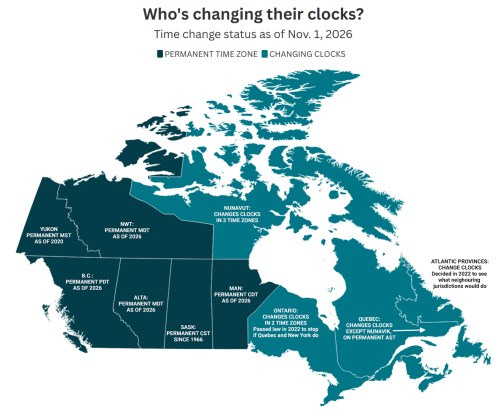
WINNIPEG - Manitoba's government said Thursday the province will be sticking with daylight time year-round, making it the latest jurisdiction to move away from twice-annual time changes. Here's a look at where things stand across Canada:

British Columbia said in March that it was moving to permanent Pacific daylight time. The change also means that parts of northeastern B.C., which have been on mountain standard time year round, are now in alignment with the rest of the province.

Alberta also switched to permanent daylight time this year in what it calls Alberta time. The change means it now has the same time as Saskatchewan year round.

Saskatchewan has been on permanent central standard time since 1966.

Read
Friday, Sep. 18, 2026

Hellebuyck standoff caused by… Nathan MacKinnon?

Mike McIntyre 6 minute read Preview

Hellebuyck standoff caused by… Nathan MacKinnon?

Mike McIntyre 6 minute read Friday, Sep. 18, 2026

Looking for someone to blame in the Connor Hellebuyck fiasco and cast as public enemy No. 1? How about long-time Winnipeg Jets nemesis Nathan MacKinnon?

Allow us to explain as we fire up the time machine and head back to February in Italy.

Oh, what could have been if MacKinnon had been able to score on what appeared to be an open net late in the third period of the men’s gold medal game with Hellebuyck down and seemingly out of position.

Instead, the star forward fired wide, keeping the score deadlocked at 1-1 as the clock ticked down on regulation.

Read
Friday, Sep. 18, 2026

Experts link graves to one of nation’s oldest Black churches

Ben Finley, The Associated Press 5 minute read Preview

Experts link graves to one of nation’s oldest Black churches

Ben Finley, The Associated Press 5 minute read Thursday, Apr. 6, 2023

Three men whose graves were found at the original site of one of the nation’s oldest Black churches were members of its congregation in the early 19th century, a team of archaeologists and scientists in Virginia announced Thursday.

The First Baptist Church was formed in 1776 by free and enslaved Black people in Williamsburg, Virginia's colonial capital. Members initially gathered in fields and under trees in defiance of laws that prevented African Americans from congregating.

The church's original brick foundation was uncovered in 2021 by archaeologists at Colonial Williamsburg, a living history museum that now owns the land. The excavation of graves began last year in partnership with First Baptist’s descendant community.

More than 60 burial plots have been identified. Thursday's announcement confirmed what oral histories had long told — that previous generations were buried on the land before it was paved over in the 20th century.

Read
Thursday, Apr. 6, 2023