Ohio train derailment highlights waste disposal predicament
Advertisement
Read this article for free:
or
Already have an account? Log in here »
To continue reading, please subscribe:

Digital Subscription
One year of digital access for only $205*
- Enjoy unlimited reading on winnipegfreepress.com
- Read the E-Edition, our digital replica newspaper
- Access News Break, our award-winning app
- Play interactive puzzles
*First annual payment billed as $205.00 + GST for one year. This annual subscription will automatically renew at $233.00 + GST every 52 weeks (10% off the regular annual price of $259.35). Offer available to new and qualified returning subscribers only. Cancel any time.
To continue reading, please subscribe:
Add Free Press access to your Brandon Sun subscription for only an additional
$1 for the first 4 weeks*
- Enjoy unlimited reading on winnipegfreepress.com
- Read the E-Edition, our digital replica newspaper
- Access News Break, our award-winning app
- Play interactive puzzles
*Your next Brandon Sun subscription payment will increase by $1.00 and you will be charged $17.95 plus GST for four weeks. After four weeks, your payment will increase to $24.95 plus GST every four weeks.
Read unlimited articles for free today:
or
Already have an account? Log in here »
Hey there, time traveller!
This article was published 11/04/2023 (1257 days ago), so information in it may no longer be current.
When word surfaced that soils and liquids laced with chemicals from the East Palestine, Ohio, train derailment were being sent to southeastern Michigan for storage, local residents and politicians were livid.
“People were seeing pictures of what happened in Ohio — the smoke plumes, wildlife dying,” said Jordyn Sellek, director of a local government coalition. “They were hearing about people having health issues, and that’s scary. And now it’s coming into your community.”
So loud was the outcry that the U.S. Environmental Protection Agency halted shipments from the crash site in the town of 5,000 to a hazardous waste landfill and underground deep-injection wells in suburban Detroit.
Resistance was fierce elsewhere, too, from a raucous town hall meeting in Roachdale, Indiana, to Oklahoma Gov. Kevin Stitt barring the waste from a landfill there. EPA finally issued a pointed reminder that states cannot interfere with federally authorized waste transport.
“We ordered Norfolk Southern to clean up the mess it made, and no one should be impeding, preventing or getting in the way,” Administrator Michael Regan said March 17, adding it would take about three months to finish the job.
Yet roadblocks keep popping up. Baltimore Mayor Brandon Scott scuttled a company’s plan to treat East Palestine liquids and dispose of them in the city wastewater system.
The controversy illuminates an uncomfortable truth: Hazardous wastes are seemingly everywhere, from sprawling factories to household garages. They’re byproducts of industrial processes and goods consumers value. And when people want to get rid of waste, it has to go somewhere.
___
The U.S. has 667 facilities that treat, store and dispose of hazardous wastes and are regulated under the Resource Conservation and Recovery Act, according to EPA. Of those, 252 are commercial facilities that receive waste from offsite customers. The others, including factories, handle only waste generated on the premises.
Seventeen of the commercial facilities have landfills, three have deep injection wells and 12 have incinerators. Others store waste in containers while awaiting treatment or disposal.
Thirty-eight Norfolk Southern train cars derailed in the fiery Feb. 3 wreck. No one was injured but about half of East Palestine’s population was evacuated for days when authorities ignited vinyl chloride in five cars to prevent explosion. Many residents have complained of headaches, rashes and other health problems, although government officials say air and water testing hasn’t found dangerous pollution.
Long-term exposure to vinyl chloride, a colorless gas used to make products including plastic pipes, wire coatings and kitchenware, is associated with liver damage and cancer, EPA says.
Ohio officials are pressing the rail company and EPA to get rid of tainted dirt and water. Gov. Mike DeWine said March 10 that 24,400 tons of excavated soil were piled at the scene. Portions had been hauled to three facilities in Ohio and others in Michigan, Indiana and Texas before protests stalled removal.
A week later, EPA notified state environmental agencies that preventing the waste shipments could violate federal law and the U.S. Constitution’s interstate commerce provision.
Since then, neither EPA nor the company have disclosed where the East Palestine waste is going, although daily reports provide updates on volumes removed. As of Monday, 19,900 tons of soil and 11.4 million gallons (43.1 million liters) of liquid wastewater had been shipped, according to DeWine’s office. That’s enough liquid to fill more than 17 Olympic swimming pools.
A truck hauling 20 tons of the soil ran off a state road Monday and overturned, spilling about half, although the waste was contained and posed no threat to nearby waters, the Highway Patrol said.
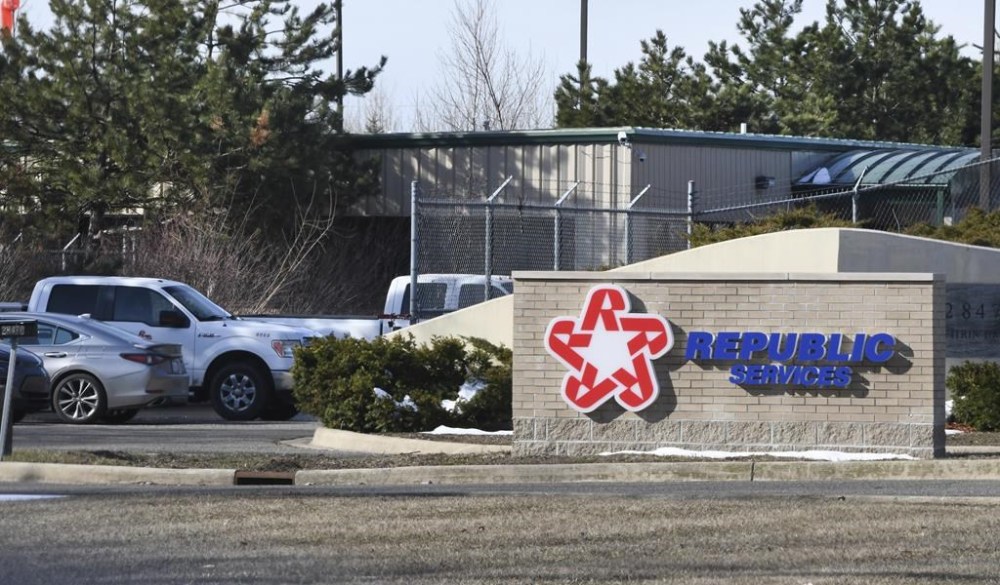
Republic Industrial and Energy Solutions in Romulus, Michigan, received February shipments of liquid wastes for disposal in its two injection wells. Some contaminated soils went to U.S. Ecology Wayne Disposal, a landfill in Belleville, Michigan, owned by the same company.
___
The Romulus facility, which also stores wastes in aboveground tanks, has past regulatory violations.
The state environment department cited the facility within the past year for leaks from a sludge dewatering press, mislabeled containers and an alarm malfunction. All problems were corrected promptly and none resulted in hazardous releases to the environment, spokesman Hugh McDiarmid Jr. said.
Both facilities have permits to take hazardous materials. Vinyl chloride is among chemicals authorized for storage at Romulus, the state says.
Even so, local leaders complained they got no advance notice. “It sounds … like we’ve been sandbagged,” said Wayne County Executive Warren Evans.
“I just don’t think Michigan, with one of the world’s biggest supplies of fresh water, is the best place to inject this stuff in the ground,” said Kevin Krause, fire services and emergency management director in Romulus.
Roman Blahoski, spokesman for the owner Republic Services, said the liquids injected into the wells were “99% water” and soils sent to the landfill had low contaminant levels. “Responsible disposal of hazardous waste is a basic community need,” he said.
___
Some hazardous wastes regularly accepted by disposal facilities pose greater health risks than vinyl chloride, said Bill Muno, a retired EPA official who previously headed the Midwest regional Superfund program. One example: PCBs, or polychlorinated biphenyls — toxic compounds widely used in electrical equipment, plastics and other products until banned in 1979.
Michigan, with 15 facilities licensed to handle hazardous wastes, doesn’t routinely get a heads-up about shipments from out of state, McDiarmid said. But in view of publicity surrounding the derailment, “we probably should have been made aware,” he said.
In a letter to state agencies, EPA said waste from the crash site “has been subject to more testing and analysis … than many other, similar wastes regularly accepted at facilities nationwide.”
“There is nothing special or out of the ordinary about this waste, other than the fact that it’s coming from a town that has suffered deeply in the wake of a horrible trauma,” Regan said.
Under federal law, hazardous waste landfills must have double liners, leak detectors and groundwater monitoring devices, Muno said.
Contaminated soils typically are dumped from trucks into trenches or pits, compacted and capped with clay and plastic layers, then several feet of earth where grass is planted to prevent rainwater from seeping inside, he said.
Operators of injection wells — often depleted oil or gas wells extending thousands of feet underground — receive federal permits only after satisfying regulators there’s no chance the waste would contaminate drinking water aquifers, Muno said.
“They’re very well operated and maintained,” he said. “Much different from the early landfills, where people would just dig a hole in the ground and fill it up and precipitation would wash the contaminants out.”
___
But it’s not unreasonable for communities to be concerned about waste from disasters like the East Palestine crash, said Eric Schaeffer, executive director of the Environmental Integrity Project.
Regulators could help by quickly describing how facilities will store, treat and dispose of the waste and posting data from air and groundwater monitoring online, said the former EPA official.
“One of the most important things government does is communicate risk as best they can,” Schaeffer said. “If you say, ‘There’s nothing to see here,’ explain why.”
While EPA and Norfolk Southern have acted legally in shipping East Palestine waste to other states, the episode should prompt discussion about its fairness — especially when the facilities are in marginalized communities, said Nick Leonard, executive director of the Detroit-based Great Lakes Environmental Law Center.
In Michigan, two-thirds of residents within three miles (4.8 kilometers) of commercial hazardous waste facilities are people of color although they make up 25% of the state’s population, he said.
“What most residents are worried about is that one catastrophic event,” Leonard said. “It basically takes one mistake and you have really serious consequences.”
The issue also raises questions about “how we might minimize the toxic materials that go into things we use in everyday life,” said McDiarmid of the Michigan environment agency. “Creating less hazardous waste is a better answer than how we dispose of it.”
___
Follow John Flesher on Twitter: www.twitter.com/JohnFlesher.
___
Associated Press climate and environmental coverage receives support from several private foundations. See more about AP’s climate initiative here. The AP is solely responsible for all content.