Scientist: Progress in identifying Tulsa massacre victims

Advertisement

Advertise with us

A forensic anthropologist believes investigators are a step closer to identifying victims of the 1921 Tulsa Race Massacre with the discovery of 19 surnames possibly connected to remains excavated from a Tulsa cemetery.

Read this article for free:


or

Already have an account? Log in here »

To continue reading, please subscribe:

Subscribe and receive a limited-edition Free Press branded hat or tote.

Digital Subscription

One year of digital access for only $205*

  • Enjoy unlimited reading on winnipegfreepress.com
  • Read the E-Edition, our digital replica newspaper
  • Access News Break, our award-winning app
  • Play interactive puzzles

*First annual payment billed as $205.00 + GST for one year. This annual subscription will automatically renew at $233.00 + GST every 52 weeks (10% off the regular annual price of $259.35). Offer available to new and qualified returning subscribers only. Cancel any time.

To continue reading, please subscribe:

Add Free Press access to your Brandon Sun subscription for only an additional

$1 for the first 4 weeks*

  • Enjoy unlimited reading on winnipegfreepress.com
  • Read the E-Edition, our digital replica newspaper
  • Access News Break, our award-winning app
  • Play interactive puzzles
Start now

*Your next Brandon Sun subscription payment will increase by $1.00 and you will be charged $17.95 plus GST for four weeks. After four weeks, your payment will increase to $24.95 plus GST every four weeks.

Hey there, time traveller!
This article was published 12/04/2023 (1255 days ago), so information in it may no longer be current.

A forensic anthropologist believes investigators are a step closer to identifying victims of the 1921 Tulsa Race Massacre with the discovery of 19 surnames possibly connected to remains excavated from a Tulsa cemetery.

Although the six bodies associated with the names are not confirmed massacre victims, nor do they show signs of trauma such as gunshot wounds, identifying them would provide a possible roadmap to the most likely areas of the cemetery to search for victims, according to Phoebe Stubblefield.

Identifying the remains would help lead to death certificates that contain the date of death, indicating when the person was buried, said Stubblefield, a member of the team that conducted excavations in the cemetery the past three years.
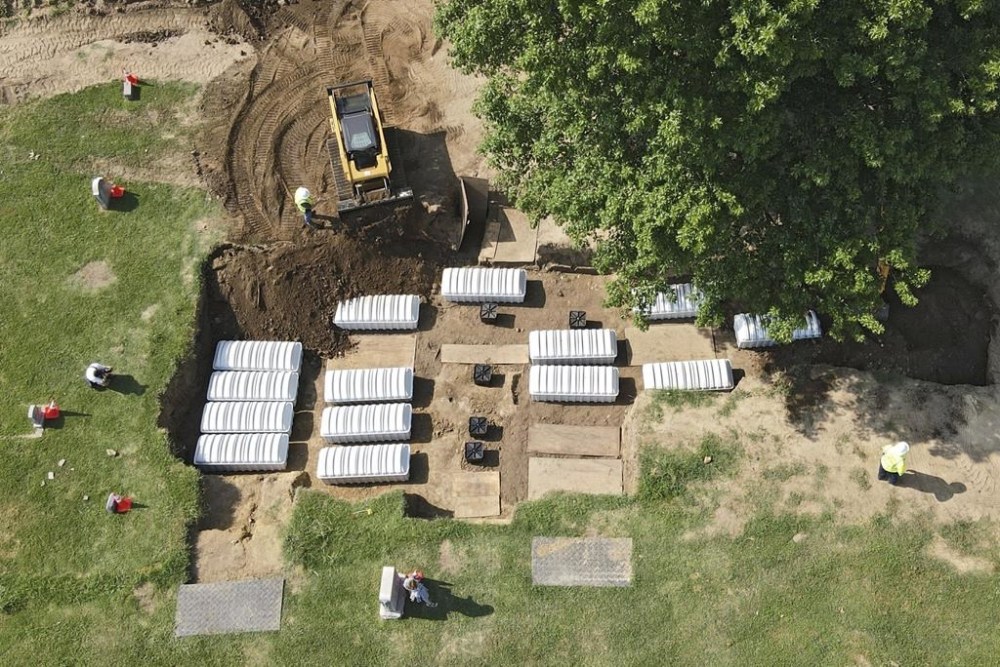
FILE - In this aerial photo, a mass grave is re-filled with dirt after a small ceremony at Oaklawn Cemetery, July 30, 2021, in Tulsa, Okla. The mass grave was discovered while searching for victims of the Tulsa Race Massacre. A forensic anthropologist believes investigators are a step closer to identifying victims of the 1921 Tulsa Race Massacre with the discovery of 19 surnames possibly connected to remains excavated from the Tulsa cemetery. (Mike Simons/Tulsa World via AP, File)/Tulsa World via AP)

“We get closer to figuring out who was buried in that cemetery and when,” Stubblefield said.

Investigators could “maybe get the pattern of how people were buried in that cemetery. By that I mean burials for January, burials for February, burials for March, and we’re moving toward June” when massacre victims were buried, said Stubblefield. “We can find a greater concentration of probable victims.”

The massacre occurred May 31 and June 1, 1921, when a white mob descended on Greenwood — the Black section of Tulsa. More than 1,000 homes were burned, hundreds more were looted and destroyed and a thriving business district known as Black Wall Street was decimated.

Most historians who have studied the event estimate the death toll to be between 75 and 300. Historians say many of the victims were buried in unmarked graves, their locations never recorded and rumors have persisted for decades of mass graves in the area.

Two of the 66 sets of remains found thus far have gunshot wounds, officials have said, and those remains are among 10 sets still being analyzed.

Those with gunshot wounds or trauma would indicate the remains were more likely to have been victims of the violence, according to Stubblefield.

City officials and Intermountain Forensics have sought DNA from people who believe they may be a relative or descendant of a massacre victim and others with a historical connection to Tulsa.

That DNA was being compared to samples from the excavated bodies in the effort to identify the remains.

None of the remains have yet been confirmed as massacre victims.

Identifying the surnames helps “move the needle on a more than century-old event,” Tulsa Mayor G.T. Bynum said in a statement. “We are still in the beginning stages of this process. There is a lot more investigative work that is happening.”

Investigators have tracked the surnames associated with the six bodies, four male and two female, to at least seven states: North Carolina, Georgia, Texas, Mississippi, Louisiana, Oklahoma and Alabama.
Report Error Submit a Tip

More Stories

Lauded Manitoba author chronicled life in the Interlake

By Sheldon Birnie 5 minute read Preview

Lauded Manitoba author chronicled life in the Interlake

By Sheldon Birnie 5 minute read Wednesday, Sep. 16, 2026

Longtime Manitoba author, editor and professor David Arnason died on Monday at age 86.

Read
Wednesday, Sep. 16, 2026

United Way, other charities fight for dollars as donor base shrinks

Scott Billeck 7 minute read Preview

United Way, other charities fight for dollars as donor base shrinks

Scott Billeck 7 minute read 2:00 AM CDT

Winnipeg’s charitable sector is being squeezed from both sides: demand for help is growing while the pool of donors to meet that need is shrinking.

The imbalance is increasingly being carried by a relatively small group of deep-pocketed donors. Last year, 600 people — about three per cent of United Way Winnipeg’s individual donors — accounted for roughly $8 million, or 55 per cent of individual donations.

The fundraising pitch isn’t getting any easier.

Homelessness and public drug use have become increasingly visible, household budgets remain strained and the problems charities are trying to address can seem so entrenched that donors may reasonably wonder what difference another contribution can make.

Read
2:00 AM CDT

His blissful kiss is well worth the risk

Maureen Scurfield 4 minute read 2:00 AM CDT

DEAR MISS LONELYHEARTS: The best kisser I ever met knocked me off balance. My little joke was, “That’s why we have to go home now and lie down in a hurry!” We’ve been seeing each other for almost six months. This man can convince me to do almost anything — so much fun!

But, now he’s been transferred out of province for bigger money at a new company.

He’s leaving soon and he could have asked me to move with him, as his trucking partner, but he didn’t! Other women will soon have their hands on him, believe me!

I’m already 27 and I don’t want to date any more guys — just him. Now what can I do? I feel sadder every day.

Quilt tradition from Underground Railroad period big part of new exhibition

Conrad Sweatman 6 minute read Preview

Quilt tradition from Underground Railroad period big part of new exhibition

Conrad Sweatman 6 minute read 2:00 AM CDT

Long before she became a professional quilter, Melinda Clayton Patterson used to watch her mother make quilts from clothing scraps and cardboard templates.

“I came from a family of 14 kids, so going to whatever the store was back then, K-Mart or Woolworth, to buy quilts or blankets for 14 kids was just not feasible because the people were not wealthy,” she says.

“Quilts were not viewed as art. But when I came to Winnipeg, I started taking quilting seriously in my 30s … the heritage came later.”

Today, the 61-year-old native of East Preston, N.S., lives in Winnipeg, stitching together stories of her Black Loyalist heritage and Preston’s foundational role in the birth of Canadian Black culture.

Read
2:00 AM CDT

Today’s horoscope

Georgia Nicols 4 minute read Preview

Today’s horoscope

Georgia Nicols 4 minute read 2:00 AM CDT

MOON ALERT: Avoid shopping (except food and gas) and important decisions after 3:15 p.m. today. After that, the moon moves from Sagittarius into Capricorn.

ARIES (March 21-April 19)

This is a poor day to challenge anyone because you won’t be pleased with the results. (You might come off worse than when you began.) Nevertheless, it’s in your best interest to work hard. You can also make improvements at home. Romance and finances are blessed.

TAURUS (April 20-May 20)

Read
2:00 AM CDT

Canada-U.S. trade relationship is broken, but the damage can — and will — be repaired

Tom Brodbeck 5 minute read Preview

Canada-U.S. trade relationship is broken, but the damage can — and will — be repaired

Tom Brodbeck 5 minute read Yesterday at 1:35 PM CDT

Canada needs to get serious about diversifying its trade beyond the United States. But at the same time, Canadians should expect relations with the U.S. to normalize after Donald Trump is no longer in the White House.

For generations, Canada-U.S. trade was considered almost a fact of geography. The two countries share the world’s longest undefended border, deeply integrated supply chains and a century of commercial relationships.

Canadian manufacturers depend on American customers. American manufacturers depend on Canadian suppliers. Energy, agriculture, automotive production and countless other industries operate across the border as though it barely exists.

That isn’t going to change dramatically, even in the midst of a bitter trade war unleashed by the U.S. president.

Read
Yesterday at 1:35 PM CDT