Russländers reunite
Russian Mennonites celebrate centennial of Manitoba migration with song

Advertisement
Read this article for free:
or
Already have an account? Log in here »
To continue reading, please subscribe:
Digital Subscription
One year of digital access for only $1.44 a week*
- Enjoy unlimited reading on winnipegfreepress.com
- Read the E-Edition, our digital replica newspaper
- Access News Break, our award-winning app
- Play interactive puzzles
*Billed as $5.77 plus GST every four weeks. After 52 weeks, price increases to the regular rate of $19.95 plus GST every four weeks. Offer available to new and qualified returning subscribers only. Cancel any time.
To continue reading, please subscribe:
Add Free Press access to your Brandon Sun subscription for only an additional
$1 for the first 4 weeks*
- Enjoy unlimited reading on winnipegfreepress.com
- Read the E-Edition, our digital replica newspaper
- Access News Break, our award-winning app
- Play interactive puzzles
*Your next Brandon Sun subscription payment will increase by $1.00 and you will be charged $17.95 plus GST for four weeks. After four weeks, your payment will increase to $24.95 plus GST every four weeks.
Read unlimited articles for free today:
or
Already have an account? Log in here »
Hey there, time traveller!
This article was published 14/07/2023 (1200 days ago), so information in it may no longer be current.
One hundred years ago, 21,000 Mennonites made their way from the Soviet Union to Canada in search of refuge and shelter.
Leaving behind all that was familiar, more than 6,000 of the Russländers, as they were then known, chose to make Manitoba their home.
On Saturday, to honour the centennial of the historic migration and to celebrate a deeply rooted culture of worship through music, a multilingual performance of 20 songs takes place at 7 p.m. at the Winnipeg Centennial Concert Hall.

Mennonite Heritage Archives
A Sängerfest held at the Winnipeg Auditorium in 1945 featured 800 singers, an orchestra and a band.
Singing Our Journey: Sängerfest 2023 is the culmination of 2 1/2 years of work, and features three choirs: a 230-strong adult choir conducted by choral director Henry Engbrecht; a youth choir with 22 singers conducted by Kristel Peters; and a treble choir of 20 singers conducted by Millie Hildebrand.
Engbrecht, who directed his first Sängerfest — “singer festival” — 60 years ago, says while this centennial event is deeply meaningful, he is also mindful of the history of the immigration and the great cost that was borne by the Indigenous people of Canada.
“I think of Singing Our Journey more as a commemoration than a celebration,” he says. “I feel so grateful to my grandparents for having given up everything they had to start all over again. They paid a high price for our freedom; the freedom to teach and exercise our faith, to develop meaningful relationships in trust in all walks of life.
“I am also mindful that room was made for us by the Canadian government at the expense of Canada’s Indigenous people.”
He says the repertoire for the event is very specific to the theme of commemoration.
“We came to Canada, they made room for us, but what happened? Some were pushed aside, some were pushed back and that history is very unfortunate.”

Mennonite Heritage Archives
Winnipeg Sängerfest
It’s a sentiment echoed by Peters, whose grandparents, like those of Engbrecht and Hildebrand, arrived in Canada in the mid-1920s. She grapples with the weight of history, acknowledging the questions surrounding the celebration of the immigration.
“Celebrating this milestone event is a huge excitement for me,” she says. “I love looking at our history and why and how we came to Canada. It is important to acknowledge and celebrate the past, but also move forward in harmony with wrongdoings.
“I personally feel pulled in many directions by this event. We are celebrating an immigration to this country, but whose land are we on? This is an important element we must study and do our part in helping [to implement] the truth and reconciliation recommendations. We are all living in this beautiful province and country. We need to acknowledge the ancestors that first lived on this land before we arrived.”
The program includes choral pieces from the distant past along with newly commissioned pieces by Leonard Enns and Michael Janzen and features songs in Latin, Swahili, English and German.
The first piece the audience hears, Ambe, is by Andrew Balfour, a Winnipeg composer of Cree descent. It is sung in Ojibwe and will be performed by the youth choir.

Mennonite Heritage Archives
A 1942 Sängerfest in Reinland, Man., led by K.H. Neufeld.
Engbrecht says the organizers took the name of the event to heart when coming up with the selection of pieces.
“It was clear to me immediately that the contents of this program would have to say something about where we came from to where we have come, and hopefully, make a statement about where our singing may lead.”
For Hildebrand, the occasion is also an opportunity to recognize the trials and tribulations the Russländers experienced as they made their journey towards liberation.

“This event has been two years in the making and its significance to those of us who know the Russländer story has grown exponentially over the months,” she says. “To be part of this now has brought back the solemnity of this history, but it has also been a reminder of the gratitude that was a daily prompt in the households of my grandparents.
“‘Kinder, ihr sollen dankbar sein’ was the mantra of my Tante Liese: ‘Children, you should be thankful.’ She said it kindly, but we could sense there was no place for complaining by any kind from us, whose life of free-and-easy living would have been the stuff of dreams in the early 1920s in the country that she was forced to flee.”
The concert ends with a particularly poignant number, a mass choir piece with all voices singing Now Thank We All Our God, a hymn the Russländer sang at various points as they made their way to Canada and the first thing they sang when they arrived in their new country.
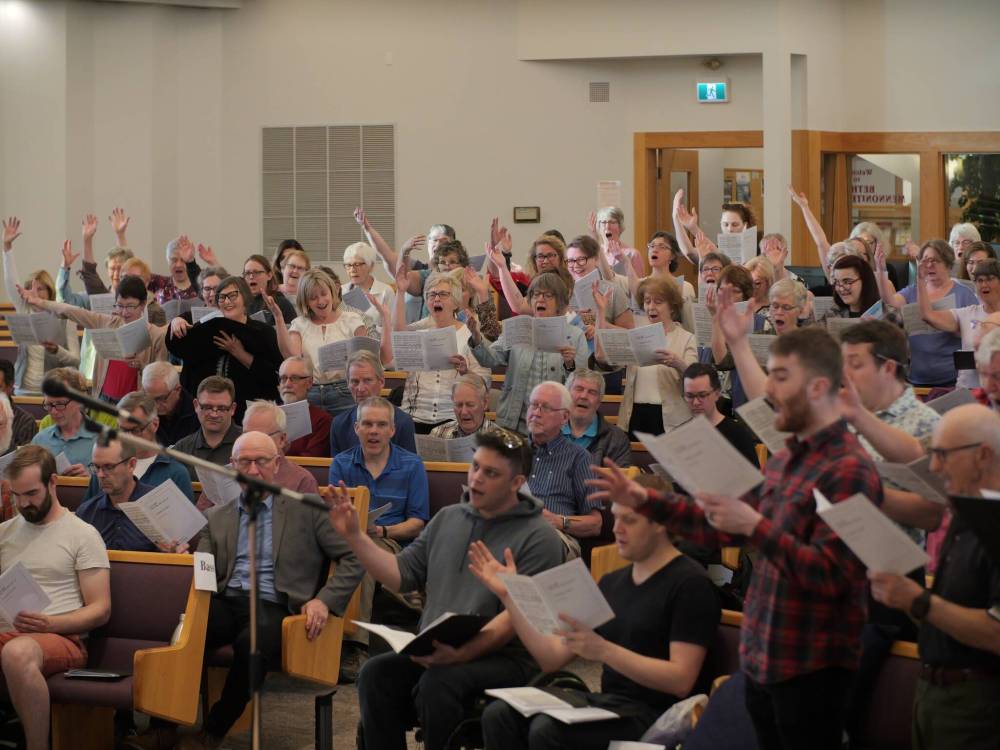
Henry Engbrecht photo
The 230-member adult choir rehearses for Sängerfest, which takes place tonight.
“In many ways this Sängerfest calls us to keep the spirit of thankfulness alive,” Hildebrand says. “I think is very easy for all that to suddenly just dissipate. I am really grateful to be able to participate in this event in light of that memory.”
av.kitching@winnipegfreepress.com
AV Kitching is an arts and life writer at the Free Press. She has been a journalist for more than two decades and has worked across three continents writing about people, travel, food, and fashion. Read more about AV.
Every piece of reporting AV produces is reviewed by an editing team before it is posted online or published in print — part of the Free Press‘s tradition, since 1872, of producing reliable independent journalism. Read more about Free Press’s history and mandate, and learn how our newsroom operates.
Our newsroom depends on a growing audience of readers to power our journalism. If you are not a paid reader, please consider becoming a subscriber.
Our newsroom depends on its audience of readers to power our journalism. Thank you for your support.
Concert preview
Singing our Journey: Sängerfest 2023
● Centennial Concert Hall
● July 15, 7 p.m.
● Sold out
Russländer Centenary Train Tour
The Winnipeg choral performance forms part of a broader celebration of Mennonite culture and immigration. To commemorate the centenary of the wave that started in 1923, a cross-country train tour — organized by the Russländer Centenary Committee (RCC) of the Mennonite Historical Society of Canada (MHSC) — retraces the original migration route, taking guests from Quebec City and Montreal to Kitchener-Waterloo, Ont., and then westward to Winnipeg, Rosthern, Sask., Didsbury, Alta., and Abbotsford, B.C.
The tour visits significant locations, including the Russländer landing site at Grosse Isle off the coast of Quebec City, Erb Street Mennonite Church in Waterloo, where Canadian Mennonites welcomed the first group to arrive in Ontario in 1924 and a train platform in Rosthern, where many of the Russländers arrived.
In Abbotsford and other places along the way, travellers will explore truth and reconciliation as they learn about the dislocation of local First Nations people, making way for Mennonite settlement.
Each leg of the tour includes informative historic presentations, tours, and events, plus banquets, Sängerfests and interaction with local Mennonites.
— from the CMHS website
AV Kitching is an arts and life writer at the Free Press. She has been a journalist for more than two decades and has worked across three continents writing about people, travel, food, and fashion. Read more about AV.
Every piece of reporting AV produces is reviewed by an editing team before it is posted online or published in print — part of the Free Press‘s tradition, since 1872, of producing reliable independent journalism. Read more about Free Press’s history and mandate, and learn how our newsroom operates.
Our newsroom depends on a growing audience of readers to power our journalism. If you are not a paid reader, please consider becoming a subscriber.
Our newsroom depends on its audience of readers to power our journalism. Thank you for your support.
Advertisement Advertise With Us
Advertisement Advertise With Us
History
Updated on Friday, July 14, 2023 9:03 AM CDT: Corrects date of event to Saturday, July 15
Updated on Friday, July 14, 2023 1:21 PM CDT: Fixes typo