Deadly flooding hit several countries at once. Scientists say this will only be more common
Advertisement
Read this article for free:
or
Already have an account? Log in here »
To continue reading, please subscribe:

Digital Subscription
One year of digital access for only $205*
- Enjoy unlimited reading on winnipegfreepress.com
- Read the E-Edition, our digital replica newspaper
- Access News Break, our award-winning app
- Play interactive puzzles
*First annual payment billed as $205.00 + GST for one year. This annual subscription will automatically renew at $233.00 + GST every 52 weeks (10% off the regular annual price of $259.35). Offer available to new and qualified returning subscribers only. Cancel any time.
To continue reading, please subscribe:
Add Free Press access to your Brandon Sun subscription for only an additional
$1 for the first 4 weeks*
- Enjoy unlimited reading on winnipegfreepress.com
- Read the E-Edition, our digital replica newspaper
- Access News Break, our award-winning app
- Play interactive puzzles
*Your next Brandon Sun subscription payment will increase by $1.00 and you will be charged $17.95 plus GST for four weeks. After four weeks, your payment will increase to $24.95 plus GST every four weeks.
Read unlimited articles for free today:
or
Already have an account? Log in here »
Hey there, time traveller!
This article was published 17/07/2023 (1161 days ago), so information in it may no longer be current.
Extreme rainfall accompanied by deadly flooding hit the United States and several other countries over the weekend and last week.
There were several dozen fatalities in central and southern regions of South Korea, including the Chongju region where an underpass flooded and drowned motorists who became trapped in their submerged vehicles.
In the U.S., flooding claimed five lives in Upper Makefield Township, Pennsylvania, where a search is ongoing for two missing children. Flooding also struck parts of New Hampshire, Massachusetts, Connecticut, New York and New Jersey this past weekend. A state of emergency was declared in New Jersey by Gov. Phil Murphy following significant damage from flooding and landslides.
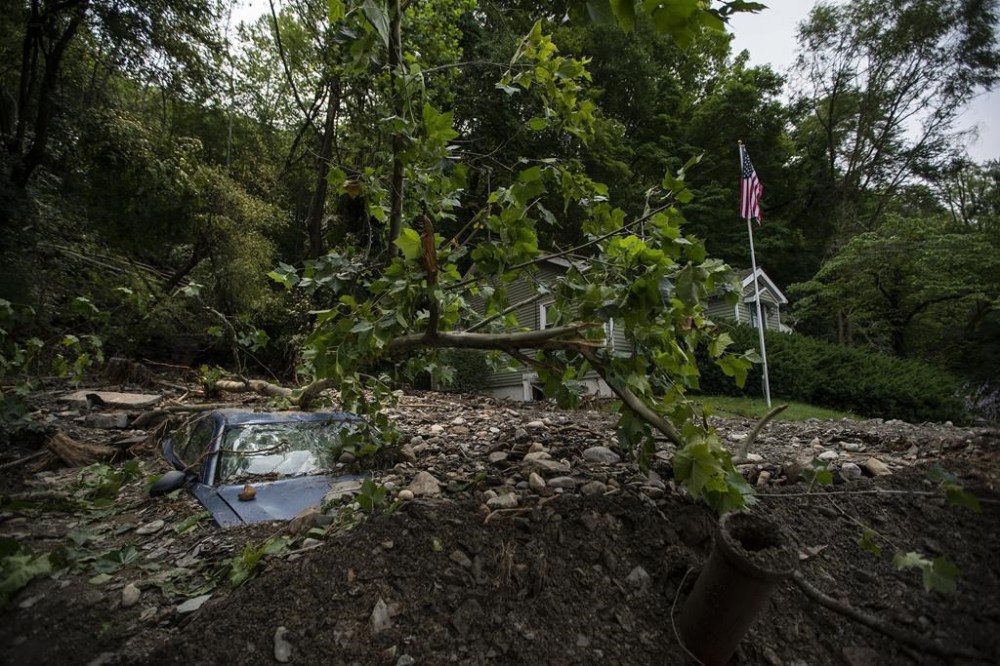
This follows last week’s relentless flooding in India, Japan, China, Turkey and the U.S.
Although the destructive floods are occurring in different parts of the world, atmospheric scientists say they have this in common: With climate change, storms are forming in a warmer atmosphere, making extreme rainfall a more frequent reality now. The additional warming that scientists predict is coming will only make it worse.
That’s because a warmer atmosphere holds more moisture, which results in storms dumping more precipitation that can have deadly outcomes. Pollutants, especially carbon dioxide and methane, are heating up the atmosphere. Instead of allowing heat to radiate away from Earth into space, they hold onto it.
While climate change is not the cause of storms unleashing the rainfall, these storms are forming in an atmosphere that is becoming warmer and wetter.
“Sixty-eight degrees Fahrenheit can hold twice as much water as 50 degrees Fahrenheit,” said Rodney Wynn, a meteorologist at the National Weather Service in Tampa Bay. “Warm air expands and cool air contracts. You can think of it as a balloon — when it’s heated the volume is going to get larger, so therefore it can hold more moisture.”
For every 1 degree Celsius (1.8 degrees Fahrenheit) that the atmosphere warms, it holds approximately 7% more moisture. According to NASA, the average global temperature has increased by at least 1.1 degrees Celsius (1.9 degrees Fahrenheit) since 1880.
“When a thunderstorm develops, water vapor gets condensed into rain droplets and falls back down to the surface. So as these storms form in warmer environments that have more moisture in them, the rainfall increases,” explained Brian Soden, professor of atmospheric sciences at the University of Miami.
Along Turkey’s mountainous and scenic Black Sea coast, heavy rains swelled rivers and damaged cities with flooding and landslides.
At least 15 people were killed by flooding in another mountainous region, in southwestern China.
“As the climate gets warmer we expect intense rain events to become more common, it’s a very robust prediction of climate models,” Soden added. “It’s not surprising to see these events happening, it’s what models have been predicting ever since day one.”
Gavin Schmidt, climatologist and director of the NASA Goddard Institute for Space Studies, said the regions being hit hardest by climate change are not the ones that emit the largest amount of planet-warming pollutants.
“The bulk of the emissions have come from the industrial Western nations and the bulk of the impacts are happening in places that don’t have good infrastructure, that are less prepared for weather extremes and have no real ways to manage this,” said Schmidt.
In last week’s flooding, schools in New Delhi were forced to close on July 10 after heavy monsoon rains battered the Indian capital, with landslides and flash floods killing at least 15 people. Farther north, the overflowing Beas River swept vehicles downstream as it flooded neighborhoods.
In Japan, torrential rain pounded the southwest, causing floods and mudslides that left two people dead and at least six others missing. Local TV showed damaged houses in Fukuoka prefecture and muddy water from the swollen Yamakuni River appearing to threaten a bridge in the town of Yabakei.
In Ulster County, in New York’s Hudson Valley and in Vermont, some said the flooding is the worst they’ve seen since Hurricane Irene’s devastation in 2011.
_____
Associated Press climate and environmental coverage receives support from several private foundations. See more about AP’s climate initiative here. The AP is solely responsible for all content.