New study finds far more hurricane-related deaths in US, especially among poor and vulnerable

Advertisement

Advertise with us

Hurricanes in the U.S. the last few decades killed thousands more people than meteorologists traditionally calculate and a disproportionate number of those victims are poor, vulnerable and minorities, according to a new epidemiological study.

Read this article for free:


or

Already have an account? Log in here »

To continue reading, please subscribe:

Subscribe and receive a limited-edition Free Press branded hat or tote.

Digital Subscription

One year of digital access for only $205*

  • Enjoy unlimited reading on winnipegfreepress.com
  • Read the E-Edition, our digital replica newspaper
  • Access News Break, our award-winning app
  • Play interactive puzzles

*First annual payment billed as $205.00 + GST for one year. This annual subscription will automatically renew at $233.00 + GST every 52 weeks (10% off the regular annual price of $259.35). Offer available to new and qualified returning subscribers only. Cancel any time.

To continue reading, please subscribe:

Add Free Press access to your Brandon Sun subscription for only an additional

$1 for the first 4 weeks*

  • Enjoy unlimited reading on winnipegfreepress.com
  • Read the E-Edition, our digital replica newspaper
  • Access News Break, our award-winning app
  • Play interactive puzzles
Start now

*Your next Brandon Sun subscription payment will increase by $1.00 and you will be charged $17.95 plus GST for four weeks. After four weeks, your payment will increase to $24.95 plus GST every four weeks.

Hey there, time traveller!
This article was published 16/08/2023 (1132 days ago), so information in it may no longer be current.

Hurricanes in the U.S. the last few decades killed thousands more people than meteorologists traditionally calculate and a disproportionate number of those victims are poor, vulnerable and minorities, according to a new epidemiological study.

A team of public health and storm experts calculated that from 1988 to 2019 more than 18,000 people likely died, mostly indirectly, because of hurricanes and lesser tropical cyclones in the continental United States. That’s 13 times more than the 1,385 people directly killed by storms that the National Oceanic and Atmospheric Administration figures, but the study authors said those numbers aren’t directly comparable.

Instead of just looking at people who drowned, were hit by debris or killed directly by the storm, the study in Wednesday’s journal Science Advances examines changes in a storm-hit county’s overall number of deaths just before, during and after a hurricane and compared those to normal years. Researchers attributed the excess deaths to the storm, using a standard public health technique.
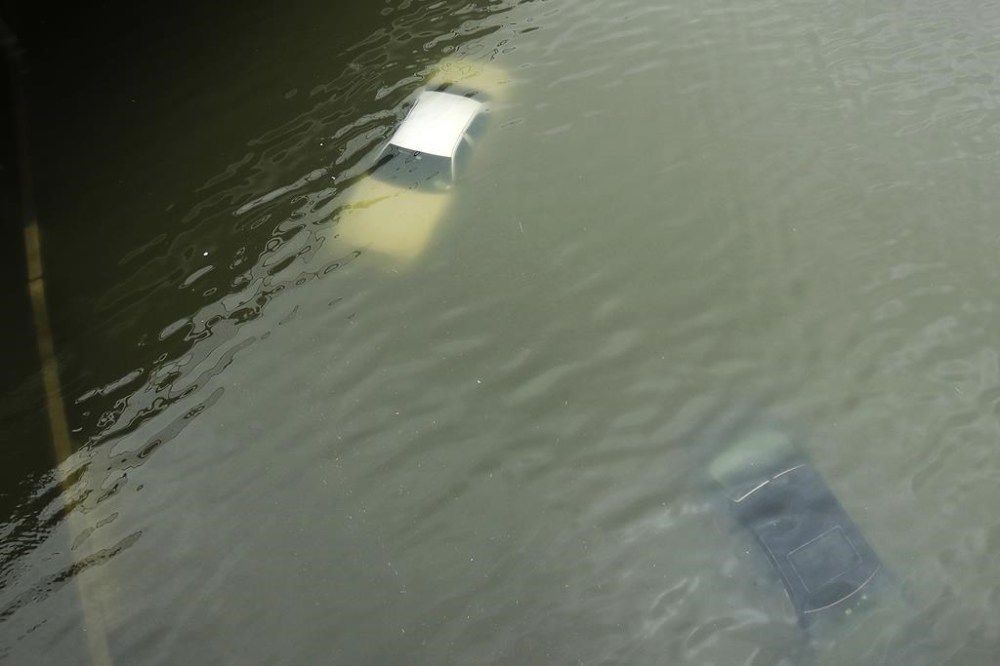
FILE - Cars are submerged on a freeway flooded in the aftermath of Hurricane Harvey near downtown Houston, Texas, on Aug. 27, 2017. Hurricanes in the U.S. over last few decades killed thousands more people than meteorologists traditionally calculate and a disproportionate number of those victims are poor, vulnerable and minorities, according to a new epidemiological study released Wednesday, Aug. 16, 2023. (AP Photo/Charlie Riedel, File)

“It’s the difference between how many people died and how many people would have died on a normal day” with no hurricane, said study lead author Robbie Parks, an environmental epidemiologist at Columbia University’s Mailman School of Public Health.

After a storm, deaths spike because of heart and lung problems, infections, injury and mental health issues, Parks said. It’s a stressful time with clean-up and rebuilding.

Parks said meteorologists do an admirable job counting people killed during the height of the storm, but so many people die indirectly and especially after the storm, he said “it does seem to be an undercount” that misses the poorest and most vulnerable Americans.

“People who have the least means suffer the most,” said study lead author Robbie Parks, an environmental epidemiologist at Mailman. “It’s a good opportunity to put a number on that.”

Using the Centers of Disease Control and Prevention’s social vulnerability index, Parks divided American counties into the least vulnerable third, the most vulnerable third and the middle, categories that often correlate with the richest, poorest and middle income people. In the case of the heaviest hurricane winds, the most vulnerable third had 57% of the excess deaths and least vulnerable had 6%.

“Conceptually the results of the study make sense, as tropical cyclones often leave communities vulnerable for long periods of time after impact,” National Hurricane Center Director Michael Brennan said in an email.

The hurricane center has noticed this when their experts study storm sites, so the center is trying to increase community engagement to more socially vulnerable populations and expand translation of storm warnings into other languages, Brennan said.

“It does not surprise me, but deeply saddens me that excess mortality is largest among the most vulnerable segments of our population,” said MIT hurricane scientist Kerry Emanuel, who wasn’t part of the study. “It is the poorer people with fewer places to evacuate to and fewer means to get out who take the brunt of the suffering.”

After a storm, people need to have money “to do more than just survive from day to day,” which is why the poorer, more vulnerable survive less, said former NOAA hurricane scientist Jim Kossin of the climate risk nonprofit First Street Foundation, who also was not part of the study.

Finding out how many people are really killed because of a storm is much more challenging to quantify than merely counting direct deaths reported in the media, Kossin said.

For example, the National Hurricane Center estimates that 1,200 people died in 2005’s Hurricane Katrina, but using deaths before, during and after and comparing them to 30 years of normal death rates for those places at that time of year, Parks and colleagues figured a death count of 1,491.

Parks’ team found bigger gaps between official death counts and what they calculated for 2012’s Superstorm Sandy, where the hurricane center said 147 people died. Parks put the death toll at 1,193. And the largest gap was for 2017’s Irma, where NOAA said 92 people died directly or indirectly in the United States, while Parks counted 1,202.

The National Hurricane Center’s Brennan said his agency writes official reports on storms that use fatality statistics based on information from government officials, medical examiners and the media within several months of landfall. The center doesn’t have access to the longer-term statistical studies used to calculate “indirect” deaths, but tries to bring them in when able, such as in the case of 2005’s Katrina and 2017’s Maria.

In a separate report for the American Meteorological Society, the National Hurricane Center analyzed how people died in direct hurricane deaths the last 10 years and compared them to earlier. It found that a much lower percentage of people are being killed by storm surge, but a higher percentage of Americans are dying in freshwater flooding.

From 1963 to 2012, storm surge was responsible for almost half of the hurricane deaths. NOAA has made a concerted effort to improve storm surge forecasts, warning and education of residents on the coast. Since 2013, only 11% of the hurricane deaths were storm-surge related, the hurricane center said.

But freshwater flooding deaths went from 27% of the deaths to 57% of all hurricane deaths, a figure that may be skewed by 2017’s Hurricane Harvey, when there 65 freshwater flooding deaths. Rip current and surf deaths went from 6% of the hurricane deaths to 15%.

___

Follow AP’s climate and environment coverage at https://apnews.com/hub/climate-and-environment

___

Follow Seth Borenstein on Twitter at @borenbears

___

Associated Press climate and environmental coverage receives support from several private foundations. See more about AP’s climate initiative here. The AP is solely responsible for all content.

Report Error Submit a Tip

More Stories

Steinbach Credit Union member warns others after scammer steals $10K

Scott Billeck 5 minute read Preview

Steinbach Credit Union member warns others after scammer steals $10K

Scott Billeck 5 minute read Friday, Sep. 18, 2026

A Winnipeg single mother whose bank account was drained of nearly $10,000 says Steinbach Credit Union needs to warn its members about what she believes is a broader security problem.

The woman, who is not being named to protect her identity, said a scammer gained access to her account earlier this week after calling SCU’s contact centre, claiming to be her and successfully completing the credit union’s authentication process.

She said she knows of at least six others who have experienced similar incidents in which callers impersonate SCU account holders and pass the authentication checks.

The woman discovered something was wrong when her minor son asked why money had been transferred out of an account they jointly hold.

Read
Friday, Sep. 18, 2026

Grieving child builds backyard rocket ship

Harriet Zaidman 4 minute read Yesterday at 2:01 AM CDT

I Built a Rocket Ship (Kids Can Press, 32 pages, hardcover, $22) by Winnipegger Anna Lazowski is a tender story for children ages 4-8 about a little girl trying to make sense of her mother’s death. The child engages in conversation with her late mom, agreeing and disagreeing about things said as she carries objects (and of course, the cat) to the backyard. There, she is building a rocket ship she will pilot into the skies to find her mom again.

Jennica Lounsbury’s varied perspectives show the range of emotions the little girl experiences.

● ● ●

Northwoods Lullaby by Mary Casanova (University of Minnesota Press, 32 pages, hardover, $25) is a bedtime book for readers up to age eight, perfect to bring a busy, happy day to a close. Just like children who are listening to adults reading the book, all the animal babies are being tucked into their nests and burrows by loving parents: “Thump and scamper,/nimble clover./ Soon it’s time to rest. Baby loon/ nestles in/as Papa floats along.”

Today’s horoscope

Georgia Nicols 4 minute read Preview

Today’s horoscope

Georgia Nicols 4 minute read 2:00 AM CDT

MOON ALERT: There are no restrictions to shopping or important decisions today. The moon is in Capricorn.

ARIES (March 21-April 19)

Be aware that people notice you more than usual. In fact, some people will even know personal details about your private life. Consider this in case you have to do some damage control. This is a relaxed day and a chatty one.

TAURUS (April 20-May 20)

Read
2:00 AM CDT

A quick look at where provinces and territories stand on time changes

The Canadian Press 2 minute read Preview

A quick look at where provinces and territories stand on time changes

The Canadian Press 2 minute read Friday, Sep. 18, 2026

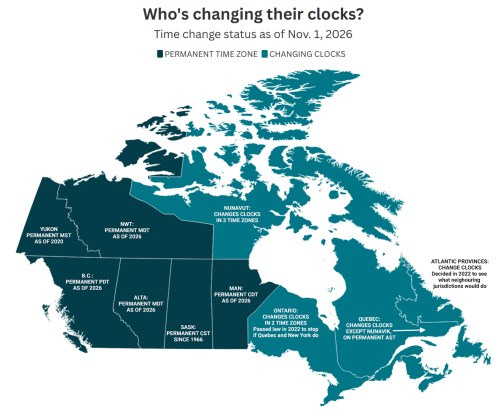
WINNIPEG - Manitoba's government said Thursday the province will be sticking with daylight time year-round, making it the latest jurisdiction to move away from twice-annual time changes. Here's a look at where things stand across Canada:

British Columbia said in March that it was moving to permanent Pacific daylight time. The change also means that parts of northeastern B.C., which have been on mountain standard time year round, are now in alignment with the rest of the province.

Alberta also switched to permanent daylight time this year in what it calls Alberta time. The change means it now has the same time as Saskatchewan year round.

Saskatchewan has been on permanent central standard time since 1966.

Read
Friday, Sep. 18, 2026

Near-future U.S. the setting for surreal dual-world storyline

Reviewed by Morley Walker 4 minute read Preview

Near-future U.S. the setting for surreal dual-world storyline

Reviewed by Morley Walker 4 minute read Yesterday at 2:01 AM CDT

It’s not every day you encounter a seriously intended literary novel that attempts to dramatize a mind-bending physics theory like quantum entanglement.

But then the B.C.-born-and-raised Emily St. John Mandel is not your everyday Canadian literary writer.

In her late 40s, she has lived in the U.S. for her entire writing career. She is best known for her 2014 dystopian novel Station Eleven, about a Shakespearean acting troupe navigating a pandemic-ravaged America.

Her new outing, her seventh, Exit Party, shares DNA with detective and sci-fi genres more than with conventional literary fiction.

Read
Yesterday at 2:01 AM CDT

Cabernet Sauvignon star of wine festival

Ben Sigurdson 5 minute read Preview

Cabernet Sauvignon star of wine festival

Ben Sigurdson 5 minute read Yesterday at 3:00 AM CDT

The Winnipeg Wine Festival will celebrate the king of red wine grapes next weekend — the theme of this year’s festival, which takes place Sept. 25 and 26 at the RBC Convention Centre, is Cabernet Sauvignon.

Cab Sauv, as it’s also known, is the world’s most widely planted wine grape of any colour, first coming to prominence in the 1800s in France’s Bordeaux region, where the grape is still popular. Rather than single-variety wines, Bordeaux reds tend to be blends, with those coming from the left bank of the Gironde estuary being Cabernet-dominant, while right-bank wines are Merlot-dominant, with Cabernet Sauvignon playing a supporting role. Cabernet and Merlot work well together and many other countries have followed suit in blending the two.

A team at University of California Davis put Cabernet Sauvignon through a DNA test in 1996 and discovered its parent grapes are Cabernet Franc and Sauvignon Blanc — it’s likely that at some point the two varieties, planted next to each other in some vineyard, crossed and mutated and became the grape we know today. (Someone growing grapes in the 19th century must have had an inkling of what was up, as the grape has been called Cabernet Sauvignon since long before the DNA test.)

Flavour-wise, most Cabernet Sauvignon wines are big and bold, with a core of deep dark berry flavours, some graphite and spice notes and relatively bright acidity. It’s a grape that is well-suited to barrel aging, with most examples seeing at least some time in wood.

Read
Yesterday at 3:00 AM CDT