B.C. frog relocation project aims to better understand conservation practice
Advertisement
Read this article for free:
or
Already have an account? Log in here »
To continue reading, please subscribe:

Digital Subscription
One year of digital access for only $205*
- Enjoy unlimited reading on winnipegfreepress.com
- Read the E-Edition, our digital replica newspaper
- Access News Break, our award-winning app
- Play interactive puzzles
*First annual payment billed as $205.00 + GST for one year. This annual subscription will automatically renew at $233.00 + GST every 52 weeks (10% off the regular annual price of $259.35). Offer available to new and qualified returning subscribers only. Cancel any time.
To continue reading, please subscribe:
Add Free Press access to your Brandon Sun subscription for only an additional
$1 for the first 4 weeks*
- Enjoy unlimited reading on winnipegfreepress.com
- Read the E-Edition, our digital replica newspaper
- Access News Break, our award-winning app
- Play interactive puzzles
*Your next Brandon Sun subscription payment will increase by $1.00 and you will be charged $17.95 plus GST for four weeks. After four weeks, your payment will increase to $24.95 plus GST every four weeks.
Read unlimited articles for free today:
or
Already have an account? Log in here »
Hey there, time traveller!
This article was published 23/09/2023 (1076 days ago), so information in it may no longer be current.
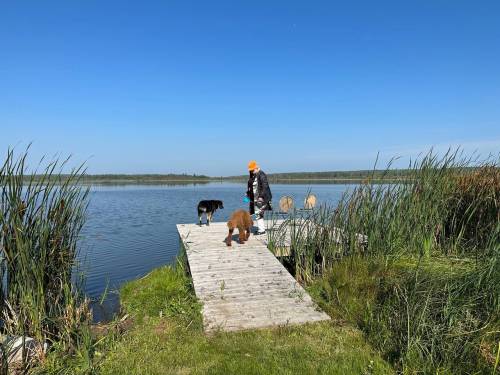
VANCOUVER – Almost every day this summer, University of British Columbia master’s student Megan Winand waded through wetlands with an antenna, following the beeping sounds to find Columbia spotted frogs.
Winand is one of the first to study the impacts of mitigation translocation, or the movement of animals from one location to “the next available habitat that is of the same or better value than where they came from.”
It is typically done as a conservation effort during construction or development projects, she explained.
The practice gained attention ahead of the 2010 Winter Olympics in Vancouver and Whistler, when the Sea-to-Sky Highway was upgraded andmore than 1,000 amphibians were carefully moved out of the construction zone. Among those animals was the red-legged frog, which is listed as a “species of special concern” in B.C.
Frogs are important because they are an “indicator species,” said Winand.
“They act as the canary in the coal mine, if you will. If the frog isn’t doing well, because it’s taking in whatever pollutants are from the air or the wetland itself, it’s likely because the ecosystem isn’t doing well.”
She also noted they are also “in the middle of the food web,” serving as a tasty snack for some animals, while feasting on lower-ranked species like insects and acting as a natural “bio control.”
Mitigation translocation has become increasingly more common in B.C. since the Sea to Sky project, but its impacts have been little studied, Winand explained.
“We don’t know a lot about the effectiveness of this,” she said. “We don’t really know what happens to them after we move them, and even globally there’s not a lot of published research around this type of translocation.”
That’s where her project began at the Mayook Wetland near Cranbrook, in southeastern B.C.
She spent the spring and summer using radio trackers and transponder tags that fit like tiny backpacks on the frogs to track their movements.
“What we’re doing is we’re capturing Columbia spotted frogs at this wetland and all of them are getting what’s called a PIT tag, a passive integrated transponder tag,” she explained.
“Simply, it’s like giving your pet a microchip. There’s no battery in it. When you wave this wand over top of it, it gives you a series of numbers that are unique to that frog.”
The frogs were then divided into three groups, Winand said. Either she left them in their original habitat, which served as her control group, moved them a short distance of about one kilometre or relocated them a farther distance of about five kilometres.
Then, over the summer months, she documented their movement and recorded their measurements, including their weight and size.
“I just want to see if they’re growing, how they’re doing. I want to see if they’re in the same spot that I originally captured them or if they moved. All that kind of adds into my questions about movement and survival.”
The two-year endeavour is in partnership with Ducks Unlimited Canada and the B.C. Ministry of Water, Land and Resource Stewardship.
The project officially began in April, when she and research assistants began tagging frogs. Her field work continued throughout the summer, before concluding in August. Now, Winand is analyzing the field data.
While she said it’s too soon to predict the results, she hopes it begins to answer some of the ongoing questions about the “under researched” topic of translocation mitigation.
“My project is really just like the tip of a very large iceberg in understanding this topic. I’m just looking simply at survival and movement,” she said.
Once those basic questions are answered, Winand said researchers can begin to tackle harder ones, like the impacts such movement has on resource and food competition, disease and genetics.
“There’s still a lot to understand and I hope that this will just keep the momentum going for more people to invest in understanding this research topic.”
This report by The Canadian Press was first published Sept. 23, 2023.