Let there be light and sweets
The Hindu festival of Diwali celebrates goodness, truth and hope with colourful confections
Advertisement
Read this article for free:
or
Already have an account? Log in here »
To continue reading, please subscribe:

Digital Subscription
One year of digital access for only $205*
- Enjoy unlimited reading on winnipegfreepress.com
- Read the E-Edition, our digital replica newspaper
- Access News Break, our award-winning app
- Play interactive puzzles
*First annual payment billed as $205.00 + GST for one year. This annual subscription will automatically renew at $233.00 + GST every 52 weeks (10% off the regular annual price of $259.35). Offer available to new and qualified returning subscribers only. Cancel any time.
To continue reading, please subscribe:
Add Free Press access to your Brandon Sun subscription for only an additional
$1 for the first 4 weeks*
- Enjoy unlimited reading on winnipegfreepress.com
- Read the E-Edition, our digital replica newspaper
- Access News Break, our award-winning app
- Play interactive puzzles
*Your next Brandon Sun subscription payment will increase by $1.00 and you will be charged $17.95 plus GST for four weeks. After four weeks, your payment will increase to $24.95 plus GST every four weeks.
Read unlimited articles for free today:
or
Already have an account? Log in here »
Hey there, time traveller!
This article was published 07/11/2023 (1006 days ago), so information in it may no longer be current.
The special time of Diwali, known as the Festival of Lights, begins on Friday. Observed around the world by the Hindu diaspora, Diwali, or Deepavali, signifies the victory of good over evil, the triumph of truth over falsehood and the hope for knowledge over ignorance, and marks a significant time for Sikhs and Jains worldwide.
As places of worship and homes are lit up in bright lights, this time brings forth wishes of prosperity, peace, happiness and good health. There could not be a better time to express all this goodness with a lot of sweetness.
FAREED KHAN / THE ASSOCIATED PRESS FILES From a temple like this one in Karachi, Pakistan, to the world beyond, the Hindu festival of light called Diwali celebrates the triumph of light over darkness.
Indian sweets, referred to as mithais, come in a variety of shapes, sizes, textures and types. While some mithais are unique to certain Indian states, there are nuances of the same sweets across different regions of the country.
Indian sweets look as delicious as they taste, dotted with decorations that give them a decadent flair. Slivered almonds, pistachio pieces, cashew chunks and varak (edible silver or gold foil) are some of the eye-catching accents used as garnish.
Spices including ground cardamom, saffron threads, cloves and nutmeg, along with raisins and nuts, are incorporated into the making of Indian sweets, delivering comforting flavours and warm, aromatic scents.
Local Indian eateries, as well as grocery stores, carry them throughout the year, but many offer a more elaborate spread leading up to the Festival of Lights, a five-day celebration taking place this year from Friday, Nov. 10, to Tuesday, Nov. 14 with the actual day of Diwali falling on Sunday, Nov. 12.
Many mainstream grocery stores carry pre-packaged boxes of Indian sweets, which include the brands Brar’s, Nanak and Bikaji.
KATIE WORKMAN / THE ASSOCIATED PRESS FILES Unlike other cultures’ sweets, served after meals, mithais of all sorts are offered to guests upon arrival, before meals and during religious ceremonies.
Indian sweets are not like a typical North American dessert that is relished only after a meal; they are woven into the culture. In the Indian home, they are the first food offered to guests as a welcoming gesture. Before a meal, guests are often offered a small piece of mithai. Eating something sweet first is considered to create an atmosphere of positive conversation and cordial interactions. Often you will see an assortment of Indian sweets included alongside appetizers.
Mithais are offered during Hindu religious ceremonies and handed out at festivals. Certain sweets are synonymous with a particular Hindu deity: ladoos and modaks, steamed sweet dumplings, are made specifically for and offered to the deity Lord Ganesha.
While halwa can be considered a dessert, it is usually prepared for all religious offerings, in the form of semolina halwa. Other special occasions where Indian sweets are a must include engagements, weddings and the arrival of a new child.
Traditionally, Indian sweets are given in boxes that are uniquely designed with creative patterns, sparkles and bright colours. It can be adventurous to mix and match the mithai in your sweet box.
Here is a list of some of the varied types of Indian sweets:
● Halwa/halva is similar to pudding, finished with a thick, crumbly texture made using either semolina, carrots, moong dal or besan/gram flour parched in ghee or butter, with boiled milk, sugar, saffron threads, raisins, ground cardamom and nuts added. Some unique versions of halwa are made with sweet potato and beetroot.
● Barfi/burfi is a fudge-like sweet that is milk-based. The most basic version is plain milk barfi, simplified by using milk powder combined with milk, sugar, ghee, ground cardamom, raisins and nuts. Varieties include, besan, mango, coconut, pistachio and cashew nut/kaju barfi. Contemporary twists feature peanut butter, chocolate and strawberry flavours.
● Rasgulla is made from chenna dough that has a base of curdled milk, or Indian cottage cheese (made by adding lemon juice to boiled milk). This soft, moist milk solid is kneaded into small balls and cooked in a bubbling sugary syrup with added flavours. The taste of rasgulla, which has a spongy texture, is accented with the addition of rosewater to the syrup. Chenna is also the base ingredient in ras malai and sandesh, two very popular Indian sweets.
RAHMAT GUL / THE ASSOCIATED PRESS FILES During Diwali, Jalebi is one of the sweets or mithais made and enjoyed worldwide.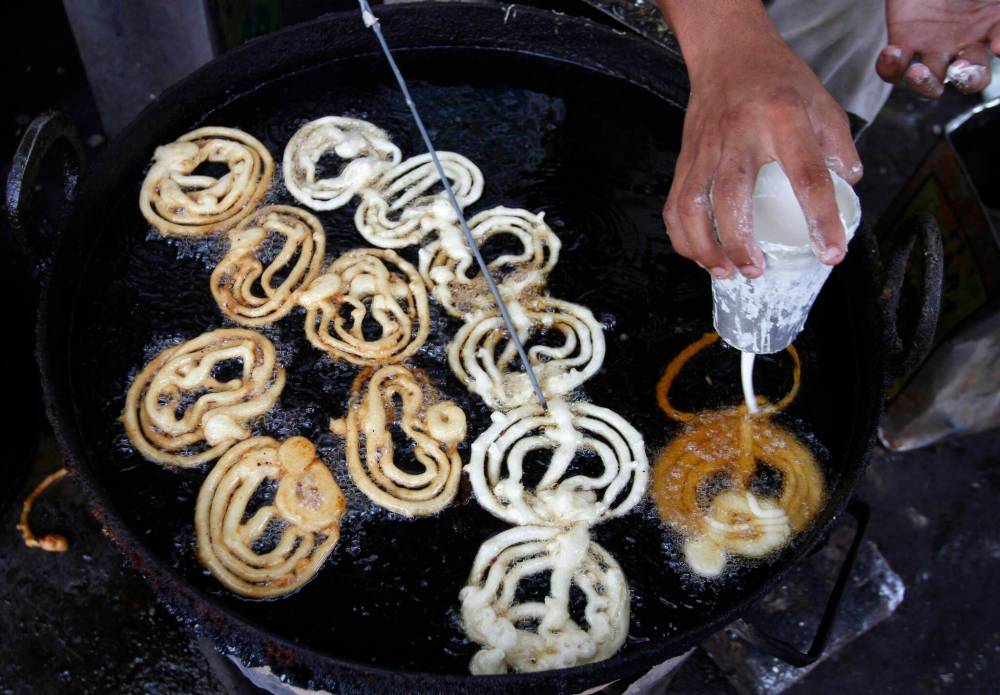
● Jalebi is like an Indian funnel cake. It is a batter of all-purpose flour, besan, baking soda, water and yogurt: the dough is then fermented, deep-fried and then dipped in a flavoured, sugary syrup. By adding orange food colouring to the batter, brightness is added to this very sticky and sweet treat. The spiral-shaped goodie is perfection with its crunchy texture on the outside and soft chewiness on the inside.
● Gulab jamun is made from khoya, which is milk simmered until its moisture evaporates and it becomes thickened with a crumbly texture. The khoya is combined with some all-purpose flour, baking powder and ghee to form a dough. The doughnut-like mixture is made into mid-sized balls that are deep-fried and soaked in a simmering flavoured sugar syrup.
● Ladoo is a rounded ball made using the base ingredients of different flours, sugar and ghee or oil. Popular versions of this sweet are motichoor, besan, coconut and semolina ladoo.
The giving of sweets captures the spirit of Diwali — fun, camaraderie, cheer, caring and kindness. Whether the mithais are made at home, as part of a yearly family tradition, or if they are sweets you take the time to buy for family and friends, it is indeed a time to wholeheartedly give, share and connect with others, both near and far. All this goodness is phrased just right with delicious Diwali delights.
— Romona Goomansingh, PhD, is an educator, freelance writer and author in Winnipeg.

Carrot Halwa
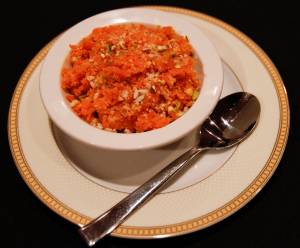
Carrot Halwa
Preparation Time: 45 minutes to 1 hour
Serves: 4-5
4 large bright orange carrots, grated
500 ml (2 cups) whole milk
60 ml (¼ cup) ghee, or unsalted butter
2.5 ml (½ tsp) ground cardamom
125 ml (½ cup) white sugar, or to taste
60 ml (¼ cup) golden raisins, or to taste
60 ml (¼ cup) slivered almonds, optional
In a deep, heavy-bottomed pot, combine grated carrots and whole milk.
Cook the mixture until carrots become soft and milk evaporates. Stir regularly. Use low-medium heat to avoid burning the mixture.
Add the ghee or unsalted butter and stir until carrots are fully cooked. (Unlike other halwas, carrot halwa is not parched in ghee or butter first.)
Still on low-medium heat, add sugar and allow the mixture to become thick and slightly dry.
Add raisins, cardamom and almonds and stir for a few minutes. Then turn off heat and leave halwa to cool down slightly.
Carrot halwa is best served warm. Add some decadence by topping it with a dollop of whipping cream or ice cream.
Advertisement Advertise With Us
Advertisement Advertise With Us