

AFN’s new national chief takes over troubled, bitterly divided organization

Advertisement
Read this article for free:
or
Already have an account? Log in here »
To continue reading, please subscribe:

Digital Subscription
One year of digital access for only $205*
- Enjoy unlimited reading on winnipegfreepress.com
- Read the E-Edition, our digital replica newspaper
- Access News Break, our award-winning app
- Play interactive puzzles
*First annual payment billed as $205.00 + GST for one year. This annual subscription will automatically renew at $233.00 + GST every 52 weeks (10% off the regular annual price of $259.35). Offer available to new and qualified returning subscribers only. Cancel any time.
To continue reading, please subscribe:
Add Free Press access to your Brandon Sun subscription for only an additional
$1 for the first 4 weeks*
- Enjoy unlimited reading on winnipegfreepress.com
- Read the E-Edition, our digital replica newspaper
- Access News Break, our award-winning app
- Play interactive puzzles
*Your next Brandon Sun subscription payment will increase by $1.00 and you will be charged $17.95 plus GST for four weeks. After four weeks, your payment will increase to $24.95 plus GST every four weeks.
Read unlimited articles for free today:
or
Already have an account? Log in here »
Hey there, time traveller!
This article was published 08/12/2023 (983 days ago), so information in it may no longer be current.
In a video posted on social media days after her removal as national chief of the Assembly of First Nations, Roseanne Archibald was very specific when describing who was responsible for what she called a “coup.”
Last June, in an online meeting called by regional chiefs at the AFN, Archibald was voted out by 163 chiefs after a human resources report claimed she bullied and harassed staff.
Calling the report a “smokescreen,” Archibald declared in the video she was going to “connect the dots” to show “what is really going on at the AFN.”
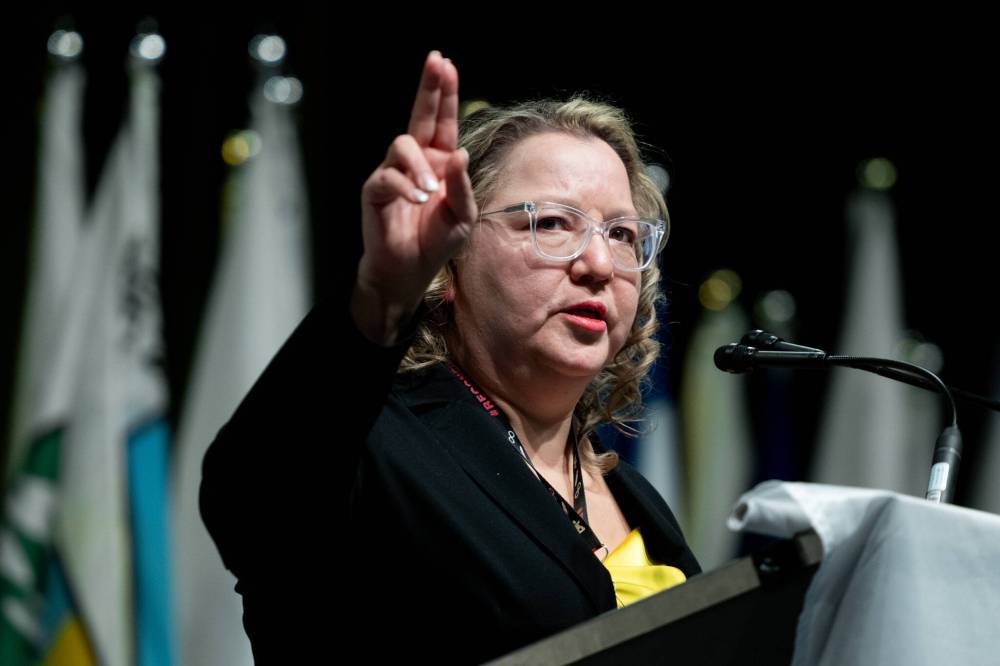
SPENCER COLBY / THE CANADIAN PRESS
In Ottawa Thursday, 234 chiefs voted to make Cindy Woodhouse the 16th national chief of the Assembly of First Nations.
She went on accuse former National Chief Perry Bellegarde and his supporters among regional chiefs at the AFN for orchestrating her removal after she called for investigations into financial corruption and what she called “federal government meddling.”
She then highlighted one specific person.
“The person who has been talking behind the scenes,” Archibald said, “is (Manitoba) regional chief Cindy Woodhouse. She used to work for Perry Bellegarde. She is a member of the Liberal party and supports the Liberal party.”
Archibald then accused Woodhouse of conspiring to become the next national chief.
At a special meeting in Ottawa Thursday, 234 chiefs voted to make Cindy Woodhouse the 16th national chief of the Assembly of First Nations.
The election took six rounds and two days, with neither Woodhouse nor David Pratt, second vice-chief of the Federation of Sovereign Indigenous Nations in Saskatchewan, securing the 60 per cent support necessary from the estimated 415 chiefs who registered and were eligible to cast a ballot.
Pratt conceded the election Thursday morning.
“I know a lot of our chiefs wanted me to keep going and pushing the fight. But I knew that it wasn’t doing our convention any good to prolong it,” he said.
In her victory speech, Woodhouse called for unity within the AFN and for accountability from the Trudeau government.
“Canada, you cannot forget First Nations,” she said. “You take our money from our land, you have to make sure that you work with us to get that out the door to our communities… if you don’t listen to our people, you don’t listen to our chiefs — you don’t answer them — then there’s problems.
“And so to Canada, we’re coming for you.”
Such rhetoric is a bit odd for Woodhouse, a former Manitoba president and national member of the Indigenous Peoples Commission (an advocacy and policy-writing group in the federal Liberal party). It’s could also be symbolic of the odd position she will now be in advocating for First Nations with the party she used to advocate for.
There was also no mention of Woodhouse’s longtime Liberal affiliations on her national chief election campaign website, either — another odd look.
At the same time, Woodhouse has proven she can get things done with the Liberal government, having been the lead AFN negotiator in the $23-billion compensation package for First Nations children in care.
She’s no stranger to national Indigenous politics, having worked for Bellegarde, former national chief Shawn Atleo and Manitoba chief Francis Flett.
She’s also been a noted advocate for clean drinking water, better infrastructure and internet connectivity on First Nations, and told reporters after her speech she will pick up on these issues, as well as child welfare, policing and Indigenous rights.
Woodhouse’s largest body of work though, has been as Manitoba regional chief of the AFN during the tumultuous reign of Archibald, the first woman elected to the historically male-dominated organization.
In her speech on unity at the AFN, Woodhouse acknowledged and thanked Archibald for having “smashed the glass ceiling.”
I have a feeling Archibald might not return that favour.
Woodhouse inherits an organization in crisis — one for which she and her fellow regional chiefs are at least partly to blame — and mired in Archibald’s still-lingering questions of financial corruption and allegations of federal government interference.
The conflicts over AFN leadership has led to apathy, too. Nearly a third of the more than 630 member chiefs don’t participate in meetings, votes or creating policy.
There is also lingering resentment directed at Woodhouse, too.
In her concession speech after finishing in third place, fellow national chief candidate Sheila North admonished the crowd for forcibly ending Archibald’s term six months early and then said “women can be violent” before endorsing Pratt — comments that were clearly directed at Woodhouse.

This has all led to complicated situation for the new national chief.
Woodhouse will certainly have time. She and her fellow regional chiefs voted to extend the length of her term to three years and six months — something she will benefit from.
The next election won’t happen until July 2027.
That is, unless there’s a coup.
niigaan.sinclair@freepress.mb.ca
Niigaan Sinclair is Anishinaabe from Peguis First Nation and a professor in the Department of Indigenous Studies at the University of Manitoba. He’s been a columnist for the Free Press since 2018. Read more about Niigaan.
Every piece of writing Niigaan produces is reviewed by an editing team before it is posted online or published in print — part of the Free Press‘s tradition, since 1872, of producing reliable independent journalism. Read more about Free Press’s history and mandate, and learn how our newsroom operates.
Our newsroom depends on a growing audience of readers to power our journalism. If you are not a paid reader, please consider becoming a subscriber.
Our newsroom depends on its audience of readers to power our journalism. Thank you for your support.
Niigaan Sinclair is Anishinaabe from Peguis First Nation and a professor in the Department of Indigenous Studies at the University of Manitoba. He’s been a columnist for the Free Press since 2018. Read more about Niigaan.
Every piece of writing Niigaan produces is reviewed by an editing team before it is posted online or published in print — part of the Free Press‘s tradition, since 1872, of producing reliable independent journalism. Read more about Free Press’s history and mandate, and learn how our newsroom operates.
Our newsroom depends on a growing audience of readers to power our journalism. If you are not a paid reader, please consider becoming a subscriber.
Our newsroom depends on its audience of readers to power our journalism. Thank you for your support.
Advertisement Advertise With Us
Advertisement Advertise With Us