A controversial theory linking climate change to Arctic cold snaps, explained
Advertisement
Read this article for free:
or
Already have an account? Log in here »
To continue reading, please subscribe:

Digital Subscription
One year of digital access for only $205*
- Enjoy unlimited reading on winnipegfreepress.com
- Read the E-Edition, our digital replica newspaper
- Access News Break, our award-winning app
- Play interactive puzzles
*First annual payment billed as $205.00 + GST for one year. This annual subscription will automatically renew at $233.00 + GST every 52 weeks (10% off the regular annual price of $259.35). Offer available to new and qualified returning subscribers only. Cancel any time.
To continue reading, please subscribe:
Add Free Press access to your Brandon Sun subscription for only an additional
$1 for the first 4 weeks*
- Enjoy unlimited reading on winnipegfreepress.com
- Read the E-Edition, our digital replica newspaper
- Access News Break, our award-winning app
- Play interactive puzzles
*Your next Brandon Sun subscription payment will increase by $1.00 and you will be charged $17.95 plus GST for four weeks. After four weeks, your payment will increase to $24.95 plus GST every four weeks.
Read unlimited articles for free today:
or
Already have an account? Log in here »
Hey there, time traveller!
This article was published 31/01/2024 (989 days ago), so information in it may no longer be current.
The capricious start to the winter season has already seen dramatic temperature swings across much of Canada, with energy grid-disrupting cold snaps giving way to an ice-thawing warm spell.
Scientists agree on how climate change, driven by the burning of fossil fuels, is altering winter globally – the season is getting warmer and shorter, studies suggest the snowpack is thinning out earlier across large parts of Southern Canada, and the Far North is warming faster than the rest of the world.
Cold snaps, like the one felt across the country earlier this month, are not changing those overall trends, scientists say.
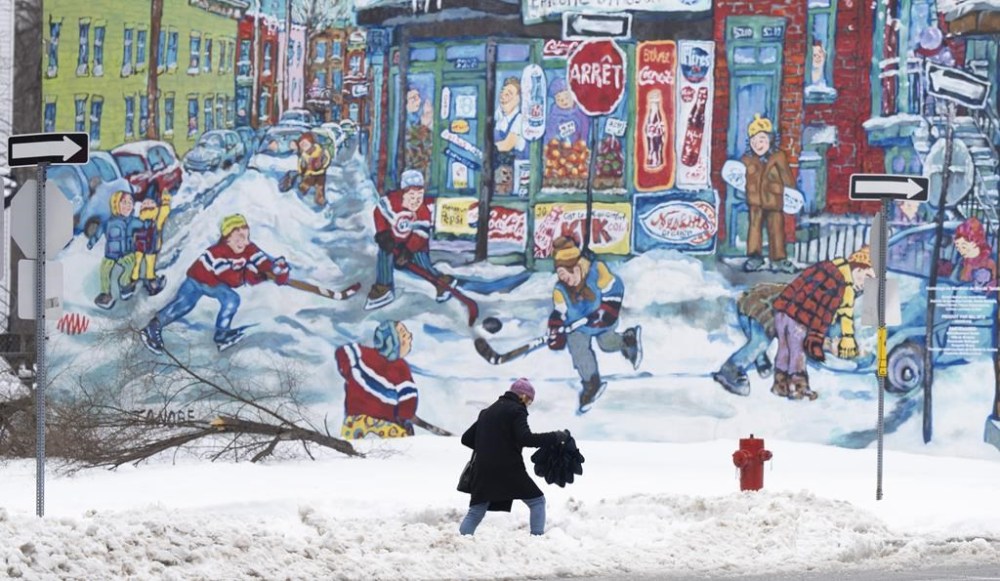
But there is a controversial idea that suggests rapid warming in the Far North could actually be linked to outbreaks of Arctic air.
The theory suggests that the overall warming trend for winters may continue, but would be punctuated by lashes of Arctic cold, possibly stretching further south than before. While the science underpinning the idea is far from settled, one of the theory’s leading exponents says it could help explain some of the wild swings in weather seen recently.
“There’s a lot of resistance to it, because I think it’s so non-intuitive,” said Judah Cohen, a research affiliate with MIT, who works as a director of seasonal forecasting at Verisk AER.
“But with the way Arctic change is occurring right now, I’d say there’s more disruption in the polar vortex and we have these competing or conflicting influences … There’s more volatility in winter weather, it’s more easier to go from record warm to record cold back to record warm.”
Some of the scientists most publicly skeptical of the theory include research scientist Michael Sigmond and his colleagues with the Canadian Centre for Climate Modelling and Analysis, a group housed under the federal government. Members of the group based out of Victoria, B.C., have co-authored several papers and letters in scientific journals raising their critiques.
Despite being hotly debated, however, the theory offers a look at how a warming planet and continued cold snaps may not be as contradictory as they may first appear.
THE THEORY
Key to understanding the theory is the polar jet stream – the ribbon of strong atmospheric winds circling the north. One of the factors driving the jet stream is the temperature difference between cold Arctic air and mid-latitude warm air to the south.
American climate scientist Jennifer Francis and her co-authors, whose work in the early 2010s introduced the theory, have argued that as the north-south temperature difference gets smaller, jet stream winds slow down. As that happens, the jet stream is more likely to be deflected off course, leading to wider outbreaks of cold air.
Kent Moore, a professor of atmospheric physics at the University of Toronto, called the theory a “novel twist” on how scientists had typically thought about planetary waves.
“In the past, maybe a jet stream undulation would only get as far south as say, Winnipeg, now it’s getting as far south as Texas,” he said.
“That larger undulation is proposed to be one of the effects of climate change.”
Another theory, this one tied to Cohen, arrives at a similar conclusion, but following a different path. He looks to the polar vortex, a strong band of wind circling higher than the jet stream and above the North Pole.
Cohen and his colleagues suggest less sea ice and more snow cover across parts of the Far North, both linked to faster warming, are exaggerating certain west to east temperature contrasts. Those contrasts generate more energy in atmospheric pressure waves.
Those bigger waves, he suggests, are more likely to disrupt the polar vortex, stretching it out like a rubber band and increasing the likelihood of severe winter weather.
In January, frigid conditions stretched Alberta’s energy grid, leading the operator to urge people to conserve energy at peak times and warn of possible rolling blackouts. In British Columbia, residents weathered a chilling cold snap and snowfall that has since given way to double digit highs and heavy rain.
Cohen says his theory played out as predicted in recent weather patterns.
“This is textbook.”
THE PUSHBACK
The ideas have both been hotly contested.
Sigmond, the Canadian research scientist, says the disruptions in the polar vortex and the jet stream could both be explained by natural variations in the climate system, rather than pinning it on human-caused climate change.
“Because the time series of the observations are very short, it’s almost impossible to determine which part of those trends are due to internal variability, or which part is due to climate change,” he said.
He said the trend in increased jet stream waviness, observed between the 1990s and early 2010s, has recently stopped and even reversed. This, he said, suggests it may have just been “a fluke, like a result of natural variability.”
One of Sigmond’s colleagues, Russell Blackport, has published a number of studies putting cold water on the theory.
In one study from 2021, Blackport and his co-author suggest there might be a connection between sea ice loss and midlatitude winter climate extremes but it is far weaker than others suggest and may be better explained by changes in atmospheric circulation. Another 2020 paper by the duo suggests that even as sea ice loss and Artic warming has accelerated, there has not been more frequent or widespread cold extremes.
“It does annoy me sometimes,” Sigmond said of the theory re-emerging following bouts of extreme cold.
“What’s more relevant is to realize that we are living in climate crisis and scientists agree on that. There is many things that scientists agree on. This is not one of them.”
THE IMPACT
For Cohen, the theory comes down to helping make better weather predictions.
“These ideas help make a better forecast,” he said.
Better forecasts can help decision makers, from operators of energy grids to homeless shelters, better prepare for extreme weather, he said. In the long-term, figuring out whether climate change contributes to cold snaps can also help communities make more informed choices about their climate resilience, especially in places unaccustomed to extreme cold.
“Maybe when you’re planning, you say, ‘well, climate change says we need to focus on tornadoes, hurricanes and heat waves, and I don’t need to be worried about Arctic outbreaks. That’s going to become a thing of the past.’ Maybe my research says, you know what? Not so fast,” Cohen said.
Sigmond, on the other hand, suggests misattribution of climate change to outbreaks of extreme cold could also lead to climate inaction.
For example, warmer winters are expected to increase the survival rate of certain pests. Those concerns may be overlooked if people think climate change will lead to outbreaks of extreme cold capable of wiping out those pests.
“That is a problem,” he said.
This report by The Canadian Press was first published Jan. 31, 2024.