Four characters in search of a rainbow of pink possibilities
Strong performances, lush visuals
Advertisement
Read this article for free:
or
Already have an account? Log in here »
To continue reading, please subscribe:

Digital Subscription
One year of digital access for only $205*
- Enjoy unlimited reading on winnipegfreepress.com
- Read the E-Edition, our digital replica newspaper
- Access News Break, our award-winning app
- Play interactive puzzles
*First annual payment billed as $205.00 + GST for one year. This annual subscription will automatically renew at $233.00 + GST every 52 weeks (10% off the regular annual price of $259.35). Offer available to new and qualified returning subscribers only. Cancel any time.
To continue reading, please subscribe:
Add Free Press access to your Brandon Sun subscription for only an additional
$1 for the first 4 weeks*
- Enjoy unlimited reading on winnipegfreepress.com
- Read the E-Edition, our digital replica newspaper
- Access News Break, our award-winning app
- Play interactive puzzles
*Your next Brandon Sun subscription payment will increase by $1.00 and you will be charged $17.95 plus GST for four weeks. After four weeks, your payment will increase to $24.95 plus GST every four weeks.
Read unlimited articles for free today:
or
Already have an account? Log in here »
Hey there, time traveller!
This article was published 21/02/2024 (936 days ago), so information in it may no longer be current.
Not that long ago, the colour pink popped like bubblegum around planet Barbie, enjoying a giddy resurgence as the ultimate badge of girly-girl femininity.
Manitoba Theatre for Young People’s presentation of the award-winning The Problem with Pink digs deeper into what the hue has traditionally represented. That includes flagrant gender-based stereotyping and often suffocating societal pressures to conform to preconceived norms.
The touring show — equal parts theatre and dance — marks the second co-production between Le Petit Théâtre de Sherbrooke (Quebec), helmed by Erika Tremblay-Roy, and La parenthèse/Christophe Garcia (France), founded by its artistic director, Christophe Garcia.
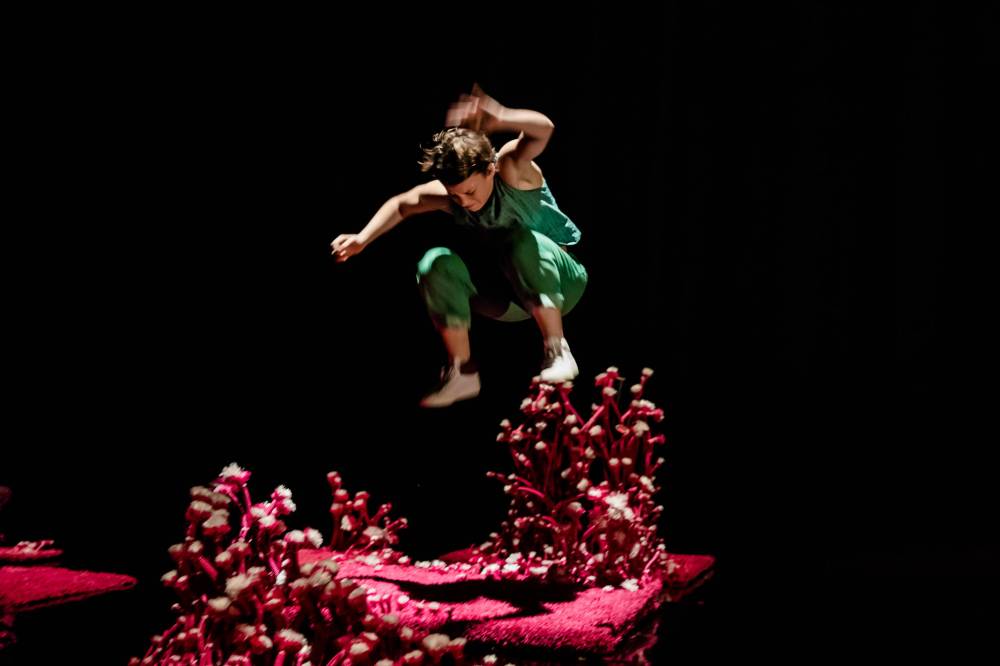
VERCHERE JEAN-CHARLES PHOTO
The Problem with Pink unfolds through a series of kaleidoscopic vignettes, kicked off by the terrible news from the outside world that pink is just for girls.
Its crackerjack international ensemble of actors/dancers, hailing from both Canada and France, frolic and leap about the stage with the fearlessness of children, skilfully directed by Garcia and Tremblay-Roy, the latter of whom penned the story.
While each well-crafted character functions as an equal in this private, pink society, Tremblay-Roy ensures they take turns revealing their all-too-human strengths and foibles.
Protagonist Alix (Samuel Décary) struggles with his insecurities and fears, hiding behind a shield of toxic masculinity while unwittingly wearing pink socks he later tears off in horror.
Floral-shirted Lou (Olivier Rousseau) innocently replies “Which one?” when asked about his dad by Alix. Sasha (Idir Chatar) proves a chameleon who shapeshifts to the needs of others.
Noa (Amélie Olivier) easily holds her own as the show’s lone female, blithely unaware of her “otherness” among the guys, before crumpling into a despondent heap after Sasha and Lou shut her out because of her assigned sex at birth.
The storytelling-based narrative (performed in English, with Saturday’s 4 p.m. matinée in French) unfolds primarily through a series of kaleidoscopic vignettes, kicked off by the terrible news from the outside world that “pink is for girls.”
Intricate dances choreographed by Garcia are interlaced throughout, including athletic lifts and visceral falls as fluidly organic as contact improvisation. Gentle humour and clever insight also abound, such as when the foursome initially strikes a pact to call pink “pale red,” only to be challenged by Alix’s “Is pale red a boy colour?”
There’s always a certain “je ne sais quoi” with French productions, with such legendary trailblazers as the great Robert Lepage (a past collaborator of Garcia), Robert Desrosiers and Marie Chouinard firmly stamping the Canadian arts scene with their ooh-la-la Euro sensibility. Pink is part of that heritage, its plotline propelled by a dreamy poetic ethos that might have gone still further.
One of the most powerful moments during Sunday’s performance came during Chatar’s later monologue/dance solo, performed with balletic grace to a droning piano waltz. He offers a litany of boastful accomplishments to his imagined parents, including, “I am one of the boys” and a final, chilling, “Mom, I break hearts.” His pride at this revelation, uttered with complete sincerity, infuses the show with a further subtext of intergenerational trauma.

Another is Olivier’s solo, when she begins to recite, “Once upon a time there was a princess…” after being rejected by her friends, her movement becoming increasingly agitated as she physically convulses and rails against female stereotypes. A thunderous explosion of pink petals — literally the bursting of conventional images — takes viewers deeper into the players’ fantastical world.
French visual artist Julia Morlot’s luscious “hyper pink” playground provides plenty of eye candy; a space-defining rug is flanked by an otherworldly garden filled with flowers (mushrooms?) created by twisted, tufted ropes. The production rounds out with effective lighting by Quebec designer Andréanne Deschênes, with Pascale Guené’s (mostly) earth-toned costumes keeping the focus squarely on pink.
At times, the episodic scenes feel overly frenetic — even for a kid’s show — and the actors’ lines are sometimes obfuscated by composer Jakub Trzepizur’s pre-recorded, electro-acoustic score. It’s also tricky to hear the dialogue clearly when it’s directed upstage, rather than projected into the house filled with audience members of all ages.
However, there is resolution, and even a pink peripeteia for Alix as he dons his socks once again, while Noa gently affirms that “no one cares.” At last, he has embraced “pink” and the freedom to choose one’s path, irrespective of colour, creed, sex or gender, accepting a rainbow of new possibilities in this deliciously pink paradise not too far from home.
holly.harris@shaw.ca
Holly Harris writes about music for the Free Press Arts & Life department.
Our newsroom depends on a growing audience of readers to power our journalism. If you are not a paid reader, please consider becoming a subscriber.
Our newsroom depends on its audience of readers to power our journalism. Thank you for your support.
Theatre review
The Problem with Pink
Manitoba Theatre for Young People
● To Saturday
★★★★½ out of five
Holly Harris writes about music for the Free Press Arts & Life department.
Our newsroom depends on a growing audience of readers to power our journalism. If you are not a paid reader, please consider becoming a subscriber.
Our newsroom depends on its audience of readers to power our journalism. Thank you for your support.
Related Articles
$1.3M gives MTYP starring role in green scene
Advertisement Advertise With Us
Advertisement Advertise With Us