Lobster catch dips to lowest level since 2009 as fishers grapple with climate change, whale rules

Advertisement

Advertise with us

PORTLAND, Maine (AP) — America's lobster fishing business dipped in catch while grappling with challenges including a changing ocean environment and new rules designed to protect rare whales.

Read this article for free:


or

Already have an account? Log in here »

To continue reading, please subscribe:

Subscribe and receive a limited-edition Free Press branded hat or tote.

Digital Subscription

One year of digital access for only $205*

  • Enjoy unlimited reading on winnipegfreepress.com
  • Read the E-Edition, our digital replica newspaper
  • Access News Break, our award-winning app
  • Play interactive puzzles

*First annual payment billed as $205.00 + GST for one year. This annual subscription will automatically renew at $233.00 + GST every 52 weeks (10% off the regular annual price of $259.35). Offer available to new and qualified returning subscribers only. Cancel any time.

To continue reading, please subscribe:

Add Free Press access to your Brandon Sun subscription for only an additional

$1 for the first 4 weeks*

  • Enjoy unlimited reading on winnipegfreepress.com
  • Read the E-Edition, our digital replica newspaper
  • Access News Break, our award-winning app
  • Play interactive puzzles
Start now

*Your next Brandon Sun subscription payment will increase by $1.00 and you will be charged $17.95 plus GST for four weeks. After four weeks, your payment will increase to $24.95 plus GST every four weeks.

Hey there, time traveller!
This article was published 01/03/2024 (932 days ago), so information in it may no longer be current.

PORTLAND, Maine (AP) — America’s lobster fishing business dipped in catch while grappling with challenges including a changing ocean environment and new rules designed to protect rare whales.

The lobster industry, based mostly in Maine, has had an unprecedented decade in terms of the volume and value of the lobsters brought to the docks. But members of the industry have also said they face existential threats from proposed rules intended to protect the North Atlantic right whale and climate change that is influencing where lobsters can be trapped.

Maine fishermen’s catch in 2023 fell more than 5% from the year that preceded it, and the total of 93.7 million pounds of lobsters caught was the lowest figure since 2009, according to data released Friday by the Maine Department of Marine Resources. The figure tracks with the up-and-down year lobster fishermen experienced, said Dave Cousens a fishermen based out of Criehaven island and a former president of the Maine Lobstermen’s Association.
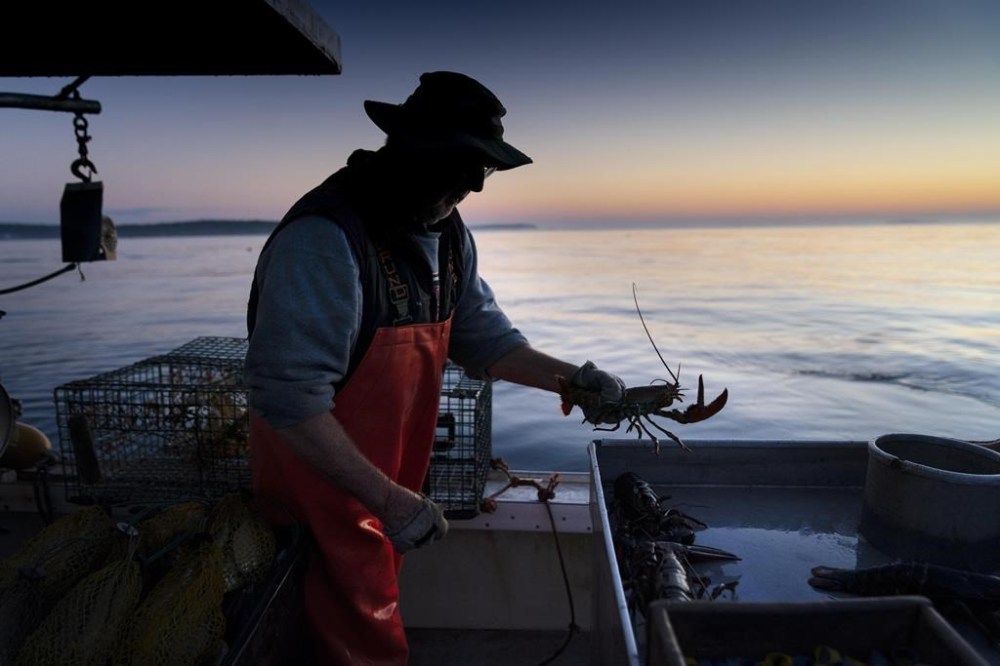
FILE - Max Oliver moves a lobster to the banding table aboard his boat while fishing off Spruce Head, Maine, on Aug. 31, 2021. America's lobster fishing business dipped in catch while grappling with challenges including a changing ocean environment and new rules designed to protect rare whales. (AP Photo/Robert F. Bukaty, File)

The price of bait and fuel eased somewhat, but the volume of catch didn’t seem to match other recent years, Cousens said. The Maine lobster haul has fallen from a high of 132.6 million pounds in 2016, though the 2023 year’s figure was still much more than fishermen produced in most of the 2000s. The 2023 haul was also the second year in a row the total catch declined.

Fishermen who participate in Maine’s lifeblood lobster industry are on edge about what the future holds, as lobsters have inched steadily northward as waters have warmed, Cousens said.

“We’ve gone down steadily from 132 million. We’re going back downhill,” Cousens said. “There’s no question climate change is affecting it.”

Fishermen from Massachusetts, Rhode Island and other Northeast states also harvest lobsters with traps from the cold waters of the Atlantic Ocean, but about 80% of the catch comes to the docks in Maine in a typical year.

The price of lobsters at the docks has ebbed and flowed in recent years, but it has stayed fairly consistent to consumers. The price at the docks spiked to more than $6.70 per pound in 2021 and fell to less than $4 per pound in 2022. Last year, it was a little less than $5 per pound, and the total catch was worth more than $460 million at the docks, according to data released Friday. That is the third highest figure of the last four years.

“The price Maine lobstermen received last year is a reflection of the continued strong demand for this iconic seafood,” said Maine marine resources Commissioner Patrick Keliher.

The state’s fishermen have been in a lengthy legal battle with the federal government over rules designed to protect the whales, which are vulnerable to entanglement in fishing gear. The fishermen argue the proposed rules are so strict they could put them out of business, but conservationists say they are essential to save the whales, which number less than 360 in the world. A right whale found dead off Massachusetts this winter showed signs of entanglement in Maine gear.

The ways in which climate change is affecting the industry are a subject of ongoing scientific study. The southern New England lobster industry has collapsed as the ocean has warmed, and the waters off Maine logged the second-warmest year on record in 2022.

Report Error Submit a Tip

More Stories

A quick look at where provinces and territories stand on time changes

The Canadian Press 2 minute read Preview

A quick look at where provinces and territories stand on time changes

The Canadian Press 2 minute read Updated: Yesterday at 6:28 AM CDT

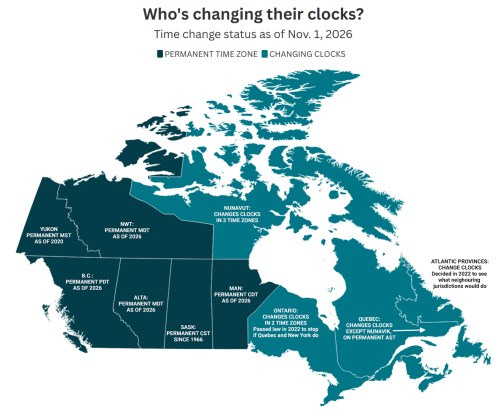
WINNIPEG - Manitoba's government said Thursday the province will be sticking with daylight time year-round, making it the latest jurisdiction to move away from twice-annual time changes. Here's a look at where things stand across Canada:

British Columbia said in March that it was moving to permanent Pacific daylight time. The change also means that parts of northeastern B.C., which have been on mountain standard time year round, are now in alignment with the rest of the province.

Alberta also switched to permanent daylight time this year in what it calls Alberta time. The change means it now has the same time as Saskatchewan year round.

Saskatchewan has been on permanent central standard time since 1966.

Read
Updated: Yesterday at 6:28 AM CDT

Gillingham in lead with decided voters

Nicole Buffie 6 minute read Preview

Gillingham in lead with decided voters

Nicole Buffie 6 minute read Yesterday at 6:55 PM CDT

A cloud of uncertainty is hanging over Winnipeg as October’s municipal election nears.

Three months after a poll showed more than 40 per cent of Winnipeggers wanted to see someone other than current mayor Scott Gillingham elected, a new Abacus Data poll indicates more than half of Winnipeg voters are undecided heading into next month’s civic election.

Of decided voters, 55 per cent favour Gillingham compared to 23 per cent for former councillor and provincial cabinet minister Kevin Klein and 11 per cent for funeral director Mike Vogiatzakis.

Of all respondents, just over 50 per cent said they were unsure while 13 per cent said they will not vote.

Read
Yesterday at 6:55 PM CDT

Desperate Poilievre wants Canadians to believe the sky is falling when it’s just cloudy outside

Tom Brodbeck 5 minute read Preview

Desperate Poilievre wants Canadians to believe the sky is falling when it’s just cloudy outside

Tom Brodbeck 5 minute read Yesterday at 12:47 PM CDT

Pierre Poilievre has a problem.

Canadians just don’t seem to be paying much attention to him anymore.

So, naturally, the Conservative Opposition leader has decided to turn up the volume.

At a recent party caucus retreat in Penticton, B.C., Poilievre delivered the familiar message: Canada is in trouble, Canadians are hurting and the Liberal government is making everything worse.

Read
Yesterday at 12:47 PM CDT

Near-future U.S. the setting for surreal dual-world storyline

Reviewed by Morley Walker 4 minute read Preview

Near-future U.S. the setting for surreal dual-world storyline

Reviewed by Morley Walker 4 minute read 2:01 AM CDT

It’s not every day you encounter a seriously intended literary novel that attempts to dramatize a mind-bending physics theory like quantum entanglement.

But then the B.C.-born-and-raised Emily St. John Mandel is not your everyday Canadian literary writer.

In her late 40s, she has lived in the U.S. for her entire writing career. She is best known for her 2014 dystopian novel Station Eleven, about a Shakespearean acting troupe navigating a pandemic-ravaged America.

Her new outing, her seventh, Exit Party, shares DNA with detective and sci-fi genres more than with conventional literary fiction.

Read
2:01 AM CDT

Hellebuyck standoff caused by… Nathan MacKinnon?

Mike McIntyre 6 minute read Preview

Hellebuyck standoff caused by… Nathan MacKinnon?

Mike McIntyre 6 minute read Yesterday at 6:34 PM CDT

Looking for someone to blame in the Connor Hellebuyck fiasco and cast as public enemy No. 1? How about long-time Winnipeg Jets nemesis Nathan MacKinnon?

Allow us to explain as we fire up the time machine and head back to February in Italy.

Oh, what could have been if MacKinnon had been able to score on what appeared to be an open net late in the third period of the men’s gold medal game with Hellebuyck down and seemingly out of position.

Instead, the star forward fired wide, keeping the score deadlocked at 1-1 as the clock ticked down on regulation.

Read
Yesterday at 6:34 PM CDT

Canada must not accept another Iranian autocracy

David Matas 5 minute read 2:01 AM CDT

Iran is a state run by a radical government victimizing its citizens and its neighbours. How do we change that? Any regime change that repeats the mistakes of the past is not a solution.

What went wrong in the past which led to the current regime? One answer is the U.K. and American aided coup which led to the ouster in 1953 of a democratically elected government headed at the time by Mohammad Mossadegh and its replacement with an American friendly autocrat, the Shah of Iran, Mohammad Reza Pahlavi.

The Shah imposed his rule through the Iranian National Intelligence and Security Organization — SAVAK, the acronym of its Persian name. SAVAK systematically inflicted torture, arbitrary killings and extra-judicial killings on perceived opponents of the regime. It was only a matter of time before repression of a regime directed to serving foreign interests would be overthrown.

What replaced the regime of the Shah, in 1979, the current regime of the mullahs, is a regime as intolerant and violent as the regime of the Shah and then some. That was not inevitable. But neither was it surprising. The vicious nature of the current regime, following the example set by the Shah, and its hatred for the United States, reacting to the U.S. aided imposition of the Shah, both echoes and reacts to the past. In 1979, the U.S. reaped what it sowed in 1953.