Seagrass’s raw emotions roil in the film’s finest details

Advertisement
Read this article for free:
or
Already have an account? Log in here »
To continue reading, please subscribe:

Digital Subscription
One year of digital access for only $205*
- Enjoy unlimited reading on winnipegfreepress.com
- Read the E-Edition, our digital replica newspaper
- Access News Break, our award-winning app
- Play interactive puzzles
*First annual payment billed as $205.00 + GST for one year. This annual subscription will automatically renew at $233.00 + GST every 52 weeks (10% off the regular annual price of $259.35). Offer available to new and qualified returning subscribers only. Cancel any time.
To continue reading, please subscribe:
Add Free Press access to your Brandon Sun subscription for only an additional
$1 for the first 4 weeks*
- Enjoy unlimited reading on winnipegfreepress.com
- Read the E-Edition, our digital replica newspaper
- Access News Break, our award-winning app
- Play interactive puzzles
*Your next Brandon Sun subscription payment will increase by $1.00 and you will be charged $17.95 plus GST for four weeks. After four weeks, your payment will increase to $24.95 plus GST every four weeks.
Read unlimited articles for free today:
or
Already have an account? Log in here »
Hey there, time traveller!
This article was published 08/03/2024 (933 days ago), so information in it may no longer be current.
The opening credits of this Canadian indie drama are in such tiny typeface that some viewers might find themselves leaning forward. And that feels apt. Writer-director Meredith Hama-Brown’s strong feature debut is small and delicate, but it draws us in.
As the story opens, Judith (Ally Maki of Dear White People), a Japanese Canadian woman, her husband Steve (Luke Roberts of Black Sails) and their two daughters, 12-year-old Stephanie (Nyha Huang Breitkreuz) and six-year-old Emmy (Remy Marthaller), are travelling to a ruggedly beautiful island off the coast of British Columbia.
The kids are in the back of the car singing, “When you’re happy and you know it, clap your hands.”
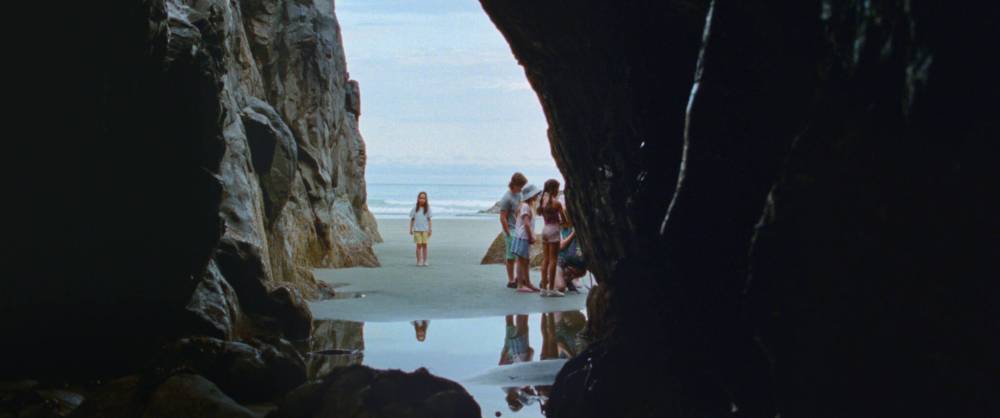
Norm Li / THE CANADIAN PRESS
Canadian director Meredith Hama-Brown’s debut feature film, Seagrass, is about the breakdown of a marriage and a family coming apart at the seams.
But Judith and Steve are not happy, and we know it. Seagrass is another addition to the rapidly expanding genre of the marriage-breakdown movie, and while Hama-Brown’s approach may be quiet and indirect, we can sense the raw emotions roiling underneath.
It turns out the family is headed to a marriage retreat, where the parents will attend group therapy sessions during the day while the children are off doing supervised activities.
At the first session, we learn Judith is re-evaluating her life after the recent death of her mother. Fault lines are opening up in the couple’s marriage, especially around the experiences and assumptions that come out of their different upbringings.
Steve’s family was white and middle-class, while Judith’s parents were dealing with the emotional and economic aftereffects of the internment of Japanese Canadians during the Second World War.
Judith and Steve’s problems — their miscommunications and misunderstandings, their passive-aggressive sniping, their long silences and occasional screaming matches, their awkward attempts at intimacy — are made tragicomically worse by the presence of another couple, the seemingly perfect Pat and Carol (Chris Pang and Sarah Gadon), who come to the retreat annually, just for a tune-up. They get gold stars from the therapist for their enthusiastic participation and full and frank emotional declarations.
Pat, who is Asian Australian, also adds to Judith’s guilt by knowing more about the history of the wartime internments than she does. Were her family’s fishing boats confiscated, he asks, their salting shacks burned? Where were they interned? Judith is ashamed she doesn’t know, but her parents left her only silence about that time, and now, with her mother’s death, she feels it’s too late.
As Judith and Steve attempt to “do the work,” punching pillows and holding up mirrors during therapy sessions, the children, who have internalized the tensions of their parents’ marriage, are having eerily parallel experiences. The sisters are close, but they’ve been split up.
Steph has been put into the teenage group, where she struggles to navigate tricky social currents while answering questions like, “Where is your mother from? Like, from-from?”

Emmy, a shy girl, is in with the younger children, and she’s become obsessed with a camp legend, whispered by the other kids, about a sea cave where the spirits of your dead will come to haunt you.
Hama-Brown has an incredible eye for the emotional lives of children, and she gets astonishing work from the child actors. The adults do pretty well, too. Maki’s subtle performance ranges from inward-looking anguish to a stunning drunken dance scene — not an easy thing to pull off — while Roberts registers Steve’s confusion and hurt, his difficulty expressing a pain he’s only just coming to realize. (“I don’t have any f—ing words, OK?” he yells during one fraught therapy session.)
Much of the film is about not having “any f—ing words.” Everyone struggles, everyone makes mistakes, everyone covers over their suffering, but we sense Hama-Brown’s compassion for her failing, flailing and very human characters.
Hama-Brown also picks up on Emmy’s fear of the haunted cave, deliberately shooting some sequences like a horror film, all spooky tracking shots and canted angles. But Seagrass is not a standard ghost story. This family is haunted by the ghosts of the past — and the ghosts of a future not to be.
alison.gillmor@freepress.mb.ca
Studying at the University of Winnipeg and later Toronto’s York University, Alison Gillmor planned to become an art historian. She ended up catching the journalism bug when she started as visual arts reviewer at the Winnipeg Free Press in 1992.
Our newsroom depends on a growing audience of readers to power our journalism. If you are not a paid reader, please consider becoming a subscriber.
Our newsroom depends on its audience of readers to power our journalism. Thank you for your support.
Movie review
Seagrass
- Starring Ally Maki and Luke Roberts
- Dave Barber Cinematheque
- 115 minutes, PG
★★★1/2 out of five
Other Voices
By deftly tugging at divorce narrative conventions and the slow erosion of a household, the film surveys the ways we curl inward in crisis.
— Saffron Maeve, Globe and Mail
A raw and emotional drama about marriage, childhood, parenting and this thorny thing we call family.
— Marya E. Gates, RogerEbert.com
Evocative … psychologically interesting, and touching here and there. But one can’t help but get the feeling our filmmaker never got out of the shallows.
— Roger Moore, Movie Nation
Studying at the University of Winnipeg and later Toronto’s York University, Alison Gillmor planned to become an art historian. She ended up catching the journalism bug when she started as visual arts reviewer at the Winnipeg Free Press in 1992.
Our newsroom depends on a growing audience of readers to power our journalism. If you are not a paid reader, please consider becoming a subscriber.
Our newsroom depends on its audience of readers to power our journalism. Thank you for your support.
Advertisement Advertise With Us
Advertisement Advertise With Us
History
Updated on Wednesday, March 27, 2024 11:05 AM CDT: Correcst reference to Pat and Carol (Chris Pang and Sarah Gadon)