New music series features return of homegrown soprano
Advertisement
Read this article for free:
or
Already have an account? Log in here »
To continue reading, please subscribe:

Digital Subscription
One year of digital access for only $205*
- Enjoy unlimited reading on winnipegfreepress.com
- Read the E-Edition, our digital replica newspaper
- Access News Break, our award-winning app
- Play interactive puzzles
*First annual payment billed as $205.00 + GST for one year. This annual subscription will automatically renew at $233.00 + GST every 52 weeks (10% off the regular annual price of $259.35). Offer available to new and qualified returning subscribers only. Cancel any time.
To continue reading, please subscribe:
Add Free Press access to your Brandon Sun subscription for only an additional
$1 for the first 4 weeks*
- Enjoy unlimited reading on winnipegfreepress.com
- Read the E-Edition, our digital replica newspaper
- Access News Break, our award-winning app
- Play interactive puzzles
*Your next Brandon Sun subscription payment will increase by $1.00 and you will be charged $17.95 plus GST for four weeks. After four weeks, your payment will increase to $24.95 plus GST every four weeks.
Read unlimited articles for free today:
or
Already have an account? Log in here »
Hey there, time traveller!
This article was published 19/03/2024 (897 days ago), so information in it may no longer be current.
Lyric coloratura soprano Lara Secord-Haid, 35, recalls finding her voice at age 12 during her bat mitzvah, the rite of passage ceremony considered a milestone in a Jewish person’s life as they are formally welcomed into the faith.
“I received an overwhelming amount of reassurance that I did have a instrument worth hearing,” says the singer, the only child of local businesswoman/philanthropist Elba Haid and late architect Marshall Haid, during an interview at her mother’s sunny, art-filled home.
“It meant a lot to have other people notice it in that way, and also believe I could sing.”
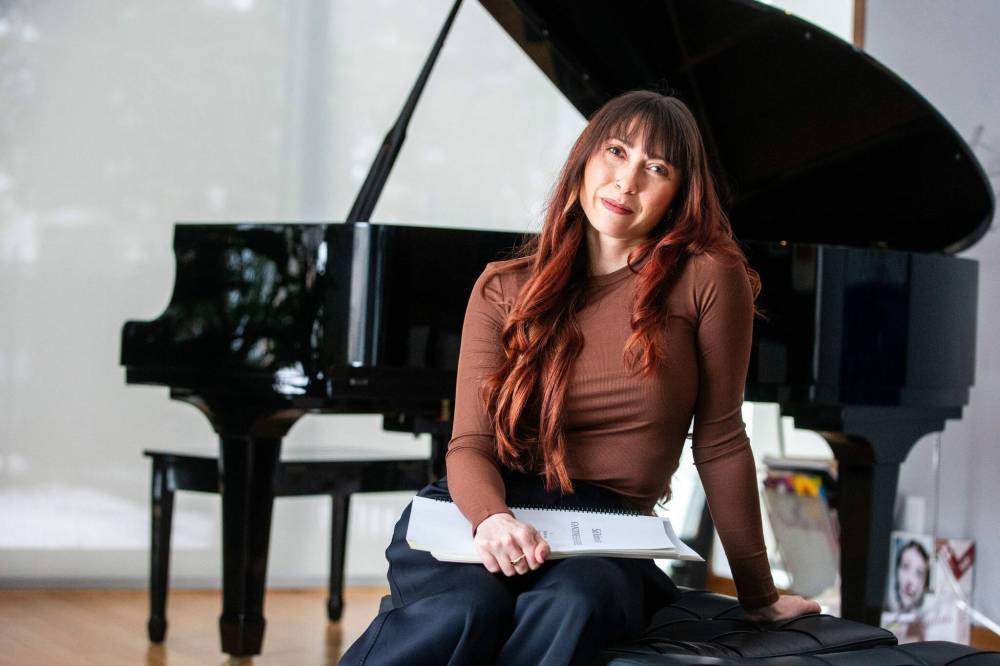
MIKAELA MACKENZIE / FREE PRESS
Lara Secord-Haid scoured music libraries for 10 years looking for classical art songs written in Hebrew
Local audiences will get to hear Secord-Haid’s stratospheric, three-plus-octave voice for themselves when the artist marks her Manitoba Chamber Orchestra debut Wednesday as the inaugural offering of the MCO’s new Spring Series.
Now based in Berlin, where she shares a home with acclaimed Canadian bass-baritone Daniel Okulitch — both singers are cast in Manitoba Opera’s upcoming production of Carmen — Secord-Haid will treat listeners to two song cycles by another well-known Winnipegger, Juno-nominated composer Sid Robinovitch, with the evocative program led by MCO music director Anne Manson.
Praised by the New York Times for her “flinty acuity,” Secord-Haid — her first name was inspired by her mother’s legendary great-grandmother, Laura Secord — is a graduate of New York’s Juilliard School, following undergraduate studies at the New England Conservatory of Music. She has graced stages worldwide, and has appeared with Nashville Opera, New York Lyric Opera, Little Opera Company and Opera on the Avalon, as well as with Manitoba Opera and the Winnipeg Symphony Orchestra.
Wednesday’s concert began as a pandemic project, born in the vacuum of live performance opportunities after COVID-19 shuttered concert venues.
Secord-Haid, having scoured music libraries for 10 years seeking classical art songs written in Hebrew, reached out to Robinovitch in 2020, asking if he might have suitable repertoire she could work on during lockdown. Fortunately, the composer did — even creating several new songs written especially for the singer — that have been newly arranged for chamber orchestra by Winnipeg’s Tadeusz Biernacki, who will be joining the performers onstage as pianist during both works.
One of those, Shir Hashirim, is a setting of six erotic poems derived from the biblical Song of Songs, in which two lovers express their desire for each other.
Secord-Haid, who also speaks French, Italian and some German, meticulously prepared the score with detailed pronunciation guides to be able to perform the approximately 20-minute work in Hebrew — the same language she sang in during her bat mitzvah more than 20 years ago — as life comes full circle.
“Performing these works in languages that I learned earlier in life comes from a deeper place in my body, and the access to the emotional world is more vivid, including a greater connection to memories and experiences,” says the singer, who graduated from Jewish day school.
“There’s a much greater resonance with this music because of that.”
She says listeners don’t need to be ascribed to any particular faith, be fluent in Hebrew or be versed in the bible to enjoy the piece, originally written for mezzo-soprano voice, clarinet and guitar.
“This is not a religious piece per se, but is culturally informed, much in the same way that works by Brahms and Beethoven relate to the context that they’re from. It’s just good music, with really evocative poetry that offers a slightly different lens than you might typically hear,” she says.
The second piece, Canciones Sefaradies, is composed of six Sephardic folk songs based on traditional Judeo-Spanish texts. Secord-Haid will be singing in Ladino, a version of Spanish spoken by Jewish inhabitants of Spain during medieval times, as well as a smattering of Hebrew, Turkish, French and Greek.
Robinovitch reflects on his artistic relationship with the singer, who has performed many of his works before in Winnipeg, including at last year’s annual Rady JCC’s Tarbut: Festival of Jewish Culture, as well as throughout Canada and Europe.
“She’s going to be terrific,” the Brandon-born composer says, admitting he’s eager to hear the world première of his music in their new chamber orchestra arrangements for his first time.
Fans — if they were lucky — might recall hearing the debut of the composer’s oratorio, Jonah, on the same stage last spring; its second performance was abruptly cancelled due to a surprise April blizzard that shuttered the city for several days.
“Lara really does a beautiful job with my music, and her voice just continues to grow each year. She puts a lot of passion into all of her performances, and at the same time, brings a certain sweetness to whatever it is she’s singing,” the composer attests.

“She’s also a wonderful communicator.”
Though she’s now living an ocean away from the community that first nurtured her artistic gifts, Secord-Haid says her Prairie hometown will always hold a special place in her heart — and art.
“Berlin is such an artistically, culturally rich place, and as a lover of this art form, I’m just soaking that up every single day; however, I also miss Canada terribly, and I jump at every opportunity to come back. Winnipeg will always be my home.”
The program also features the music of Arvo Part and Osvaldo Golijov.
holly.harris@shaw.ca
Holly Harris writes about music for the Free Press Arts & Life department.
Our newsroom depends on a growing audience of readers to power our journalism. If you are not a paid reader, please consider becoming a subscriber.
Our newsroom depends on its audience of readers to power our journalism. Thank you for your support.