Climate change could virtually disappear in Florida – at least according to state law

Advertisement

Advertise with us

TALLAHASSEE, Fla. (AP) — Florida, perhaps the most vulnerable state to sea-level rise and extreme weather, is on the verge of repealing what's left of a 16-year-old law that lists climate change as a priority when making energy policy decisions. Instead, the state would make energy affordability and availability its main focus.

Read this article for free:


or

Already have an account? Log in here »

To continue reading, please subscribe:

Subscribe and receive a limited-edition Free Press branded hat or tote.

Digital Subscription

One year of digital access for only $205*

  • Enjoy unlimited reading on winnipegfreepress.com
  • Read the E-Edition, our digital replica newspaper
  • Access News Break, our award-winning app
  • Play interactive puzzles

*First annual payment billed as $205.00 + GST for one year. This annual subscription will automatically renew at $233.00 + GST every 52 weeks (10% off the regular annual price of $259.35). Offer available to new and qualified returning subscribers only. Cancel any time.

To continue reading, please subscribe:

Add Free Press access to your Brandon Sun subscription for only an additional

$1 for the first 4 weeks*

  • Enjoy unlimited reading on winnipegfreepress.com
  • Read the E-Edition, our digital replica newspaper
  • Access News Break, our award-winning app
  • Play interactive puzzles
Start now

*Your next Brandon Sun subscription payment will increase by $1.00 and you will be charged $17.95 plus GST for four weeks. After four weeks, your payment will increase to $24.95 plus GST every four weeks.

Hey there, time traveller!
This article was published 30/04/2024 (873 days ago), so information in it may no longer be current.

TALLAHASSEE, Fla. (AP) — Florida, perhaps the most vulnerable state to sea-level rise and extreme weather, is on the verge of repealing what’s left of a 16-year-old law that lists climate change as a priority when making energy policy decisions. Instead, the state would make energy affordability and availability its main focus.

A bill waiting to be signed by Republican Gov. Ron DeSantis would strip the term “climate change” from much of state law and reverse a policy then-Gov. Charlie Crist championed as he built a reputation for being a rare Republican fighting to promote green energy over fossil fuels.

While Florida is distinct for having an enormous coastline and being flat — Miami’s average elevation is roughly 6 to 7 feet (2 meters) above sea level — the chairman of House Infrastructure Strategies Committee said it also has unique challenges and the climate change language in law makes meeting them more difficult.

FILE - Florida Gov. Ron DeSantis speaks at a Contractors of America conference, Jan. 10, 2024, in Des Moines, Iowa. A Florida bill waiting to be signed by DeSantis would strip the term “climate change” from much of state law and reverse a policy then-Gov. Charlie Crist championed as he built a reputation for being a rare Republican fighting to promote green energy over fossil fuels. (AP Photo/Abbie Parr, File)

“We’re protecting consumers, we’re protecting consumer pricing, we’re protecting them with great reliability and we’re protecting to make sure we don’t have a lack of energy security in our state. That’s where we’re moving as far as our policies,” said Republican Rep. Bobby Payne.

But critics say now is not the time to go backwards when it comes to climate change policy, including Crist, who is now a Democrat who last served in the U.S. House.

“It’s disappointing to see a continuing lurch in the wrong direction, particularly when Florida, with our coastline, is probably the most vulnerable to rising sea levels, I mean if we don’t address it, who’s going to?” Crist said. “It breaks my heart.”

In 2008, the bill to address climate change and promote renewable energy passed unanimously in both legislative chambers. Crist signed the bill with fanfare at an international climate change conference he hosted with guests such as then-California Republican Gov. Arnold Schwarzenegger.

But Payne said the Crist-era law makes it more difficult for the state to be more flexible in meeting its energy needs.

“When he invited Arnold Schwarzenegger to Miami for the environmental summit, that was a good indication that his ideologies collide with the public’s from the perspective of reliability and cost,” Payne said.

After Crist left office in 2011, Gov. Rick Scott, now a U.S. senator, gutted much of what Crist enacted. This year’s bill repeals what’s left of it. The bill passed the Legislature with Republican support and Democratic opposition. It was sent to DeSantis on Friday and he has until May 15 to take action. His office didn’t respond to multiple emails asking his position on it.

Payne, who spent nearly four decades in the power industry before retiring, said he isn’t convinced that humanity’s energy consumption is destroying the planet. He also notes three-quarters of the state’s energy is provided by natural gas, leaving it vulnerable to market fluctuations.

The enormous energy legislation he shepherded through the Legislature prevents local governments from enacting some energy policy restrictions and de-emphasizes clean energy by banning wind energy turbines or facilities off or within a mile (less than 2 kilometers) of the coast.

It eliminates requirements that government agencies hold conferences and meetings in hotels certified by the state’s environmental agency as “green lodging” and that government agencies make fuel efficiency the top priority in buying new vehicles.

Brooke Alexander-Gross of Sierra Club’s Florida chapter said that stripping climate change from state law won’t make the problem go away, but she isn’t optimistic that DeSantis will veto the bill.

“Having that language there really encourages a lot of people to take a look at what climate change actually is and it’s disappointing to see a governor in a state like ours strip that language, which is really just a way for him and his administration to ignore everything that’s going on,” she said.

Report Error Submit a Tip

More Stories

A quick look at where provinces and territories stand on time changes

The Canadian Press 2 minute read Preview

A quick look at where provinces and territories stand on time changes

The Canadian Press 2 minute read Friday, Sep. 18, 2026

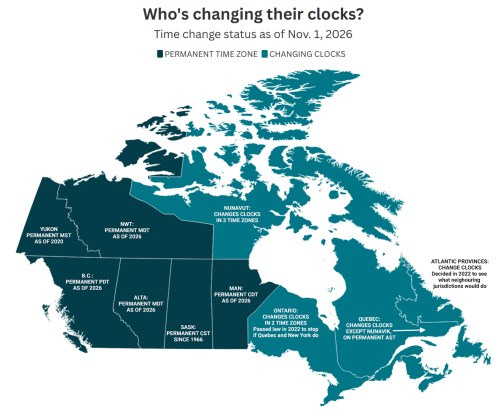
WINNIPEG - Manitoba's government said Thursday the province will be sticking with daylight time year-round, making it the latest jurisdiction to move away from twice-annual time changes. Here's a look at where things stand across Canada:

British Columbia said in March that it was moving to permanent Pacific daylight time. The change also means that parts of northeastern B.C., which have been on mountain standard time year round, are now in alignment with the rest of the province.

Alberta also switched to permanent daylight time this year in what it calls Alberta time. The change means it now has the same time as Saskatchewan year round.

Saskatchewan has been on permanent central standard time since 1966.

Read
Friday, Sep. 18, 2026

Klein has burned bridges with PM, Gillingham says

Joyanne Pursaga 3 minute read Preview

Klein has burned bridges with PM, Gillingham says

Joyanne Pursaga 3 minute read Friday, Sep. 18, 2026

One mayoral candidate accused another of writing a column so critical it could compromise his ability to work with the federal government.

Read
Friday, Sep. 18, 2026

Canada must not accept another Iranian autocracy

David Matas 5 minute read Yesterday at 2:01 AM CDT

Iran is a state run by a radical government victimizing its citizens and its neighbours. How do we change that? Any regime change that repeats the mistakes of the past is not a solution.

What went wrong in the past which led to the current regime? One answer is the U.K. and American aided coup which led to the ouster in 1953 of a democratically elected government headed at the time by Mohammad Mossadegh and its replacement with an American friendly autocrat, the Shah of Iran, Mohammad Reza Pahlavi.

The Shah imposed his rule through the Iranian National Intelligence and Security Organization — SAVAK, the acronym of its Persian name. SAVAK systematically inflicted torture, arbitrary killings and extra-judicial killings on perceived opponents of the regime. It was only a matter of time before repression of a regime directed to serving foreign interests would be overthrown.

What replaced the regime of the Shah, in 1979, the current regime of the mullahs, is a regime as intolerant and violent as the regime of the Shah and then some. That was not inevitable. But neither was it surprising. The vicious nature of the current regime, following the example set by the Shah, and its hatred for the United States, reacting to the U.S. aided imposition of the Shah, both echoes and reacts to the past. In 1979, the U.S. reaped what it sowed in 1953.

Desperate Poilievre wants Canadians to believe the sky is falling when it’s just cloudy outside

Tom Brodbeck 5 minute read Preview

Desperate Poilievre wants Canadians to believe the sky is falling when it’s just cloudy outside

Tom Brodbeck 5 minute read Friday, Sep. 18, 2026

Pierre Poilievre has a problem.

Canadians just don’t seem to be paying much attention to him anymore.

So, naturally, the Conservative Opposition leader has decided to turn up the volume.

At a recent party caucus retreat in Penticton, B.C., Poilievre delivered the familiar message: Canada is in trouble, Canadians are hurting and the Liberal government is making everything worse.

Read
Friday, Sep. 18, 2026

Former Bombers linebacker Gauthier enjoying career as electrician

Taylor Allen 6 minute read Preview

Former Bombers linebacker Gauthier enjoying career as electrician

Taylor Allen 6 minute read Friday, Sep. 18, 2026

Most professional football players don’t ride off into the sunset on their own terms.

Shayne Gauthier was well aware of that, but it didn’t make it sting any less when the Winnipeg Blue Bombers informed the veteran linebacker that they weren’t bringing him back for 2026.

“I was really hoping to play one more (season) because it would have been my 10th season, so, I’d say it didn’t really end the way I wanted,” Gauthier recently told the Free Press.

“It left a little sour taste in my mouth, but that’s part of pro sports. If everybody got the ending that they wanted, then it wouldn’t really work.”

Read
Friday, Sep. 18, 2026

Not good bet to shoulder gambling issue alone

Maureen Scurfield 5 minute read Yesterday at 2:01 AM CDT

DEAR MISS LONELYHEARTS: We’re living a lie over at our house, but it’s holding the family together.

I know my husband is deeply into gambling. If it weren’t for my steady job I don’t know where the family would be! I insist on paying all of our bills. I also funnel some major cash off to my sister, in case my husband tries to tap into my accounts somehow when I’m out of the house.

He doesn’t know my passwords, since I keep changing them, but he sometimes shows up behind me when I’m online, like he’s dying to ask something.

I say, “What are you looking at? Stop looking over my shoulder!” Then he makes a lame joke and goes away.