Europe is slapping tariffs on Chinese electric vehicles – for now. Here’s what to know
Advertisement
Read this article for free:
or
Already have an account? Log in here »
To continue reading, please subscribe:

Digital Subscription
One year of digital access for only $205*
- Enjoy unlimited reading on winnipegfreepress.com
- Read the E-Edition, our digital replica newspaper
- Access News Break, our award-winning app
- Play interactive puzzles
*First annual payment billed as $205.00 + GST for one year. This annual subscription will automatically renew at $233.00 + GST every 52 weeks (10% off the regular annual price of $259.35). Offer available to new and qualified returning subscribers only. Cancel any time.
To continue reading, please subscribe:
Add Free Press access to your Brandon Sun subscription for only an additional
$1 for the first 4 weeks*
- Enjoy unlimited reading on winnipegfreepress.com
- Read the E-Edition, our digital replica newspaper
- Access News Break, our award-winning app
- Play interactive puzzles
*Your next Brandon Sun subscription payment will increase by $1.00 and you will be charged $17.95 plus GST for four weeks. After four weeks, your payment will increase to $24.95 plus GST every four weeks.
Read unlimited articles for free today:
or
Already have an account? Log in here »
Hey there, time traveller!
This article was published 04/07/2024 (808 days ago), so information in it may no longer be current.
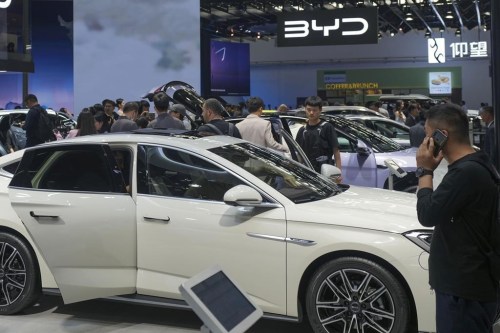
FRANKFURT, Germany (AP) — The European Union is imposing sharply higher customs duties on electric vehicles imported from China. EVs are the latest flash point in a broader trade dispute over Chinese government subsidies and Beijing’s burgeoning exports of green technology to the 27-nation bloc.
The higher duties go into effect on Friday, pending a final decision in four month’s time.
Here are some basic facts about the EU’s planned customs duties:

What did the European Union do?
After an eight-month investigation, the European Commission, the EU’s executive arm, found that companies making electric cars in China benefit from massive government help that means they can undercut rivals in the EU on prices, take a big market share and threaten European jobs.
It announced the higher duties on June 12 and they go into effect from Friday. The duties are provisional, meaning they will be totaled up but won’t need to be paid until they’re confirmed by a vote of EU governments before Nov. 2. The EU will only collect the duties if there’s a further finding that the European auto industry would have suffered material harm without them.
That gives the EU and the Chinese government time to negotiate. Talks have been held between Valdis Dombrovskis, the EU commissioner for the economy, and Chinese Trade Minister Wang Wentao, as well as at the level of technical experts.
The higher duties are not a goal in themselves but “a means to correct an imbalance,” commission spokesman Eric Mamer said Thursday. “We certainly hope we can come to a solution which would allow us not to have to move forward on this path.”
The rates, if applied, would be: 17.4% on cars from BYD, 19.9% on those from Geely and 37.6% for vehicles exported by China’s state-owned SAIC. Geely has brands including Polestar and Sweden’s Volvo, while SAIC owns Britain’s MG, one of Europe’s bestselling EV brands. Other EV manufacturers in China including Western companies such as Volkswagen, BMW and Tesla would be subject to duties of at least 20.8%. The commission mentioned that Tesla might get an “individually calculated” rate if duties are definitively imposed.
Under EU rules it’s possible — though at present it seems unlikely — that the higher duties could be blocked ahead of the Nov. 2 effective date by vote of what the EU calls a “qualified majority” of countries. That means at least 15 of the 27 EU member governments representing at least 65% of the bloc’s population.
Why did the commission take action?
Chinese-built electric cars jumped from 3.9% of the EV market in 2020 to 25% by September 2023, the commission said, in part by unfairly undercutting EU industry prices.
The commission says companies in China accomplished that with the help of subsidies all along the chain of production, from cheap land for factories from local governments to below-market supplies of lithium and batteries from state-owned enterprises to tax breaks and below-interest financing from state-controlled banks.
The rapid growth in market share has sparked fears that Chinese cars will eventually threaten the EU’s ability to produce its own green technology needed to combat climate change, as well as the jobs of 2.5 million workers at risk in the auto industry and 10.3 million more people whose jobs depend indirectly on EV production.
Subsidized solar panels from China have wiped out European producers — an experience that European governments don’t want to see repeated with their auto industry.
Unusually, the commission acted on its own, without a complaint from the European auto industry. Industry leaders and Germany, home to BMW, Volkswagen and Mercedes-Benz, have been skeptics about the subsidy investigation. That’s because many of the cars that will be hit with tariffs are made by European companies, and because China could retaliate against the auto industry or in other areas.
How do the EU tariffs compare to ones announced by the U.S.?
The Biden administration is raising tariffs on Chinese EVs to 100% from the current 25%. At that level, the U.S. tariffs block virtually all Chinese EV imports.
That’s not what Europe is trying to do.
EU officials want affordable electric cars from abroad to achieve their goals of cutting greenhouse gas emissions by 55% by 2030 — but without the subsidies EU leaders see as unfair competition
The planned tariffs are aimed at leveling the playing field by approximating the size of the excess or unfair subsidies available to Chinese carmakers.
European countries subsidize electric cars, too. The question in trade disputes is whether subsidies are fair and available to all carmakers or distort the market in favor of one side.
Just how cheap are Chinese EVs?
Chinese carmakers have learned to make electric vehicles cheaply amid ferocious price competition at home in the world’s largest car market.
BYD’s Seal U Comfort model sells for the equivalent of 21,769 euros ($23,370) in China but 41,990 euros ($45,078) in Europe, according to Rhodium Group figures. The base model of BYD’s compact Seagull, due to arrive in Europe next year, sells for the equivalent of around $10,000 in China.
What does this mean for European drivers and carmakers?
It’s not clear what impact the duties will have on car prices. Chinese carmakers are able to make some cars so cheaply that they could absorb the duties in the form of lower profits instead of raising their prices.
While consumers might benefit from cheaper Chinese cars in the short term, allowing unfair practices could eventually mean less competition and higher prices in the long term, the commission argues.
Currently, Chinese carmakers often sell their vehicles in Europe at much higher prices than the same cars fetch in China, meaning they are favoring profits over market share, even given their recent market gains. Five of BYD’s six models would still earn a profit in Europe even at a 30% tariff, according to Rhodium Group calculations.
The fear is Europe is that Chinese competitors will turn to lowering their prices closer to the ones they are charging in China. and gain an even bigger chunk of the market.
How is China likely to react?
Beijing was sharply critical of the higher duties when they were announced, calling them “a naked act of protectionism.”
On Thursday, He Yadong, a spokesperson for the Chinese Commerce Ministry, said that the two sides had held several rounds of technical consultations and noted that a final EU ruling won’t be made for four months.
“It is hoped that the European side and the Chinese side will move in the same direction, show sincerity, expedite the consultation process and reach a mutually acceptable solution as soon as possible on the basis of facts and rules,” he said at a weekly media briefing in Beijing.
He also said that China hopes the EU will seriously listen to the voices of the European automakers and governments that have come out against the tariffs and avoid anti-subsidy measures that would harm cooperation between the Chinese and European auto industries.

It’s not clear what agreement might look like. One move could be to agree on minimum prices for Chinese cars.
China could retaliate against European products such as pork or brandy imports, or against European luxury car imports.
Over the longer term, Chinese carmakers could avoid tariffs by making cars in Europe. BYD is building a plant in Hungary, while Chery has a joint venture to build cars in Spain’s Catalonia region.
___
Moritsugu reported from Beijing.