

A powerful quake hits off Japan’s coast, causing minor injuries but prompting new concerns
Advertisement
Read this article for free:
or
Already have an account? Log in here »
To continue reading, please subscribe:

Digital Subscription
One year of digital access for only $205*
- Enjoy unlimited reading on winnipegfreepress.com
- Read the E-Edition, our digital replica newspaper
- Access News Break, our award-winning app
- Play interactive puzzles
*First annual payment billed as $205.00 + GST for one year. This annual subscription will automatically renew at $233.00 + GST every 52 weeks (10% off the regular annual price of $259.35). Offer available to new and qualified returning subscribers only. Cancel any time.
To continue reading, please subscribe:
Add Free Press access to your Brandon Sun subscription for only an additional
$1 for the first 4 weeks*
- Enjoy unlimited reading on winnipegfreepress.com
- Read the E-Edition, our digital replica newspaper
- Access News Break, our award-winning app
- Play interactive puzzles
*Your next Brandon Sun subscription payment will increase by $1.00 and you will be charged $17.95 plus GST for four weeks. After four weeks, your payment will increase to $24.95 plus GST every four weeks.
Read unlimited articles for free today:
or
Already have an account? Log in here »
Hey there, time traveller!
This article was published 08/08/2024 (794 days ago), so information in it may no longer be current.
TOKYO (AP) — A powerful earthquake struck off southern Japan on Thursday, causing mostly minor injuries but raising the level of concern over possible major quakes stemming from an undersea trough east of the coast.
Officials said nine people were injured on Japan’s southern main island of Kyushu, but the injuries were mostly minor, there were no reports of serious damage and tsunami advisories for the quake were later lifted.
However, the quake prompted seismologists to hold an emergency meeting in which they reassessed and raised the level of risk of major quakes associated with the Nankai Trough east of southern Japan.
The Japan Meteorological Agency said that Thursday’s quake registered magnitude 7.1 and was centered in waters off the eastern coast of Kyushu at a depth of about 30 kilometers (about 19 miles) below sea surface.
The quake most strongly shook Nichinan city and nearby areas in Miyazaki prefecture on Kyushu island.
The agency said tsunami waves of up to 50 centimeters (1.6 feet) were detected along parts of Kyushu’s southern coast and the nearby island of Shikoku about a half hour after the quake struck. Tsunami advisories were issued, but lifted for most areas three hours later, and for all remaining coastlines five and a half hours later.
Seismologists at the agency held an emergency meeting to analyze whether the quake had affected the nearby Nankai Trough, the source of past devastating earthquakes. They later issued an assessment that the potential for a future quake in the area from Kyushu to central Japan is higher than previously predicted. The agency said it will continue to closely watch movements of plates near the Nankai Trough.
That does not mean there’s an imminent danger of a big quake in the near future, but they urged residents on the coasts along the trough — which spans about 500 kilometers (310 miles) — to review their quake preparedness, University of Tokyo seismologist Naoshi Hirata, a member of an expert panel, told a joint news conference with JMA officials.
There is a 70-80% chance of a magnitude 8 or 9 quake stemming from the Nankai Trough within the next 30 years, Hirata said, adding that Thursday’s quake raises that probability even while the timing or exact location cannot be predicted. He urged residents to keep their caution levels high for a week for the time being.

Prime Minister Fumio Kishida told reporters that the government crisis management team was to step up disaster preparedness, and called on residents to pay close attention to information from the authorities in case of another big one and never to spread disinformation.
The Fire and Disaster Management Agency said nine people were injured, most of them slightly when falling down or hit by objects in Thursday’s quake in Miyazaki and neighboring Kagoshima.
Chief Cabinet Secretary Yoshimasa Hayashi said officials were assessing possible injuries or serious damage, though none were immediately reported. He urged residents of the affected region to stay away from the coastline.
JMA Seismology Department official Shigeki Aoki warned that strong aftershocks could occur for about a week.
Japan’s NHK public television said windows were broken at the Miyazaki airport near the epicenter. The airport’s runway was temporarily closed for safety checks.
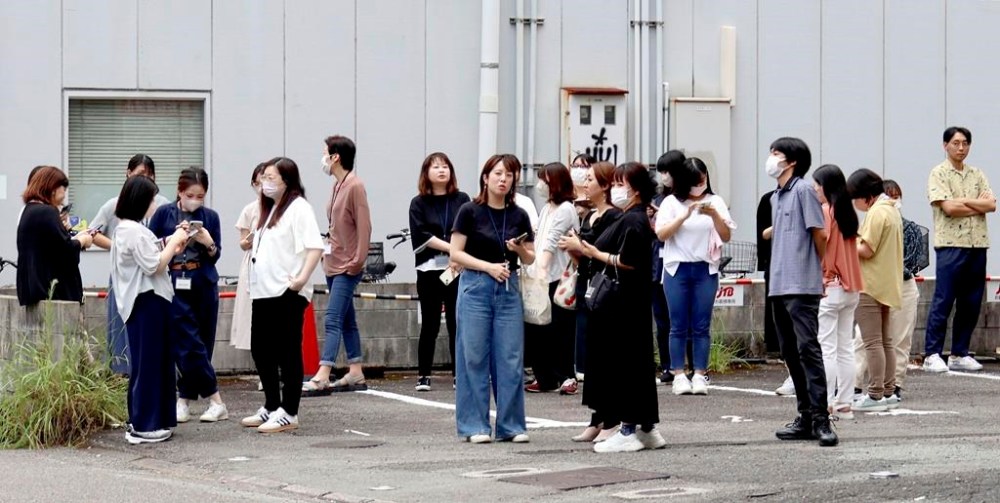
Kyushu “shinkansen” super-express trains returned to normal operations after temporary safety checks, but a number of local train lines in the quake-hit areas were to be suspended through Friday, according to Kyushu Railway Co.
NHK showed dozens of people gathering at a designated hilltop evacuation area.
In Osaki in neighboring Kagoshima prefecture, concrete walls collapsed and a wooden house was damaged, but no injuries were reported.
The Nuclear Regulation Authority said all 12 nuclear reactors, including three that are currently operating, on Kyushu and Shikoku remained safe.
Earthquakes in areas with nuclear power plants have been a major concern since a massive earthquake and tsunami in March 2011 triggered the Fukushima nuclear disaster.
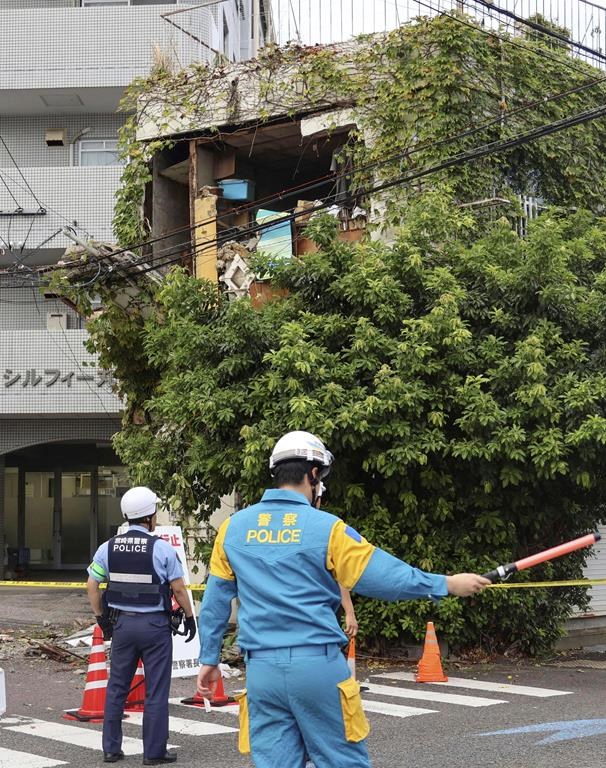
Japan sits on the Pacific “Ring of Fire,” a line of seismic faults encircling the Pacific Ocean, and is one of the world’s most earthquake-prone countries.
An earthquake on Jan. 1 in Japan’s north-central region of Noto left more than 240 people dead.
Related Articles
No Tsunami threat in B.C. after powerful Japan earthquake
Advertisement Advertise With Us
Advertisement Advertise With Us