‘Short corn’ could replace the towering cornfields steamrolled by a changing climate

Advertisement

Advertise with us

WYOMING, Iowa (AP) — Taking a late-summer country drive in the Midwest means venturing into the corn zone, snaking between 12-foot-tall green, leafy walls that seem to block out nearly everything other than the sun and an occasional water tower.

Read this article for free:


or

Already have an account? Log in here »

To continue reading, please subscribe:

Subscribe and receive a limited-edition Free Press branded hat or tote.

Digital Subscription

One year of digital access for only $205*

  • Enjoy unlimited reading on winnipegfreepress.com
  • Read the E-Edition, our digital replica newspaper
  • Access News Break, our award-winning app
  • Play interactive puzzles

*First annual payment billed as $205.00 + GST for one year. This annual subscription will automatically renew at $233.00 + GST every 52 weeks (10% off the regular annual price of $259.35). Offer available to new and qualified returning subscribers only. Cancel any time.

To continue reading, please subscribe:

Add Free Press access to your Brandon Sun subscription for only an additional

$1 for the first 4 weeks*

  • Enjoy unlimited reading on winnipegfreepress.com
  • Read the E-Edition, our digital replica newspaper
  • Access News Break, our award-winning app
  • Play interactive puzzles
Start now

*Your next Brandon Sun subscription payment will increase by $1.00 and you will be charged $17.95 plus GST for four weeks. After four weeks, your payment will increase to $24.95 plus GST every four weeks.

Hey there, time traveller!
This article was published 23/09/2024 (727 days ago), so information in it may no longer be current.

WYOMING, Iowa (AP) — Taking a late-summer country drive in the Midwest means venturing into the corn zone, snaking between 12-foot-tall green, leafy walls that seem to block out nearly everything other than the sun and an occasional water tower.

The skyscraper-like corn is a part of rural America as much as cavernous red barns and placid cows.

But soon, that towering corn might become a miniature of its former self, replaced by stalks only half as tall as the green giants that have dominated fields for so long.
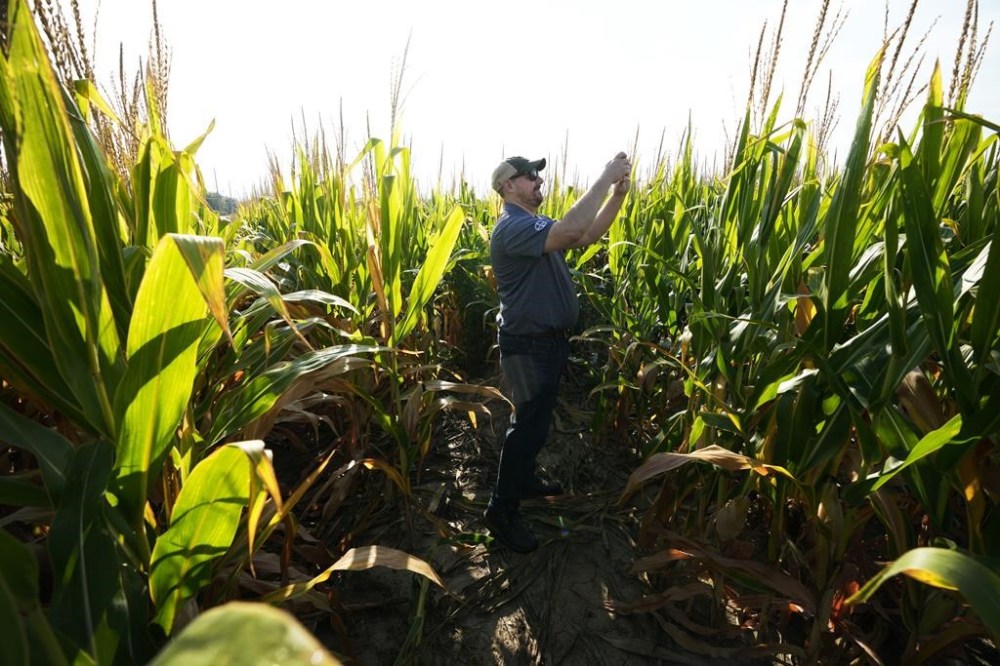
Bayer Crop Science spokesman Brian Leake takes a photo as he stands among short corn in a field, Monday, Sept. 16, 2024, in Wyoming, Iowa. (AP Photo/Charlie Neibergall)

“As you drive across the Midwest, maybe in the next seven, eight, 10 years, you’re going to see a lot of this out there,” said Cameron Sorgenfrey, an eastern Iowa farmer who has been growing newly developed short corn for several years, sometimes prompting puzzled looks from neighboring farmers. “I think this is going to change agriculture in the Midwest.”

The short corn developed by Bayer Crop Science is being tested on about 30,000 acres (12,141 hectares) in the Midwest with the promise of offering farmers a variety that can withstand powerful windstorms that could become more frequent due to climate change. The corn’s smaller stature and sturdier base enable it to withstand winds of up to 50 mph — researchers hover over fields with a helicopter to see how the plants handle the wind.

The smaller plants also let farmers plant at greater density, so they can grow more corn on the same amount of land, increasing their profits. That is especially helpful as farmers have endured several years of low prices that are forecast to continue.

The smaller stalks could also lead to less water use at a time of growing drought concerns.

U.S. farmers grow corn on about 90 million acres (36 million hectares) each year, usually making it the nation’s largest crop, so it’s hard to overstate the importance of a potential large-scale shift to smaller-stature corn, said Dior Kelley, an assistant professor at Iowa State University who is researching different paths for growing shorter corn. Last year, U.S. farmers grew more than 400 million tons (363 million metric tonnes) of corn, most of which was used for animal feed, the fuel additive ethanol, or exported to other countries.

“It is huge. It’s a big, fundamental shift,” Kelley said.

Researchers have long focused on developing plants that could grow the most corn but recently there has been equal emphasis on other traits, such as making the plant more drought-tolerant or able to withstand high temperatures. Although there already were efforts to grow shorter corn, the demand for innovations by private companies such as Bayer and academic scientists soared after an intense windstorm — called a derecho — plowed through the Midwest in August 2020.

The storm killed four people and caused $11 billion in damage, with the greatest destruction in a wide strip of eastern Iowa, where winds exceeded 100 mph. In cities such as Cedar Rapids, the wind toppled thousands of trees but the damage to a corn crop only weeks from harvest was especially stunning.

“It looked like someone had come through with a machete and cut all of our corn down,” Kelley said.

Or as Sorgenfrey, the Iowa farmer who endured the derecho put it, “Most of my corn looked like it had been steamrolled.”

Although Kelley is excited about the potential of short corn, she said farmers need to be aware that cobs that grow closer to the soil could be more vulnerable to diseases or mold. Short plants also could be susceptible to a problem called lodging, when the corn tilts over after something like a heavy rain and then grows along the ground, Kelley said.

Brian Leake, a Bayer spokesman, said the company has been developing short corn for more than 20 years. Other companies such as Stine Seed and Corteva also have been working for a decade or longer to offer short-corn varieties.

While the big goal has been developing corn that can withstand high winds, researchers also note that a shorter stalk makes it easier for farmers to get into fields with equipment for tasks such as spreading fungicide or seeding the ground with a future cover crop.

Bayer expects to ramp up its production in 2027, and Leake said he hopes that by later in this decade, farmers will be growing short corn everywhere.

“We see the opportunity of this being the new normal across both the U.S. and other parts of the world,” he said.

___

This story was first published on Sept. 23, 2024. It was updated Sept. 24, 2024, to correct the amount of corn that U.S. farmers grew last year. They grew more than 400 million tons (363 million metric tonnes), not 400 tons (363 metric tonnes) of corn.


Report Error Submit a Tip

More Stories

Give-and-take relationship of Roman leaders takes centre stage in Harris’s historical fiction

Reviewed by Kathryne Cardwell 4 minute read Preview

Give-and-take relationship of Roman leaders takes centre stage in Harris’s historical fiction

Reviewed by Kathryne Cardwell 4 minute read Yesterday at 2:01 AM CDT

British novelist Robert Harris’s latest work is a reflection on tyranny, corruption and betrayal among all-powerful political leaders.

You might be forgiven for thinking it’s a contemporary thriller — it’s actually historical fiction set in ancient Rome.

A former BBC journalist, Harris debuted as a novelist in 1992 with Fatherland, an alternative history where Nazi Germany won the Second World War.

Since then, the prolific author has become best-known for his works of historical fiction, especially his ancient Rome trilogy released from 2006-2015 and the novel Conclave, which was published in 2016 and was made into the film of the same name in 2024.

Read
Yesterday at 2:01 AM CDT

Not falling back means time loop remains unclosed

Jen Zoratti 4 minute read Yesterday at 2:01 AM CDT

I demand restitution. Where’s my hour?

In the traditional fall-back, spring-forward time change set up — you know, ol’ trusty that’s been effect for lo these 63 years — we lost an hour in the spring that we got back in the fall.

That was the social contract: you commit to feeling like you’re on cold medication for a week in March because you know a glorious extra hour of sleep will be returned to you in November. (Unless, of course, you have little kids, but look: we all make our choices.)

Well, that transaction, flawed as it was, isn’t happening this year. That hour you sacrificed to the sun gods in the spring? Gone. Not coming back. We’ve sprung forward and we shan’t be falling back — not in November, and (possibly) not ever. The scale shall remain unbalanced and the loop shall remain unclosed as Manitoba has adopted permanent daylight time.

Canada must not accept another Iranian autocracy

David Matas 5 minute read Yesterday at 2:01 AM CDT

Iran is a state run by a radical government victimizing its citizens and its neighbours. How do we change that? Any regime change that repeats the mistakes of the past is not a solution.

What went wrong in the past which led to the current regime? One answer is the U.K. and American aided coup which led to the ouster in 1953 of a democratically elected government headed at the time by Mohammad Mossadegh and its replacement with an American friendly autocrat, the Shah of Iran, Mohammad Reza Pahlavi.

The Shah imposed his rule through the Iranian National Intelligence and Security Organization — SAVAK, the acronym of its Persian name. SAVAK systematically inflicted torture, arbitrary killings and extra-judicial killings on perceived opponents of the regime. It was only a matter of time before repression of a regime directed to serving foreign interests would be overthrown.

What replaced the regime of the Shah, in 1979, the current regime of the mullahs, is a regime as intolerant and violent as the regime of the Shah and then some. That was not inevitable. But neither was it surprising. The vicious nature of the current regime, following the example set by the Shah, and its hatred for the United States, reacting to the U.S. aided imposition of the Shah, both echoes and reacts to the past. In 1979, the U.S. reaped what it sowed in 1953.

Hellebuyck standoff caused by… Nathan MacKinnon?

Mike McIntyre 6 minute read Preview

Hellebuyck standoff caused by… Nathan MacKinnon?

Mike McIntyre 6 minute read Friday, Sep. 18, 2026

Looking for someone to blame in the Connor Hellebuyck fiasco and cast as public enemy No. 1? How about long-time Winnipeg Jets nemesis Nathan MacKinnon?

Allow us to explain as we fire up the time machine and head back to February in Italy.

Oh, what could have been if MacKinnon had been able to score on what appeared to be an open net late in the third period of the men’s gold medal game with Hellebuyck down and seemingly out of position.

Instead, the star forward fired wide, keeping the score deadlocked at 1-1 as the clock ticked down on regulation.

Read
Friday, Sep. 18, 2026

Grieving child builds backyard rocket ship

Harriet Zaidman 4 minute read Yesterday at 2:01 AM CDT

I Built a Rocket Ship (Kids Can Press, 32 pages, hardcover, $22) by Winnipegger Anna Lazowski is a tender story for children ages 4-8 about a little girl trying to make sense of her mother’s death. The child engages in conversation with her late mom, agreeing and disagreeing about things said as she carries objects (and of course, the cat) to the backyard. There, she is building a rocket ship she will pilot into the skies to find her mom again.

Jennica Lounsbury’s varied perspectives show the range of emotions the little girl experiences.

● ● ●

Northwoods Lullaby by Mary Casanova (University of Minnesota Press, 32 pages, hardover, $25) is a bedtime book for readers up to age eight, perfect to bring a busy, happy day to a close. Just like children who are listening to adults reading the book, all the animal babies are being tucked into their nests and burrows by loving parents: “Thump and scamper,/nimble clover./ Soon it’s time to rest. Baby loon/ nestles in/as Papa floats along.”

Elmwood–East Kildonan candidate promises to tackle ‘inefficiency’ in government

Gabrielle Piché 3 minute read Preview

Elmwood–East Kildonan candidate promises to tackle ‘inefficiency’ in government

Gabrielle Piché 3 minute read Yesterday at 6:17 PM CDT

The former assistant of late Elmwood–East Kildonan councillor Jason Schreyer is again running for the seat.

Chris Sweryda officially launched his campaign Saturday. He did so with the backdrop of a grocery program he runs, where food is sold near-cost out of St. Gerard School’s gym.

Rows of cereal, pasta sauce and chips filled tables ahead of the program’s afternoon opening. Sweryda created the pop-up with Schreyer months ahead of the former councillor’s April 2025 death.

The program sees roughly 500 people each day it’s open (which is every other week on Saturday), Sweryda said.

Read
Yesterday at 6:17 PM CDT