AI will get better than humans at cyber offence by 2030: Hinton Lectures speaker

Advertisement

Advertise with us

TORONTO - Artificial intelligence will be able to beat humans at cyber offence by the end of the decade, predicted the keynote speaker at a series of lectures hosted by computer science luminary Geoffrey Hinton this week.

Read this article for free:


or

Already have an account? Log in here »

To continue reading, please subscribe:

Subscribe and receive a limited-edition Free Press branded hat or tote.

Digital Subscription

One year of digital access for only $205*

  • Enjoy unlimited reading on winnipegfreepress.com
  • Read the E-Edition, our digital replica newspaper
  • Access News Break, our award-winning app
  • Play interactive puzzles

*First annual payment billed as $205.00 + GST for one year. This annual subscription will automatically renew at $233.00 + GST every 52 weeks (10% off the regular annual price of $259.35). Offer available to new and qualified returning subscribers only. Cancel any time.

To continue reading, please subscribe:

Add Free Press access to your Brandon Sun subscription for only an additional

$1 for the first 4 weeks*

  • Enjoy unlimited reading on winnipegfreepress.com
  • Read the E-Edition, our digital replica newspaper
  • Access News Break, our award-winning app
  • Play interactive puzzles
Start now

*Your next Brandon Sun subscription payment will increase by $1.00 and you will be charged $17.95 plus GST for four weeks. After four weeks, your payment will increase to $24.95 plus GST every four weeks.

Hey there, time traveller!
This article was published 29/10/2024 (674 days ago), so information in it may no longer be current.

TORONTO – Artificial intelligence will be able to beat humans at cyber offence by the end of the decade, predicted the keynote speaker at a series of lectures hosted by computer science luminary Geoffrey Hinton this week.

Jacob Steinhardt, an assistant professor of electrical engineering and computer sciences and statistics at UC Berkeley in California, made that projection Tuesday, saying it was based around his belief that AI systems will eventually become “superhuman” when tasked with coding and finding exploits.

Exploits are weak points in software and hardware that people can abuse. Cyber criminals often covet these exploits because they can be used to gain unauthorized access to systems.
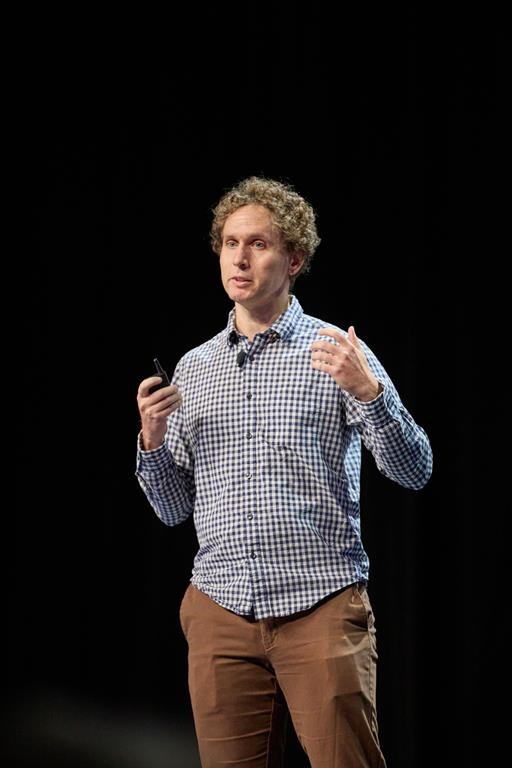
Jacob Steinhardt, an assistant professor of electrical engineering and computer sciences and statistics at UC Berkeley in California, is seen speaking in Toronto an event hosted by the Global Risk Institute in a Monday, Oct. 28, 2024, handout photo. THE CANADIAN PRESS/HO-GRI, Elaine Fancy, *MANDATORY CREDIT*

Once a criminal has access through an exploit, they can run a ransomware attack where they encrypt sensitive data or block administrators from getting into software, in hopes of extracting cash from victims.

To find exploits, Steinhardt said humans would have to read all the code underpinning a system, so that they can find an exploit and carry out an attack.

“This is really boring,” Steinhardt said. “Most people just don’t have the patience to do it, but AI systems don’t get bored.”

Not only will AI undertake the drudgery associated with finding an exploit, but it will also be meticulous with the task, Steinhardt said.

Steinhardt’s remarks come as cybercrime has been increasing

A 2023 study from EY Canada of 60 Canadian organizations found that four out of five had seen at least 25 cybersecurity incidents in the past year and experts say some companies face thousands of attempts every day.

Many have hailed AI as a potential solution because it can be used to quickly identify attackers and gather information on them, but Steinhardt said it is just as likely to be used by people with nefarious intentions.

Already, he said the world has seen instances where bad actors have harnessed the technology to create deep fakes — digitally manipulated images, videos or audio clips depicting people saying or doing things they have not said or done.

In some instances, deep fakes have been used by bad actors to make calls to people suggesting it’s their loved one reaching out and they are in need of money quicky.

Businesses have been victims, too.

Earlier this year, media reported that a worker at Arup, the British engineering company behind prominent buildings including the Sydney Opera House, had been duped into handing over US $25 million to fraudsters making use of deep fake technology to pose as the company’s chief financial officer.

“I’ve been trained to watch out for scams and phishing emails and I think I would have confirmed before sending $25 million over but I’m not sure,” Steinhardt said, explaining how new this phenomenon is and how realistic the fakes seem.

“This is not something that we’re used to and this isn’t the only use of digital impersonation to create problems.”

Steinhardt’s talk concluded the Hinton Lectures, a two-evening series of talks put on by the Global Risk Institute at the John W. H. Bassett Theatre in Toronto.

The event’s namesake, Geoffrey Hinton, who is widely known as the godfather of AI, introduced Steinhardt earlier in the evening, describing the professor as the most popular choice to debut the lecture series.

The evening before Steinhardt had told the audience he sees himself as a “worried optimist,” who believes there’s a 10 per cent chance AI will lead to human extinction and a 50 per cent chance it will cause immense economic value and “radical prosperity.”

This report by The Canadian Press was first published Oct. 29, 2024.

Report Error Submit a Tip

More Stories

Man who killed truck passenger handed new 12-year sentence

Erik Pindera 4 minute read Preview

Man who killed truck passenger handed new 12-year sentence

Erik Pindera 4 minute read Yesterday at 2:00 AM CDT

Manitoba’s highest court has given a man who shot at a passing truck and killed a 20-year-old woman a 12-year prison sentence for manslaughter.

William Ryerson Thomas Comber, now in his mid 20s, was found guilty of second-degree murder by a jury in December 2022 for the killing of Hailey Dugay on Nov. 17, 2018. Comber was later sentenced to life in prison with no chance of parole for 12 years.

Dugay died after the truck she was travelling in was struck by gunfire late at night on a gravel road near Fraserwood, 90 kilometres north of Winnipeg.

The Court of Appeal struck down Comber’s murder conviction earlier this year and ruled he was instead guilty of the lesser offence of manslaughter.

Read
Yesterday at 2:00 AM CDT

NDP defends involvement of U.S. company in Hydro project

Chris Kitching 5 minute read Preview

NDP defends involvement of U.S. company in Hydro project

Chris Kitching 5 minute read Yesterday at 6:10 PM CDT

A U.S. company that donated to Donald Trump’s 2025 presidential inauguration could build Manitoba Hydro’s proposed $3-billion natural gas turbines, which has drawn criticism from an environmental group amid the NDP government’s pushback to tariffs.

Read
Yesterday at 6:10 PM CDT

Neighbours relieved after fire strikes Quickie Mart

Morgan Modjeski 4 minute read Preview

Neighbours relieved after fire strikes Quickie Mart

Morgan Modjeski 4 minute read Yesterday at 8:38 PM CDT

As Janina McNaughton watched the Quickie Mart on River Avenue go up in flames on Tuesday, she felt relieved.

“The first thing I see is flames, like a fireball of flames inside,” McNaughton said about watching the blaze from her bedroom across the street.

On Wednesday, the bright green building, at 292 River Ave., was boarded up and charred on the outside.

Crews from the Winnipeg Fire Paramedic Service responded at 8:13 p.m. Tuesday to battle the blaze, said the city in a news release. It was under control within the hour.

Read
Yesterday at 8:38 PM CDT

Jockey wisecrack a hurtful low blow

Maureen Scurfield 4 minute read Yesterday at 2:00 AM CDT

DEAR MISS LONELYHEARTS: I ran into my boyfriend from Grade 9 at the horse races recently. He’s still really short. I said, “You’re so small you could be a great jockey!” He said, ”And you still talk before you think!”

Ouch! I was just stating what was true. If he doesn’t like being compared to a jockey, he should stay away from the racetrack, where people will mistake him for one, don’t you think?

— Hurt Feelings, St. James

Dear Hurt Feelings: It’s important not to make cracks about personal traits people are sensitive about.

Morden-born filmmaker's docudrama reveals lives of harem’s wilful women

Conrad Sweatman 6 minute read Preview

Morden-born filmmaker's docudrama reveals lives of harem’s wilful women

Conrad Sweatman 6 minute read Yesterday at 6:00 AM CDT

A stable of admiring women centred on a domineering patriarch, a secretive world of sexual oppression — the connotations of the word “harem” are not especially positive or progressive.

But there are famous examples of women who navigated this coercive hierarchy not merely to survive but ultimately to command vast influence, some rising from slavery.

The Sultan’s Women — a docudrama written, produced and directed by Emmy- and Peabody-winning, Morden-born filmmaker David Rabinovitch which has recently become available on Tubi, among other platforms — depicts this world in the turbulent final years of the Ottoman Empire, whose collapse also ended the institution.

Told with a Game of Thrones-like relish for elite intrigues, the film opens in the 1870s, with liberal-minded sultan Murad V and his sprawling harem. Ultimately placed under “house arrest” for nearly three decades in Çırağan Palace in what was then called Constantinople (now Istanbul, Turkey), Murad’s harem had women stronger in will, if not formal position, than the unstable, deposed sultan.

Read
Yesterday at 6:00 AM CDT

Climate groups urge mayoral candidates to go green

Joyanne Pursaga 5 minute read Preview

Climate groups urge mayoral candidates to go green

Joyanne Pursaga 5 minute read Yesterday at 6:51 PM CDT

Winnipeg city council candidates are being urged to commit to several green initiatives, such as exploring a maximum heat bylaw for rental units.

A 10-point People’s Climate Mandate, created by the Climate Reality Project Canada, Green Action Centre, Manitoba Eco-Network and others, urges candidates in Winnipeg’s Oct. 28 election to take action to combat climate change.

“We know that climate action often fights for attention in election discourse, especially given the many other urgent immediate issues facing our city,” said Hannah Muhajarine, campaigns manager for Climate Reality Project Canada.

A call to better protect Winnipeggers from extreme heat was highlighted as among the most urgent requests. The group wants the city to explore a maximum heat bylaw, enhance funding for cooling centres and expand hours at libraries, public pools and spray pads.

Read
Yesterday at 6:51 PM CDT