Ontario’s chief electoral officer seeks more tools to fight misinformation

Advertisement

Advertise with us

TORONTO - The rise of artificial intelligence and its ability to rapidly spread misinformation and disinformation during election campaigns should be addressed by increasing transparency around political ads and allowing for the removal of misleading content about the electoral process, Ontario's chief electoral officer recommends.

Read this article for free:


or

Already have an account? Log in here »

To continue reading, please subscribe:

Subscribe and receive a limited-edition Free Press branded hat or tote.

Digital Subscription

One year of digital access for only $205*

  • Enjoy unlimited reading on winnipegfreepress.com
  • Read the E-Edition, our digital replica newspaper
  • Access News Break, our award-winning app
  • Play interactive puzzles

*First annual payment billed as $205.00 + GST for one year. This annual subscription will automatically renew at $233.00 + GST every 52 weeks (10% off the regular annual price of $259.35). Offer available to new and qualified returning subscribers only. Cancel any time.

To continue reading, please subscribe:

Add Free Press access to your Brandon Sun subscription for only an additional

$1 for the first 4 weeks*

  • Enjoy unlimited reading on winnipegfreepress.com
  • Read the E-Edition, our digital replica newspaper
  • Access News Break, our award-winning app
  • Play interactive puzzles
Start now

*Your next Brandon Sun subscription payment will increase by $1.00 and you will be charged $17.95 plus GST for four weeks. After four weeks, your payment will increase to $24.95 plus GST every four weeks.

Hey there, time traveller!
This article was published 01/11/2024 (705 days ago), so information in it may no longer be current.

TORONTO – The rise of artificial intelligence and its ability to rapidly spread misinformation and disinformation during election campaigns should be addressed by increasing transparency around political ads and allowing for the removal of misleading content about the electoral process, Ontario’s chief electoral officer recommends.

Greg Essensa recently tabled a report in the Ontario legislature, asking the government to update laws to give him more tools to protect the integrity of the electoral process.

“The current authority of the Chief Electoral Officer (CEO) under the Election Act and the Election Finances Act to investigate, thwart and punish misconduct is insufficient to address growing threats in a rapidly evolving digital landscape where voter perceptions can be improperly manipulated by fake news and AI-generated content that is amplified by algorithms,” Essensa wrote.
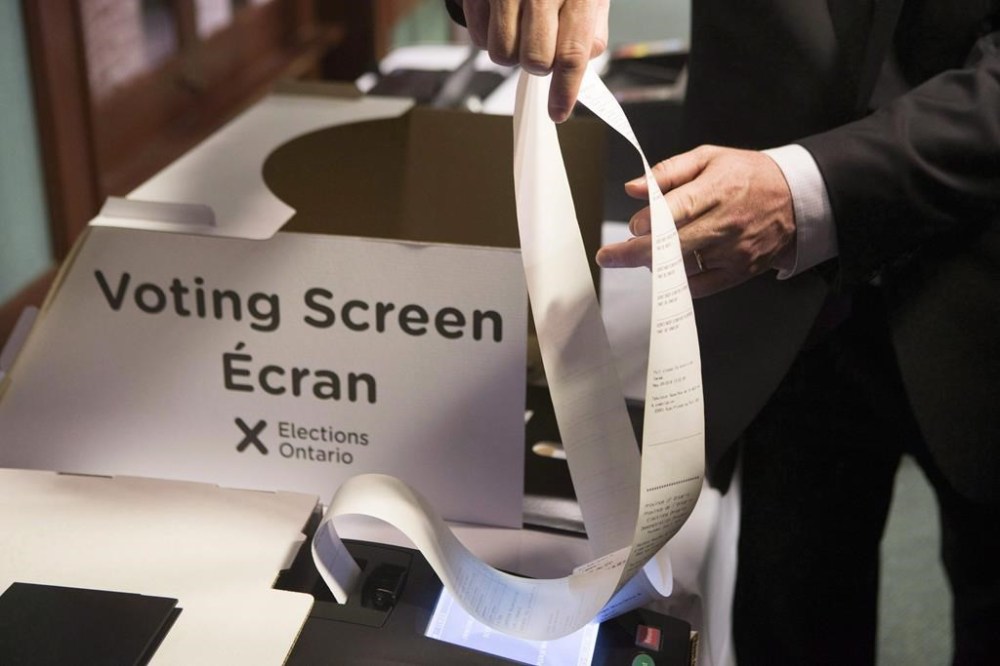
Ontario's Chief Electoral Officer Greg Essensa demonstrates an electronic voting machine during a media availability in Toronto on Wednesday, May 9 , 2018. The rise of artificial intelligence and its ability to rapidly spread misinformation and disinformation during election campaigns should be addressed by increasing transparency around political ads and allowing for the removal of misleading content about the electoral process, Essensa recommends.THE CANADIAN PRESS/Chris Young

The report largely deals with concerns around communications about the electoral process itself, such as false or misleading information about voting procedures, ballot counting, candidacy withdrawals and voter privacy. In 2021, social media posts impersonated Elections Alberta during that province’s municipal elections, Essensa wrote.

“For (electoral management bodies), the spread of synthetic content on social media has become a significant problem, with false and misleading information now being generated at unprecedented speeds,” Essensa wrote.

“For example, this can include convincing text messages from candidates, false announcements in different languages about voting processes, or fake websites that look like official government ones.”

Social media companies such as Meta and X do have policies about misleading content, but the rapid spread of misinformation often far outpaces fact checking or content moderation, the report said.

Among the changes Essensa is urging is requiring election advertisements that are automated — done by bots — to be labelled as such. Artificial intelligence can amplify the spread of misinformation both by extending the reach and personalizing it, Essensa wrote.

The chief electoral officer should also have the authority to levy administrative penalties of up to $20,000 for an individual and up to $100,000 for a corporation if they violate misinformation or disinformation political advertising regulations, Essensa wrote.

He is also recommending that the chief electoral officer be able to require people or companies to remove false or misleading content about the electoral process, with fines for non-compliance of up to $20,000 per day for individuals and up to $50,000 per day for organizations.

As well, Essensa would like to require all election advertisers to post their digital ads in a public registry during elections with the name of the person or organization sponsoring the ad, the cost, publication dates, source of funding, targeting criteria and whether AI has been used.

A spokesperson for Attorney General Doug Downey acknowledged the report in a short statement but made no comments about its recommendations.

“We understand the importance of maintaining the integrity of Ontario’s elections and are currently reviewing the report,” Jack Fazzari wrote.

The next set provincial election date is in June 2026, but opposition parties are preparing for Premier Doug Ford to possibly call an early election in the spring of 2025.

This report by The Canadian Press was first published Nov. 1, 2024.
Report Error Submit a Tip

More Stories

Corporate declaration of action takes flight

Gabrielle Piché 4 minute read Preview

Corporate declaration of action takes flight

Gabrielle Piché 4 minute read 2:01 AM CDT

Businesses pledging to support reconciliation will meet in Assiniboine Park today as a national project launches.

Read
2:01 AM CDT

Manitoba Federation of Labour calls for independent review of Workers Compensation Board

Gabrielle Piché 5 minute read Preview

Manitoba Federation of Labour calls for independent review of Workers Compensation Board

Gabrielle Piché 5 minute read Yesterday at 9:54 PM CDT

A major labour association is calling for an independent Workers Compensation Board review as Manitoba leads the country in workplace injury rates.

Last year, 2.5 employees in every 100 reported a workplace injury serious enough to take time off, WCB tracking shows. The number is higher than any other province — just as it has been for the past three years, according to the Manitoba Federation of Labour.

(In 2025, the next highest time loss injury rate was in British Columbia: 2.04 people for every 100.)

“Our prevention work in Manitoba is failing Manitobans,” said Kevin Rebeck, president of the Manitoba Federation of Labour. “We need an independent review to help shine a light on, ‘What is happening on the prevention front of WCB?’”

Read
Yesterday at 9:54 PM CDT

MPI lowers speed limit on tech upgrade with ‘IT roadmap’ following Project Nova debacle

Carol Sanders 5 minute read Preview

MPI lowers speed limit on tech upgrade with ‘IT roadmap’ following Project Nova debacle

Carol Sanders 5 minute read Monday, Oct. 5, 2026

Manitoba Public Insurance is now using an “IT road map” and phasing in new technology and systems after pulling the plug last year on its failed $164-million overhaul known as Project Nova, its annual report says.

Read
Monday, Oct. 5, 2026

Khan’s abrupt departure presents desperate Tories with a valuable opportunity

Tom Brodbeck 5 minute read Preview

Khan’s abrupt departure presents desperate Tories with a valuable opportunity

Tom Brodbeck 5 minute read Yesterday at 1:06 PM CDT

If the Manitoba Progressive Conservatives are serious about getting out of the political wilderness, they should start by electing a progressive conservative leader.

Read
Yesterday at 1:06 PM CDT

Amazon in the weeds over damage to tall grass reserve

Eva Wasney 7 minute read Preview

Amazon in the weeds over damage to tall grass reserve

Eva Wasney 7 minute read Yesterday at 6:00 AM CDT

Patricia Dutchak was devastated when she first saw the wide swaths of crushed grass and upturned soil at Winnipeg’s Rotary Prairie Nature Park, a municipal heritage site.

“This is a very rare ecosystem, a remnant of tall grass prairie, there’s barely any left in the world, and to come here and see all this damage was heartbreaking,” Dutchak, chair of the Transcona Rotary Club’s parks committee, says.

The club is responsible for maintaining the protected green space, which was significantly damaged this summer when a fence between the park and the neighbouring Amazon distribution centre was relocated.

The 20-acre nature preserve is situated on a narrow tract of land on Regent Avenue West in the commercial heart of Transcona. The park received its municipal heritage designation in 1992 and is, today, surrounded by high-traffic streets, industrial warehouses and car dealerships.

Read
Yesterday at 6:00 AM CDT

Estate of woman who died from local anesthetic injected into blood vessel sues Morden dentist, his business, clinic

Erik Pindera 4 minute read Preview

Estate of woman who died from local anesthetic injected into blood vessel sues Morden dentist, his business, clinic

Erik Pindera 4 minute read Monday, Oct. 5, 2026

The estate of a 23-year-old woman who died after receiving a local anesthetic during a wisdom tooth extraction at a Morden dental clinic has filed a lawsuit over her death.

Virginia Blatz never returned home after she went to Boundary Trails Dental Centre to have her wisdom teeth removed on Nov. 27, 2024. An autopsy later confirmed she died from local anesthetic systemic toxicity caused by an inadvertent injection into a blood vessel, her family has previously said.

Her father, Dulaney Blatz, filed a lawsuit in the Court of King’s Bench on behalf of her estate late last month, naming Ronald David Janz — the dentist who performed the procedure — his dental corporation and the dental corporation that operates the clinic as defendants.

None of the defendants have filed statements of defence in response to the claim, which has not yet been heard in court.

Read
Monday, Oct. 5, 2026