Walmart Canada axing some property controls amid grocery competition scrutiny

Advertisement

Advertise with us

Walmart Canada says it's getting rid of property controls relating to retail competition across the country.

Read this article for free:


or

Already have an account? Log in here »

To continue reading, please subscribe:

Subscribe and receive a limited-edition Free Press branded hat or tote.

Digital Subscription

One year of digital access for only $205*

  • Enjoy unlimited reading on winnipegfreepress.com
  • Read the E-Edition, our digital replica newspaper
  • Access News Break, our award-winning app
  • Play interactive puzzles

*First annual payment billed as $205.00 + GST for one year. This annual subscription will automatically renew at $233.00 + GST every 52 weeks (10% off the regular annual price of $259.35). Offer available to new and qualified returning subscribers only. Cancel any time.

To continue reading, please subscribe:

Add Free Press access to your Brandon Sun subscription for only an additional

$1 for the first 4 weeks*

  • Enjoy unlimited reading on winnipegfreepress.com
  • Read the E-Edition, our digital replica newspaper
  • Access News Break, our award-winning app
  • Play interactive puzzles
Start now

*Your next Brandon Sun subscription payment will increase by $1.00 and you will be charged $17.95 plus GST for four weeks. After four weeks, your payment will increase to $24.95 plus GST every four weeks.

Hey there, time traveller!
This article was published 22/11/2024 (666 days ago), so information in it may no longer be current.

Walmart Canada says it’s getting rid of property controls relating to retail competition across the country.

The move comes as Canada’s competition watchdog is investigating the use of the restrictive real estate covenants, and as two major grocers have indicated they would be open to eliminating them.

The grocery industry’s use of property controls, which are terms baked into commercial leases that put restrictions on other tenants and their activities, has recently come under scrutiny.

People shop at a Walmart in Vaughan, Ont., on Wednesday, July 2, 2024. THE CANADIAN PRESS/Christopher Katsarov

Walmart said Friday it decided to “unilaterally waive any competitive retail restrictions” and is in the process of notifying its landlords and other landowners of the change.

The Competition Bureau is investigating the use of property controls by the parent companies of Loblaw and Sobeys, and has said they are hampering competition in the grocery sector.

Property controls are widely used not just in the grocery industry, but in retail and other sectors. These controls could be used to prevent another grocer from entering a shopping plaza, for example, or to prevent another retailer from selling certain items. They could also be used to limit the kinds of businesses that can take over a store location after a company leaves.

In October, Loblaw said it would eliminate its use of commercial property controls if other grocers did the same.

Property controls have been around for decades across industries with the intent to incentivize development, Loblaw spokeswoman Catherine Thomas said in a statement at the time.

“That said, in some circumstances, they might reduce options for customers.”

At the time, Sobeys owner Empire said it would like to see the government eliminate the use of the clauses across retail.

On Friday, Thomas said Loblaw welcomes the decision by Walmart.

“We have taken a strong position in favour of eliminating property controls and encourage all grocers to do the same,” she said in a statement.

Empire said its position hasn’t changed.

Walmart Canada spokeswoman Sarah Kennedy said the company made the decision “in light of recent changes in Canada.”

The company did not elaborate on the changes in question.

But recent amendments to the Competition Act have given the bureau more tools to protect and promote competition.

One of these amendments, which comes into force mid-December, allows the bureau to take action against agreements or arrangements between two parties that seek to prevent or lessen competition. Before this amendment, the bureau could only take action on such arrangements if they were between two competitors, meaning a grocer and its landlord would be exempt.

Deputy commissioner Anthony Durocher previously said property controls can be a barrier both for independent grocery stores and larger chains, as well as for foreign grocers looking to enter the Canadian market.

“The Bureau is committed to using the new tools made available through these amendments wherever necessary to protect competition,” Durocher told a House of Commons committee in February as he announced the bureau’s investigation.

In a study on the grocery market prior to the Competition Act amendments, the bureau recommended that provincial and territorial governments take measures to limit the use of property controls in the grocery industry, including potential bans.

Industry Minister Francois-Philippe Champagne previously said he’s courting foreign grocers to come to Canada as a way of boosting competition amid scrutiny over food inflation and concentration in the grocery industry.

The Competition Bureau said Friday it’s aware of Walmart’s announcement but can’t comment due to the confidentiality of its work.

“Generally, we welcome any steps taken to comply with the Competition Act,” said spokeswoman Marie-Christine Vézina in a statement.

“The Competition Bureau has been clear that property controls are an important issue impacting competition in Canada.”

She noted that in August, the bureau released a guide for businesses to navigate how the changes to the Competition Act will affect its approach to property controls.

This report by The Canadian Press was first published Nov. 22, 2024.

Companies in this story: (TSX:L, TSX:EMP.A)

Report Error Submit a Tip

More Stories

Manitoba premier Wab Kinew attended the inaugural Canada Investment Summit in Toronto this past week to pitch his government’s plan for a $80-billion expansion of the Port of Churchill to more than 100 of the world’s largest companies and investment firms.

Kinew’s proposal is one of 167 projects highlighted at the summit by Prime Minister Mark Carney, appearing alongside a high-speed rail line connecting Edmonton and Calgary, a floating liquefied natural gas terminal on the B.C. coast and numerous pipeline, mineral, manufacturing and digital technology projects.

The Port of Churchill project got special attention, however. Kinew took centre stage to offer opportunities for investors to support year-round shipping, LNG facilities and a new energy corridor.

The premier also sweetened the pot for investors, announcing a provincial sales tax exemption for capital spending on the project.

Police officer faces charges of domestic assault

Free Press staff 2 minute read Preview

Police officer faces charges of domestic assault

Free Press staff 2 minute read Yesterday at 4:26 PM CDT

A Winnipeg police officer has been charged after police said he broke into a woman’s home and attacked her.

Police were sent to a home on Wednesday shortly before 10:20 p.m., the Winnipeg Police Service said in a Thursday news release. When officers arrived, they found the man, 20-year member in his 40s, inside a home assaulting the woman, the release said.

The man was taken into custody and the woman was given medical aid.

She told officers the man broke into the home, threatened to kill her and then attacked her.

Read
Yesterday at 4:26 PM CDT

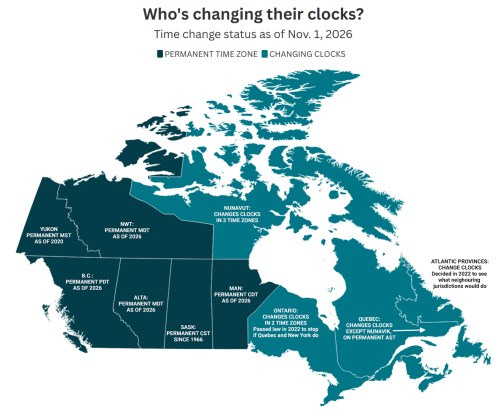
A quick look at where provinces and territories stand on time changes

The Canadian Press 2 minute read Preview

A quick look at where provinces and territories stand on time changes

The Canadian Press 2 minute read Updated: 6:28 AM CDT

WINNIPEG - Manitoba's government said Thursday the province will be sticking with daylight time year-round, making it the latest jurisdiction to move away from twice-annual time changes. Here's a look at where things stand across Canada:

British Columbia said in March that it was moving to permanent Pacific daylight time. The change also means that parts of northeastern B.C., which have been on mountain standard time year round, are now in alignment with the rest of the province.

Alberta also switched to permanent daylight time this year in what it calls Alberta time. The change means it now has the same time as Saskatchewan year round.

Saskatchewan has been on permanent central standard time since 1966.

Read
Updated: 6:28 AM CDT

‘She was looking to destroy me’: convicted harasser faces new charges

Dean Pritchard 6 minute read Preview

‘She was looking to destroy me’: convicted harasser faces new charges

Dean Pritchard 6 minute read Yesterday at 6:54 PM CDT

When Agnieszka Ciochon-Newton moved into the 55-plus apartment building on Stradbrook Avenue last year, she came across as “timid, soft-spoken and sensitive,” said building manager Tanya Owen.

Little did Owen know the meek-looking 58-year-old woman would soon turn her life and the lives of many of her tenants upside down and threaten her career and family.

“She was looking to destroy me for a simple tenant disagreement,” Owen said Thursday.

Court records show Ciochon-Newton was arrested earlier this month and charged with seven counts of criminal harassment, two counts of uttering threats and one count each of fraud, breaking and entering, attempting to obstruct justice, intimidation of a justice official, mischief and defamatory libel.

Read
Yesterday at 6:54 PM CDT

American Hostage stars recall warmth of Winnipeggers during brutal winter

Randall King 7 minute read Preview

American Hostage stars recall warmth of Winnipeggers during brutal winter

Randall King 7 minute read 6:13 PM CDT

TORONTO — When you stream the eight-part series American Hostage, a sense of familiarity may strike.

That’s because the show was shot in Winnipeg — especially in the Exchange District — from November of last year to the beginning of February, with Winnipeg portraying Indianapolis circa 1977.

The whole world seemed to be watching that midwest American city that year as a hostage crisis unfolded involving one Tony Kiritsis, an angry man who goes ballistic when a mortgage brokerage was poised to foreclose on property he had dreamed of developing into a shopping centre.

Kiritsis kidnapped his mortgage broker, Richard Hall, wiring a shotgun to the back of his head, and demanded a public airing of his grievances, with the reluctant help of popular radio broadcaster Fred Heckman.

Read
6:13 PM CDT

‘Parental rights’ issue resurfaces

Maggie Macintosh 5 minute read Preview

‘Parental rights’ issue resurfaces

Maggie Macintosh 5 minute read Yesterday at 2:00 AM CDT

Trustee campaign material that condemns rainbow flags is being met with outrage of all kinds, written complaints and, in one case, a cease-and-desist order.

“Parental rights,” including questions about classroom diversity, equity and inclusion policies, are resurfacing heading into school board elections across Manitoba.

“People are trying to advance their politics and their issues while simultaneously calling teachers ideologues and brainwashers,” said Shannon Moore, an associate professor at the University of Manitoba who studies sexual health education. “And I find that rich.”

Moore said parents have a right to choose independent school or homeschool, but they do not have a right to dictate curriculum that is currently developed using research and mainstream morals.

Read
Yesterday at 2:00 AM CDT