Architects are bringing nature home by making trees part of the plan
Advertisement
Read this article for free:
or
Already have an account? Log in here »
To continue reading, please subscribe:

Digital Subscription
One year of digital access for only $205*
- Enjoy unlimited reading on winnipegfreepress.com
- Read the E-Edition, our digital replica newspaper
- Access News Break, our award-winning app
- Play interactive puzzles
*First annual payment billed as $205.00 + GST for one year. This annual subscription will automatically renew at $233.00 + GST every 52 weeks (10% off the regular annual price of $259.35). Offer available to new and qualified returning subscribers only. Cancel any time.
To continue reading, please subscribe:
Add Free Press access to your Brandon Sun subscription for only an additional
$1 for the first 4 weeks*
- Enjoy unlimited reading on winnipegfreepress.com
- Read the E-Edition, our digital replica newspaper
- Access News Break, our award-winning app
- Play interactive puzzles
*Your next Brandon Sun subscription payment will increase by $1.00 and you will be charged $17.95 plus GST for four weeks. After four weeks, your payment will increase to $24.95 plus GST every four weeks.
Read unlimited articles for free today:
or
Already have an account? Log in here »
Hey there, time traveller!
This article was published 15/01/2025 (612 days ago), so information in it may no longer be current.
By now, you may be familiar with biophilic design — it’s the idea of integrating nature into design to enhance our connection to the environment. Sustainability, wellness and harmony are usually part of the deal.
Some architects and home designers are using one particular biophilic element to striking effect: trees.
We’ve already seen public spaces around the globe incorporate trees in remarkable and beautiful ways.
The Ford Foundation in New York boasts a 12-story-high atrium filled with magnolias, eucalyptus, jacaranda, cryptomeria, iron bark and pear trees. The Winter Garden atrium in lower Manhattan’s Brookfield Place is home to 16 40-foot-tall Washingtonia palm trees. Singapore’s Jewel Changi airport features 2,500 trees — natives to Madagascar, Australia, Malaysia and Indonesia — in a 6-acre indoor forest with walking trails. If you’re flight’s delayed, lucky you.
Apartment complexes also have seen some striking examples of trees and other greenery incorporated into their design — the buildings are sometimes called “greenscrapers.”
For instance, architect Stefano Boeri’s Bosco Verticale in Milan is a 44-story tower with 800 trees and myriad shrubbery enveloping each unit. In the Netherlands, he built the Trudo Vertical Forest, a low-income apartment tower with trees growing on all four facades.
“Architects and designers are increasingly shrouding and softening the hard-edged stone and concrete planes of urban buildings with lush vegetation,” says London-based architecture and design writer Dominic Lutyens.
Private houses are also getting the arboreal love. In some, the tree’s brought right indoors. In others, trees on the property are included as important partners in the home plan.
Whether it’s building the home around an existing tree, planting one (or more) trees within the interior space, or simply giving the illusion of a woodland indoors, the aesthetic is green and gorgeous.
A Zen-like heart of the home
New York-based firm ODA Architecture created a penthouse home for a client in New Delhi that has a closed courtyard at its center with a reflecting pool and a ficus microcarpa tree. Raindrops land on the glass ceiling and are reflected in the infinity-edged pool the tree resides in, truly giving an indoor/outdoor vibe.
Ryoko Okada, one of ODA’s principals and its interior project director, says the firm brings the outdoors in — on a big scale like this, and on less ambitious projects — as often as they can.
“There’s nothing more calming than being surrounded by nature. A living tree is a statement piece, and an art installation in itself,” she says. “It’ll bring you joy and peace, and as with a smaller houseplant, seeing it grow and evolve is regenerative.”
The tree lives in multiple feet of soil and is supported to prevent damage to the home. The level below had high ceilings, which allowed the architects to drop the floor and establish space for the tree roots to grow.
Framing the views with trees already there
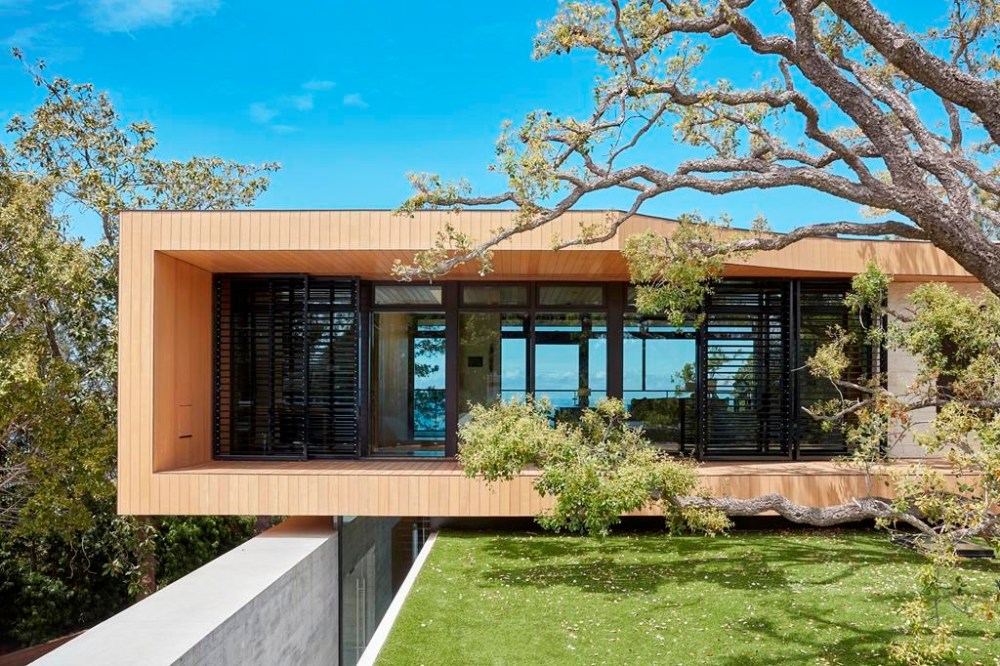
KAA Design Group in Los Angeles created a modern home in Southern California that embraces the property’s existing cork oaks, rare Torrey pines and magnolias. An impressive mature cork oak sits center stage. Leaving it in place took a bit of a sell, says one of the firm’s founding partners, Grant Kirkpatrick.
“The client’s perception was that this tree was too messy, and right in the middle of the property. We had to convince him that the tree is a 300-year-old antique that should be featured rather than removed,” he said.
“Once we developed the plan that literally embraces the tree, they understood.”
The driveway, too, offers a Zen moment, with a black pine pruned in the Japanese niwaki style with more open branching, and a miniature rock garden emerging out of the paving like an organic sculpture.
On an upper floor, you can look out onto a grassy platform built around the gnarled branches of one of the oaks. Views out the sliding glass doors of the open-plan kitchen and dining area are framed by tree limbs, and the ocean is on the horizon.
There are ways to honor trees even if you don’t have a live one
On a ranch property near Paso Robles, there’d been a fire in 2016.
“It burnt several acres of the property and took some of the beautiful manzanita trees,” says Kirkpatrick.
The team had recently visited the studios in Belgium of interior designer Axel Vervoordt, who’s known for his “wabi,” or Japanese minimalist style.
“We loved how they incorporated tree branches and other organic materials into their home space interiors,” Kirkpatrick said. “Back at the ranch, we were inspired to take one of the (burnt) manzanitas, paint it flat black, and incorporate it (into the space).” It’s now an eye-catching natural piece of art.
What to consider when making a tree part of your home plan
“We don’t recommend planting full-size trees in your home without consulting a landscape architect or other qualified specialist. A living tree will only thrive in the right environment, determined by region, access to light and air, and soil type. And it needs to be supported by proper infrastructure to stay alive and avoid home damage,” says Okada.
“We also recommend doing thorough research on the tree’s natural environment so that you’re not attracting pests,” she says.
Adds Kirkpatrick: “It can be tricky. At least 4 feet of soil depth is recommended. Plentiful natural light as well. The right tree for the right climate is important. And it needs to be acclimated in the area prior to planting.”
The landscape teams of John Mini Distinctive Landscapes and Pahokee Palms, who installed the Brookfield Place palms, did just that: After the young trees were dug up in Florida, they spent some time under the protective cover of a 48-food-high shade house, so they could adjust to light conditions in New York.
The palms in the Brookfield space need to be replaced every 10 years or so, because living indoors, they aren’t exposed to elements, becoming weaker as they get taller. “Trees need to ‘work out,’” says Anna Zarra Aldrich of the University of Connecticut’s College of Agriculture, Health and Natural Resources. “For instance, gradually exposing a tree to more wind develops its resistance and makes it more resilient in a storm.”
Once removed, the old trees are turned into mulch. Sixteen new Washingtonia Robusta palms are sourced in Florida, shipped up in groups of four by truck, and planted at Brookfield Place. The mulch is settled around native trees planted in their honor in places like serenity gardens at local hospitals.
___
New York-based writer Kim Cook covers design and decor topics regularly for The AP. Follow her on Instagram at @kimcookhome.
For more AP Lifestyles stories, go to https://apnews.com/lifestyle