Slow the flow with nature
Designed rainways mimic native flora to more effectively manage increased rainfall

Advertisement
Read this article for free:
or
Already have an account? Log in here »
To continue reading, please subscribe:

Digital Subscription
One year of digital access for only $205*
- Enjoy unlimited reading on winnipegfreepress.com
- Read the E-Edition, our digital replica newspaper
- Access News Break, our award-winning app
- Play interactive puzzles
*First annual payment billed as $205.00 + GST for one year. This annual subscription will automatically renew at $233.00 + GST every 52 weeks (10% off the regular annual price of $259.35). Offer available to new and qualified returning subscribers only. Cancel any time.
To continue reading, please subscribe:
Add Free Press access to your Brandon Sun subscription for only an additional
$1 for the first 4 weeks*
- Enjoy unlimited reading on winnipegfreepress.com
- Read the E-Edition, our digital replica newspaper
- Access News Break, our award-winning app
- Play interactive puzzles
*Your next Brandon Sun subscription payment will increase by $1.00 and you will be charged $17.95 plus GST for four weeks. After four weeks, your payment will increase to $24.95 plus GST every four weeks.
Read unlimited articles for free today:
or
Already have an account? Log in here »
Hey there, time traveller!
This article was published 01/02/2025 (595 days ago), so information in it may no longer be current.
Managing rainwater was one of the top stories across Canada in 2024 and will be again in 2025.
Extreme rain events across the country, including in Manitoba, resulted in flooded streets and basements as well as drought cycles and water restrictions. As a result, both municipalities and homeowners are seeking sustainable and resilient solutions for more efficient water management. We are also faced with the reality of aging water infrastructure and the impact of urban densification.
Rain gardens are a nature-based solution which can mitigate both extreme wetness and dryness by slowing the flow of water, helping it soak deeper into the ground and filtering it through vegetation.
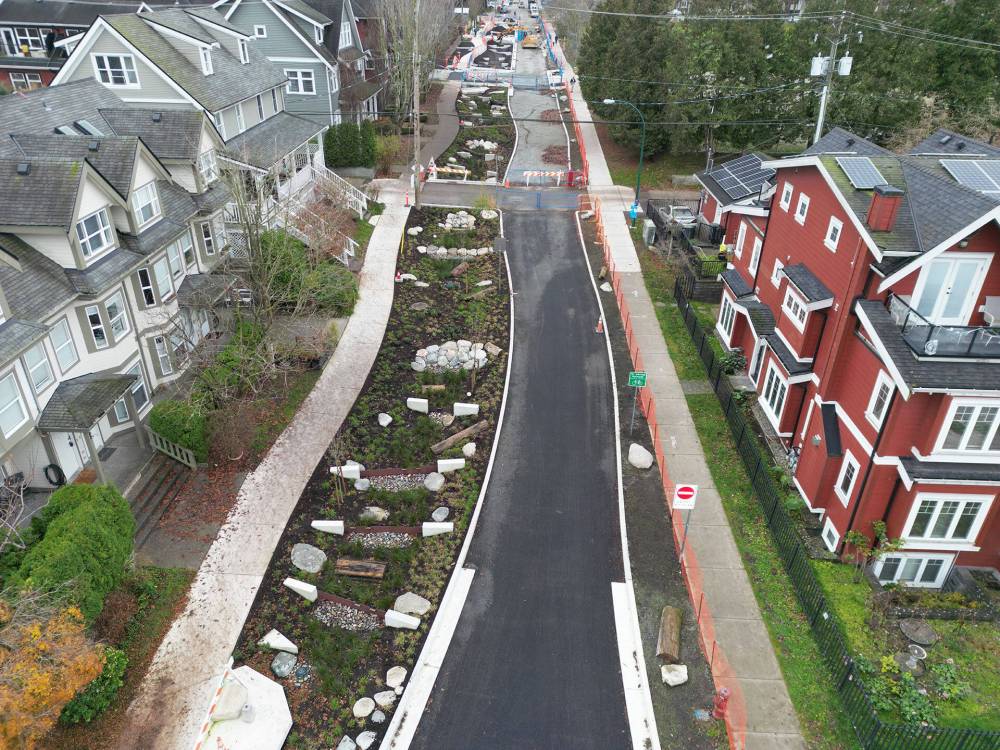
PHOTOS BY City of Vancouver
An aerial view of Vancouver’s St. George Rainway, which will run for nine city blocks once all three phases of the project are completed.
The City of Winnipeg has plans to build a rain garden in 2025 in the north part of Winnipeg along Leila Avenue between McGregor and McPhillips streets. This future green infrastructure project is sure to pique interest in the local community but will also have a significant impact on several other communities as well. That has been the experience of Vancouver’s St. George Rainway project, which is currently under construction.
Cherie Xiao is the senior project manager for the City of Vancouver. In a recent Zoom interview, Xiao said the St. George Rainway project has inspired and attracted people from all walks of life who regularly walk or cycle past the blocks-long rain garden. There is excitement, she said, at watching the construction of the rain garden that will eventually extend along nine blocks. There is also amazement at the functionality of the rain garden as water from heavy rainfall slowly percolates into the ground.
And not least, there is a sense of relief from residents that a nature-based solution is being implemented to help prevent the flooding and damage that results from intense rainfall.
The St. George Rainway project is in the Mount Pleasant neighbourhood of east Vancouver and has been almost 20 years in the making, said Xiao. “There used to be a historical creek in the neighbourhood which emptied into False Creek (one of the four main bodies of water bordering Vancouver), but it was buried to make room for houses, roads and buildings. A group of local advocates petitioned the city for restoration of the creek. The neighbourhood was experiencing quite a bit of localized flooding because the water from heavy rainfall events had nowhere to go. The green infrastructure branch at the city did feasibility studies and we found the creek was buried too deep.”
So instead, the city created a unique rainway that serves as a kind of surface reflection of the historical creek. “It’s not like a real creek but it still has all the ecological functions of the original creek,” said Xiao. The intent is for the rainway ecology to blend with its surroundings while filtering pollutants out of the water and reducing flooding.

The St. George Rainway is designed to manage water more efficiently during heavy rain events.
Phase 1 will be completed by the end of 2025. “We have completed three blocks and we have one more block to go. Then we are going to start pushing the rainway further south to do the planning and design for Phase 2 and Phase 3.” The St. George Rainway is Vancouver’s largest rainwater infrastructure.
Urban densification is putting a lot of pressure on Vancouver’s aging water infrastructure, Xiao said. “A project like a rainway can take a lot of rainwater out of the city’s water pipe system,” she said. The first four blocks of the St. George Rainway, once completed, will be able to drain 17,000 cubic metres of water per year from the roadway. This will help preserve the existing infrastructure for bigger rain events that are brought about by the changing climate, Xiao said.
The St. George Rainway runs adjacent to the sidewalk and roadway. “It’s a paradigm shift from how we use our streets,” said Ziao. “The rain garden system consists of a series of weirs. The top of each weir is flush with the level of the nearby sidewalk, but the weirs are mostly buried underneath the surface for stability.
“The weirs are very important because we are mimicking natural processes. We are learning from nature — for example, how beavers build dams. We want to hold the water in place and maximize the infiltration. During a really large rain event, the water will be able to overflow each weir and reach the overflow chamber at the end of the rainway.”
In a properly designed rain garden, said Xiao, water will drain from the entire system after 72 hours and surface water will drain within 24 hours.

City of Vancouver photo
In a well-designed rain garden, water drains from the entire system after 72 hours. Surface water drains within 24 hours.
The rainway is a living landscape that has been planted with diverse species that will provide habitat and forage for a diversity of birds and insects. The palette includes a woodland- and meadow-style planting with deep-rooted native perennials and grasses. (A complete planting list will be available in the February edition of Winnipeg Gardener, a monthly digital newsletter I write for the Free Press).
A community planting event was held on Sept. 28 and the turnout was impressive, said Xiao. “A lot of people came out to plant, not just from the community and adjacent communities but from other communities. This project is really a community project. Many people walked or cycled by and saw the entire progress. Residents are proud of the project and how much they advocated and how everything turned into reality.
“We really want to build the relationship with the community and educate people as to how the rainway will work. We also want to give the community the opportunity to adopt part of the rainway. That will help us to maintain the landscape and ensure the functionality of the rainway,” said Xiao.
Overall, Xiao estimates the green infrastructure has a life cycle of around 50 years. Like any infrastructure, it will need maintenance. “That is why we have our monitoring program, maintenance program, and we also have a rehab program,” she said.
Vancouver has a rain-city strategy which is a large toolbox for rainwater infrastructure, Xiao says. “There is the rain garden, bioswale, permeable paving, green roofs, the absorbent landscape and there are also subsurface pipes,” she said. “As part of the rain-city strategy, we require all new developments and all projects in the public realm to manage rainwater with green water infrastructure.”
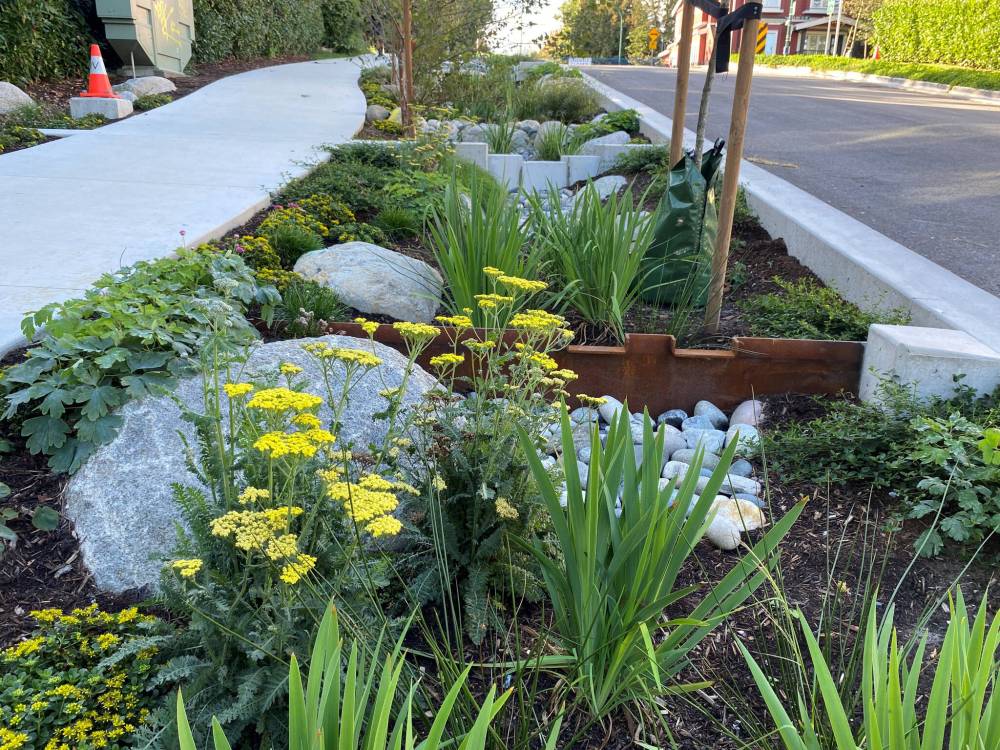
City of Vancouver photo
Deep-rooted native perennials and grasses can help filter rainwater and improve water quality.

With intense rainfall events expected to increase, would it help to reduce the amount of runoff into our storm-water systems if homeowners also used some of these green strategies to slow, catch, and filter rainwater on their properties?
“I think we should all work together,” said Xiao. “There are so many impermeable surfaces and very little absorbent landscape. If you look at city boulevards, even though there is grass, the soil is often highly compacted and water does not readily absorb. It goes into roadways and catch basins. The more absorbent landscapes we can provide, the better.”
Water should always be considered as a resource, Xiao says. “A rain garden not only reduces runoff and prevents or mitigates the risk of flooding, but it is also very beautiful year-round in all seasons and benefits pollinators and other wildlife, too.”
It’s a win-win for communities.
colleenizacharias@gmail.com

Many residents turned out for Vancouver’s St. George Rainway community planting event in September.
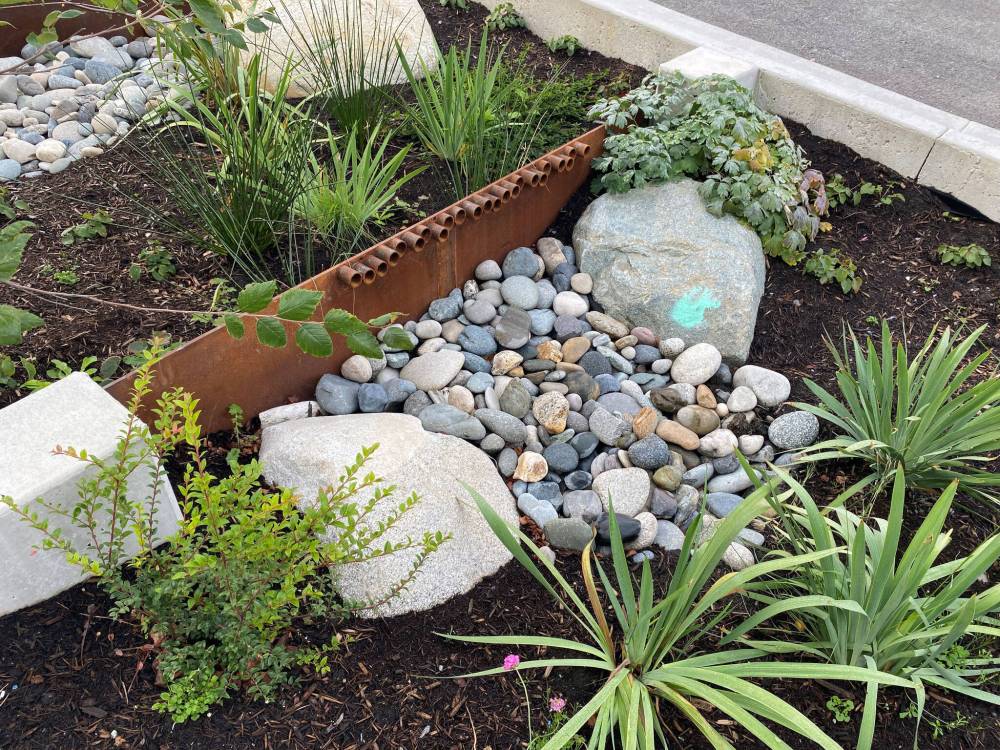
Weir barriers are built into this rain garden to hold water in place while allowing for maximum infiltration.
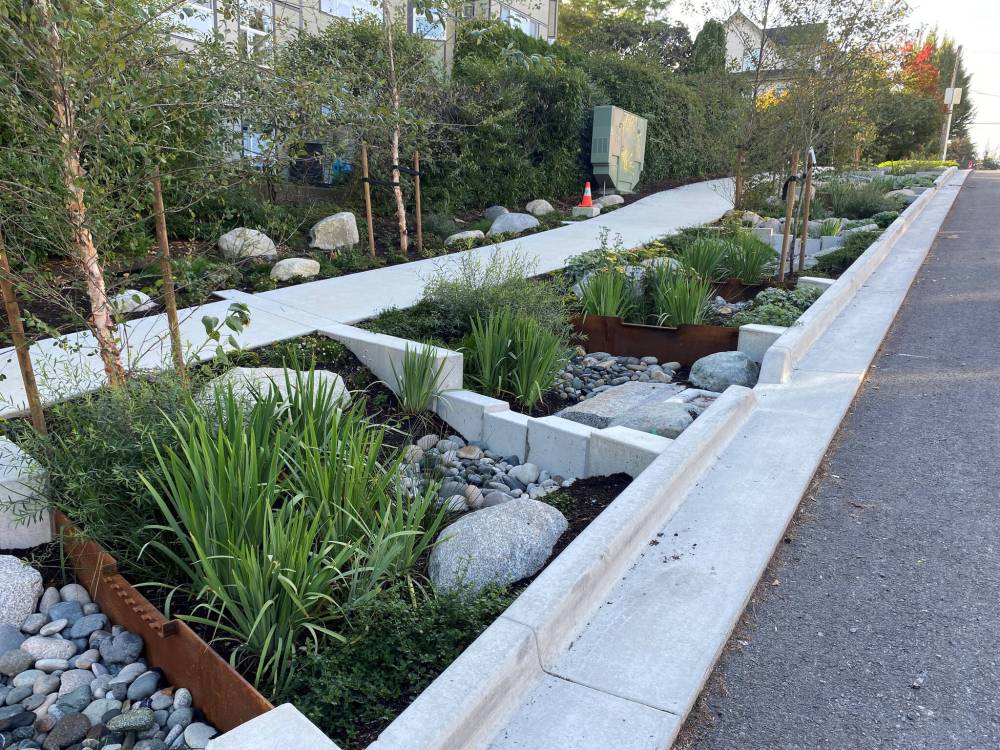
City of Vancouver photo
Once it is completed, Vancouver’s St. George Rainway project will run for nine city blocks.
Colleen Zacharias
Gardening columnist
Colleen Zacharias writes about many aspects of gardening including trends, plant recommendations, and how-to information that is uniquely relevant to Prairie gardeners. She has written a column for the Free Press since 2010 and pens the monthly newsletter Winnipeg Gardener. Read more about Colleen.
Every piece of reporting Colleen produces is reviewed by an editing team before it is posted online or published in print — part of the Free Press‘s tradition, since 1872, of producing reliable independent journalism. Read more about Free Press’s history and mandate, and learn how our newsroom operates.
Our newsroom depends on a growing audience of readers to power our journalism. If you are not a paid reader, please consider becoming a subscriber.
Our newsroom depends on its audience of readers to power our journalism. Thank you for your support.
Colleen Zacharias
Gardening columnist
Colleen Zacharias writes about many aspects of gardening including trends, plant recommendations, and how-to information that is uniquely relevant to Prairie gardeners. She has written a column for the Free Press since 2010 and pens the monthly newsletter Winnipeg Gardener. Read more about Colleen.
Every piece of reporting Colleen produces is reviewed by an editing team before it is posted online or published in print — part of the Free Press‘s tradition, since 1872, of producing reliable independent journalism. Read more about Free Press’s history and mandate, and learn how our newsroom operates.
Our newsroom depends on a growing audience of readers to power our journalism. If you are not a paid reader, please consider becoming a subscriber.
Our newsroom depends on its audience of readers to power our journalism. Thank you for your support.
Advertisement Advertise With Us
Advertisement Advertise With Us